Assessing safety through vocal cues
April 13, 2007 Assessing safety through vocal cues

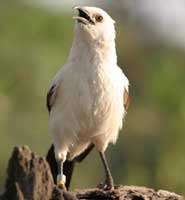
A babler. Photo by Andy Radford

For the first time foraging birds have been shown to use vocal cues, rather than vision, to gain information on both the size of the group they are in and their spatial position within that group.

Numerous studies have reported a reduction in vigilance by foraging individuals when they are less vulnerable to predation; for example, in larger groups and in the centre of a group.

It is commonly assumed that foragers assess the presence and position of other group members visually, but many social species produce frequent ‘close’ calls while foraging.

In a new study published in Biology Letters, researchers from the universities of Bristol and Cape Town used playback experiments to show that foraging pied babblers (Turdoides bicolor) are less vigilant in response to the close calling of more individuals and individuals on either side of them, compared to calls of fewer individuals and calls on one side of them.

Dr Andy Radford, from the School of Biological Sciences, said: “These results suggest for the first time that foragers can use vocal cues to gain information on group size and their spatial position within a group, and adjust their anti-predator vigilance accordingly. Individuals should therefore keep both their eyes and ears open at all times.”

Source: University of Bristol


print this article email this article download pdf blog this article bookmark this article     Stumble it Digg this share on Facebook retweet share on Reddit add to delicious
Rate this story - 5 /5 (1 vote)


April 13, 2007 all stories

Comments: 0

5 /5 (1 vote)
  • Stumble this up

  • Digg this

  • share this

  • hide
  • Related Stories


Other News

Scientists visualize how bacteria talk to one another

Scientists visualize how bacteria talk to one another

Biology / Cell & Microbiology

created 4 hours ago | popularity 4.8 / 5 (4) | comments 0

Using imaging mass spectrometry, researchers at the University of California, San Diego have developed tools that will enable scientists to visualize how different cell populations of cells communicate. Their ...


W. Africa's last giraffes make surprising comeback (AP)

W. Africa's last giraffes make surprising comeback

Biology / Ecology

created 12 hours ago | popularity not rated yet | comments 0

(AP) -- A crisp African dawn is breaking overhead, and Zibo Mounkaila is on the back of a pickup truck bounding across a sparse landscape of rocky orange soil.


W. Africa's last giraffes make surprising comeback (AP)

China sends panda expert to Taiwan to aid breeding

Biology / Plants & Animals

created 12 hours ago | popularity not rated yet | comments 0

(AP) -- Nothing like a little time apart to rekindle the affections that could lead to a baby panda.


Laser etching safe alternative for labeling grapefruit

Laser etching safe alternative for labeling grapefruit

Biology / Other

created Nov 03, 2009 | popularity 4.4 / 5 (14) | comments 8

Laser labeling of fruit and vegetables is a new, patented technology in which a low-energy carbon dioxide laser beam is used to label, or "etch" information on produce, thereby eliminating the need for common ...


Wolves, moose and biodiversity: An unexpected connection

Wolves, moose and biodiversity: An unexpected connection

Biology / Ecology

created Nov 02, 2009 | popularity 4.8 / 5 (6) | comments 4

Moose eat plants; wolves kill moose. What difference does this classic predator-prey interaction make to biodiversity?