Iowa State physicist leads team designing detector for international particle collider
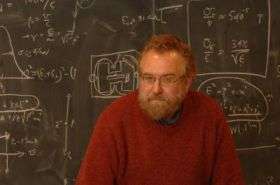
John Hauptman stood before an international gathering of particle physicists and announced he had another idea. One that was different. One that was simpler. And best of all, one that he was sure would work.
It was the August 2005 meeting of the physicists working and hoping to create the next huge thing in particle physics, the International Linear Collider. As proposed, the collider would be about 19 miles long and would accelerate electrons and positrons to nearly the speed of light. The particles would collide at the center of the machine at extremely high energies of 500 billion electron volts. The collisions would create new particles for physicists to study. Physicists are hoping those studies will lead to insights into dark matter, supersymmetry, extra dimensions – in other words, they want to find out what, exactly, the universe is made of and how it works.
Two big detectors would record each of those collisions – that’s 14,000 collisions every second – and each of the particles they create.
When Hauptman addressed his fellow physicists, three proposals to build the collider’s particle detectors were on the table – the Silicon Detector by a mostly American research team, the Global Large Detector by a mostly Japanese team and the Large Detector Concept by a mostly European team. Big groups of scientists backed by major laboratories had worked for years on designs for detectors capable of producing unprecedented performance and resolution. Those machines would be super sophisticated, cost up to $500 million and contain tens of millions of channels that would have to work together to measure the energy of all those particles. Those ambitious and innovative concepts weren’t – and have not been – fully demonstrated.
Well, Hauptman stood before the physicists gathered in Snowmass, Colo., and said, “I have another idea.”
And he offered up a detector for the linear collider that’s now known as the “4th Concept.”
“It was bold to walk into this – which John did – when it looked like there were three strong groups fighting for two places,” said Barry Barish, the director of the International Linear Collider and Linde Professor of Physics Emeritus at the California Institute of Technology in Pasadena.
The response to Hauptman’s stepping in with a 10-minute talk and launching a new effort?
“Imagine what it would be like if you were proposing the wheel for the first time,” said Alexander Mikhailichenko an accelerator physicist from Cornell University in Ithaca, N.Y., who was at that Snowmass session and is now collaborating on the 4th Concept.
Hauptman’s idea was to design a simpler detector that could compete for one of the two spots at the International Linear Collider. It would be one-third to one-half the cost of the other proposals. And it would feature four subsystems, two of which are considered innovative technologies:
-- a dual-readout calorimeter that measures the energy of particles and identifies particle types such as muons
-- and, an iron-free muon spectrometer capable of detecting muons, particles sometimes called the “big brother” of the lighter electrons.
Mikhailichenko said the spectrometer’s design eliminates 10,000 tons of iron surrounding the detector without sacrificing resolution. And he said the detector’s design is modular so new and improved components can easily be switched in and out.
Nural Akchurin, an associate professor of physics at Texas Tech University in Lubbock, helped develop the dual-readout calorimeter. He said the concept has been proven and he has data and results to support it. He expects continued testing will offer more proof.
“To me, this is a purely scientific approach to our experiment,” Akchurin said. “There was no money to gain. No money to lose. No fame to gain. We say what we think is right and that’s just it.”
And the 4th Concept collaborators say their detector is the right one for the job at the International Linear Collider.
“All four subsystems separately achieve the important scientific goal to be two- to 10-times better than the already excellent (Large Electron-Positron) detectors ALEPH, DELPHI, L3 and OPAL,” says a summary of the project. “As an integrated detector concept, we achieve comprehensive physics capabilities that put all conceivable physics at the International Linear Collider within reach.”
As the idea has advanced, the 4th Concept research team has grown to include 70 members from Iowa State, Cornell, Texas Tech, the Fermi National Accelerator Laboratory in Illinois and the University of New Mexico plus researchers from Italy, France, South Korea, China, Romania, Turkey and Ukraine. The team is working to add $2 million to the $100,000 it has attracted for research and development. The concept is now considered a competitor for a detector spot at the International Linear Collider.
And Hauptman is optimistic about the concept’s future.
Because the 4th Concept is fundamentally different that the other proposals, Hauptman said his team’s detector would be able to make measurements that are comparable and complementary to the other detector.
“We are the complementary detector,” he said.
But any decisions about the International Linear Collider and its detectors are still years away, said Barry Barish of the international collider and Caltech. Researchers are working to develop engineering designs and plans for the collider itself. Any decisions to build the collider will probably happen sometime after 2010.
Barish said the process for selecting two detectors for the collider is just being discussed. Decisions about which detectors to build will could extend beyond the decision to actually build the collider.
And yes, he said the 4th Concept is part of the international collider’s detector discussions. The idea sometimes gets left out because it’s so much newer than the other proposals. But Barish said there is plenty of time for the concept to catch up to the others.
“The 4th Concept is welcomed and encouraged,” Barish said. “In the end, it’s my hope and belief that the best ideas are what will be used in these detectors.”
Source: Iowa State University


