Bang-bang: a step closer to quantum supercomputers
January 4, 2006
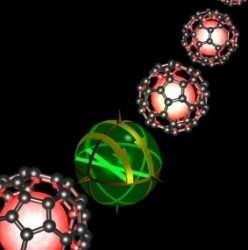
Image: A representation of the buckyball cages, with arrows showing how their rotation can be knocked back and forth.
Oxford scientists have come a step closer to quantum ‘supercomputers’ by creating a new technique called ‘bang-bang’ to hold quantum information.
The method, which the researchers report today in Nature Physics, costs £7 million pounds per gram, but fortunately the nanoscale of the information-holding molecules they have created – just ten atoms across – keeps the cost down.
The idea behind quantum computing is based on quantum mechanics, which allow an entity, such as an atom, to exist in multiple states simultaneously. Quantum computing is seen as the holy grail of computing because each individual piece of information, or ‘bit’, would exist in more than one state at once, making processing billions of times faster and thus dramatically widening the scope of what computers can do.
There’s just one problem: no-one knows how to build a quantum computer yet. The biggest hurdle is that the quantum state is only maintained as long as the quantum entity does not interact with anything. Once it is detected, or interacts in any way with the environment around it, the quantum bit (qubit) collapses into one state or another and loses the vital quality of existing in more than one state at once. The challenge is how to isolate quantum information from its surroundings.
The team, from the Materials Science Department, had a plan to ‘cage’ the qubit in a buckyball (a Buckminster fullerene particle), a molecule which has a cage structure reminiscent of a football. This isolates the qubit to some extent, but not quite enough.
The next step the researchers took was to apply the so-called ‘bang-bang’ method: the qubit is repeatedly hit with a strong pulse of microwaves which reverses the way in which it interacts with the environment. Dr John Morton, one of the authors on the paper, said: ‘The loss of information is like a child at a party game running with a blindfold on. We keep regularly turning the child around. If we do this quickly enough, the information remains intact (i.e. the child never gets very far).’
Dr Simon Benjamin, another of the authors, said: ‘The experiment was a complete success. We were able to show a very high level of decoupling of the nuclear spin from its environment, freezing the information exactly as planned. It’s likely that strategies like this will form a quintessential element in any future quantum computer.’
Source: University of Oxford
-
JQI cool nano loudspeakers could makes for better MRIs, quantum computers
Jan 25, 2012 |
4.8 / 5 (4) |
0
-
Quantum mechanics enables perfectly secure cloud computing
Jan 19, 2012 |
4.2 / 5 (15) |
13
-
Choreographing dance of electrons offers promise in pursuit of quantum computers
Jan 12, 2012 |
5 / 5 (3) |
1
-
A quantum leap in computing
Jan 04, 2012 |
4.5 / 5 (11) |
5
-
Putting artificial atoms on the clock
Nov 07, 2011 |
5 / 5 (1) |
0
-
Engineers build first sub-10-nm carbon nanotube transistor
Feb 01, 2012 |
4.9 / 5 (31) |
30
-
Something old, something new: Evolution and the structural divergence of duplicate genes
Jan 31, 2012 |
4.6 / 5 (7) |
1
-
The hidden nanoworld of ice crystals: Revealing the dynamic behavior of quasi-liquid layers
Jan 30, 2012 |
5 / 5 (3) |
1
-
Stock market network reveals investor clustering
Jan 27, 2012 |
3.9 / 5 (23) |
8
-
Of microchemistry and molecules: Electronic microfluidic device synthesizes biocompatible probes
Jan 26, 2012 |
5 / 5 (1) |
0
More news stories
New kind of solar cell could capture significantly more energy than current cells
New solar cells could increase the maximum efficiency of solar panels by over 25%, according to scientists from the University of Cambridge.
Feb 08, 2012 |
4.5 / 5 (12) |
14
|
Nanoshell whispering galleries improve thin solar panels
Visitors to Statuary Hall in the U.S. Capitol Building may have experienced a curious acoustic feature that allows a person to whisper softly at one side of the cavernous, half-domed room and for another on ...
Nanotechnology / Nanomaterials
Feb 07, 2012 |
4.3 / 5 (6) |
6
|
'Dark plasmons' transmit energy
Microscopic channels of gold nanoparticles have the ability to transmit electromagnetic energy that starts as light and propagates via "dark plasmons," according to researchers at Rice University.
Feb 09, 2012 |
4.8 / 5 (9) |
1
|
Revealing how a battery material works
Since its discovery 15 years ago, lithium iron phosphate (LiFePO4) has become one of the most promising materials for rechargeable batteries because of its stability, durability, safety and ability to deliver ...
Nanotechnology / Nanomaterials
Feb 08, 2012 |
5 / 5 (5) |
0
|
What lies beneath: Mapping hidden nanostructures
The ability to diagnose and predict the properties of materials is vital, particularly in the expanding field of nanotechnology. Electron and atom-probe microscopy can categorize atoms in thin sheets of material, ...
Feb 10, 2012 |
5 / 5 (3) |
1
Walney offshore wind farm is world's biggest (for now)
(PhysOrg.com) -- The Walney wind farm on the Irish Sea--characterized by high tides, waves and windy weather--officially opened this week. The farm is treated in the press as a very big deal as the Walney ...
GPS court ruling leaves US phone tracking unclear
A US Supreme Court decision requiring a warrant to place a GPS device on the car of a criminal suspect leaves unresolved the bigger issue of police tracking using mobile phones, legal experts say.
Study finds that anti-diabetic medication can prevent the long-term effects of maternal obesity
In a study to be presented today at the Society for Maternal-Fetal Medicine's annual meeting, The Pregnancy Meeting, in Dallas, Texas, researchers will report findings that show that short therapy with the anti-diabetic medication ...
Europe stakes billion-dollar bet on new rocket
A pencil-slim rocket is scheduled to lift into space from South America on Monday, carrying a billion-dollar bet that Europe can grab a juicy slice of the market to place satellites in low orbit.
Netflix settlement trims 14 pct off 4Q earnings
(AP) -- Netflix pressed the rewind button on its fourth-quarter earnings after settling allegations that the video subscription service violated a consumer-privacy law.
Steroid injections prove effective in treatment of lumbar disc herniations
The use of epidural steroid injections may be a more efficient treatment option for lumbar disc herniations, according to research presented today at the American Orthopaedic Society for Sports Medicine's Specialty Day in ...