Undergraduate paves way for NASA Mars mission
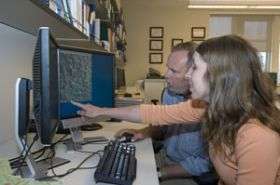
Earth and planetary scientists at Washington University in St. Louis are paving the way for a smooth landing on Mars for the Phoenix Mission scheduled to launch in August this year by making sure the set-down literally is not a rocky one.
A team led by Raymond E. Arvidson, Ph.D., James S. McDonnell Distinguished University Professor in Arts & Sciences, has been analyzing images taken from a NASA instrument to make sure that the Phoenix spacecraft lands in a spot on the Red planet's northern plains that is relatively rock-free.
"The craft has to land in a place unlikely to have slopes more than 16 degrees relative to horizontal, and it shouldn't have very many rocks higher than 30 to 40 centimeters (roughly one foot high)," said Arvidson, who also is chair of the Washington University earth and planetary sciences department. "We've been looking for locations big enough and homogeneous enough for a high probability of a successful landing. The issue isn't slopes. The issue is rocks."
If the lander would come down in an area with rocks roughly the same size as the lander or larger, the whole craft could tilt or tip over. Another problem with rocks is the craft's solar panels; Large rocks would prevent the unfurling of the craft's solar panels, which are circular and rotate open. Without solar power, which drives seven Phoenix mission instruments, there isn't much of a mission.
Linchpin of this meticulous, painstaking task of finding a smooth landing is a 21-year-old junior Washington University earth and planetary sciences major, who began working with Arvidson as a work-study student in 2005. Tabatha Heet, from Jefferson City, Mo., began the project in October of 2006.
"Ray asked if I would count some rocks in the original landing area, and I got started, thinking it was going to be a one-time thing," said Heet, who is a student in the university's acclaimed Pathfinder Program, a challenging, interdisciplinary curriculum with an environmental emphasis. "But it's turned into a big project. I've counted thousands of rocks now."
Heet gets large images from an instrument called HIRISE, a feature of the Mars Reconnaissance Orbiter Mission, which permits the viewing of rocks as small as roughly a yard across. Before HIRISE images were available, Arvidson and his colleagues settled on a region called Region B for the future landing.
"The first images for Region B were scary," Arvidson said. "There are rocks there bigger than the lander – too many big rocks sitting on craters to fit in a landing site."
Studying the HIRISE images, they looked elsewhere. Heet pieced out all of the quantitative data on the abundance of rocks at different places on the northern plains that allowed Arvidson and others to "zero in on the safe havens," Arvidson said.
Heet used ENVI, a software package that displays images and makes measurements.
"All you have to do is draw a line on the image," she said. "And then ENVI will tell you how long the line is in meters. I go through the image and pick just a small area because the HIRISE images are too big for one person to count. I'll make a little subset and then go count every rock in the subset just by drawing a line where I see the shadow of the rock.
"It's very slow and makes your eyes go crazy," she said.
She counted rocks in little areas of the large images and made cumulative frequency plots – of diameter of the rocks vs. the number of rocks bigger than that diameter. Postdoctoral researcher Amy Knudson and Robert Walker
Senior Fellow Pat McGuire came up with maps that extrapolated beyond what Heet, assisted this year by freshman Lauren Barry, a fellow Pathfinder student, counted Arvidson and Heet flew out to the Jet Propulsion Laboratory in February. She received a warm round of applause at her introduction to JPL researchers, and scientists questioned her on her technique and her stamina. Later, she encountered a team of automated rock counters who "aggressively" questioned the way she had been counting rocks. At the meeting, the automated rock counters calibrated their computed accounts to Heet's hand counts, which are considered "ground truth,' on which all subsequential data are based. She has since corresponded with the group regularly to help get the automated counts more precise.
"The automated rock counters map the shape of the shadows and from knowing where the sun is, they can compute the rock height and width, but they need very intense validation," said Arvidson. "Tab was the point contact for all of that. We've cross-calibrated against the automated counts because the hand-derived ones are considered anchors.
It's still the case that a human can do a better job with fewer errors as long as the person is not fatigued." Heet's work has led to the discovery of several potential landing sites with at least ten times fewer rocks than the original Region B, including one desirable location about 50 kilometers wide and 250 meters deep, that Arvidson and the group call Green Valley.
In addition to leading the effort to finding good landing sites for the Phoenix Mission, Arvidson is co-investigator of the robotic arm team and leads the archiving of data from that mission, as in past missions. He'll oversee the gathering of soil and water-ice samples and the function of the robotic arm camera, which will take images of soil, water-ice and trench walls. He'll lead the efforts focused on interpreting the mineralogy and geomorphology of this part of Mars.
Arvidson said that, as data come in from the mission, Heet will be at the JPL, just as former Rhodes scholar Bethany Ehlmann, now pursuing a Ph.D. at Brown University, was for the Mars Exploration Rover mission, gathering and interpreting data.
After all of her dedicated, painstaking work, Heet often thinks of the mission and the thrill of the Phoenix launch and landing.
"I will certainly be excited when Phoenix launches, and I will also probably feel a little bit of pride knowing that I helped make the launch possible," Heet said. " I suspect I'll be slightly nervous when Phoenix is landing, wondering if I did something wrong and am going to be responsible for making Phoenix crash in a field of huge boulders. Once the lander is on the surface it will be interesting to find out just how accurate all of our predictions were.
"I'm looking forward to it all."
Source: Washington University in St. Louis


