Book explores our ability to remember future intentions
If you left your kids at school; if you forgot a dentist appointment; if you came home without the bread you set out to buy — you're a victim of your own faulty prospective memory. Our brains store intentions like these — ones we mean to complete at some point later in time — until we retrieve them or until they're lost to our forgetfulness.
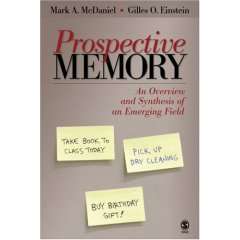
"Prospective Memory: An Overview and Synthesis of an Emerging Field," the sophomore publication of Mark A. McDaniel, Ph.D., professor of psychology in Arts & Sciences at Washington University in St. Louis and leading prospective memory expert, was published in February.
McDaniel and his colleague, Gilles O. Einstein, Ph.D., professor and chair of the psychology department at Furman University, wrote the book to give a digestible overview of the relatively new field of prospective memory studies, and to propose some new ideas.
"We tried to bring all the existing literature together, organize it and integrate it with themes to identify some interesting issues that need to be researched," McDaniel says. "It will help memory researchers begin or expand their work in the area of prospective memory."
Experimentation is important in understanding how our brain processes these intentions. McDaniel and Einstein developed some of the initial paradigms to study prospective memory.
"Memory is fallible, even for tasks that are very important," McDaniel says. "As soon as intention leaves awareness, there's no guarantee that it's going to be retrieved again."
Measuring the brain's retrieval of an intention is difficult, he explains, because typical lab memory paradigms do not parallel the usual context for prospective memory.
"With this kind of memory, there's no agent asking you what you have to do. Our own cognitive system has to initiate the retrieval of our prospective memory intentions," he says.
Enmeshed in our daily routines
Because we're often charged with remembering to do things when we're also busily engaged in ongoing daily activities, McDaniel and Einstein's experimental methods require subjects to remember one intention, while performing another, ongoing task.
For example, a subject could be asked to remember to hit a certain key on a keyboard every five minutes, while concentrating primarily on a game of Trivial Pursuit. These methods — among the first ever developed — are described in the book, illuminating experimental possibilities in the nascent field.
There's no getting around it: prospective memory tasks are enmeshed in our daily routines, and they can be easily lost in the tangles of our memory once we're distracted. Lapses in prospective memory can have dangerous implications for parents, the elderly or those responsible for the lives of others — but McDaniel's book includes a set of recommendations for improving it.
More research in this growing field should enhance our understanding of this type of memory, which, according to McDaniel, "is interwoven into the fabric of our lives."
Source: Washington University in St. Louis


