Skeleton Of Sun's Atmosphere Reveals Its True Nature
April 16, 2007 The Sun

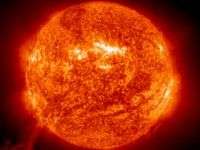
The Sun's outer atmosphere or corona is incredibly complex, as shown in observations from space. It is also extremely hot, with a temperature of over a million degrees by comparison with that of the Sun's surface of only 6000 degrees. Scientists have now made a major breakthrough in understanding this complexity by studying the ‘skeleton’ of the magnetic field.

A team of scientists from St Andrew’s University will present the results on Monday 16 April at the Royal Astronomical Society National Astronomy Meeting in Preston. "It is the Sun's magnetic field that dominates the behaviour of the corona and determines its structure", said team member Andrew Haynes, “and our work is a key step forward in understanding its structure”.

Until now the complexity of the magnetic field has baffled solar scientists. Professor Eric Priest first proposed the concept of the solar skeleton in 1996. It consists of the key elements on which the complex shape of the magnetic field is built. "We realised", added Dr Clare Parnell, "that by constructing the skeleton of the field, we could unravel this complexity and hopefully determine how the corona is heated".

Dr Parnell and colleagues have managed to develop a computer experiment, which simulates the complex structure of the corona and have found that the coronal heating is focused in specific parts of the skeleton. "In future", she added, "we should be able to compare this type of analysis with dramatic new observations from the recently launched Hinode spacecraft and thereby really nail down the heating mechanism".

The work of the St Andrew’s team indicates that the solar skeleton changes continually and has a much richer structure than anyone imagined. Their work is a building block in astronomers’ efforts to better understand events such as the solar flares and coronal mass ejections that eject billions of tonnes of matter into space.

Source: Royal Astronomical Society


print this article email this article download pdf blog this article bookmark this article     Stumble it Digg this share on Facebook retweet share on Reddit add to delicious
Rate this story - 3.8 /5 (17 votes)

Rank Filter

Move the slider to adjust rank threshold, so that you can hide some of the comments.


Display comments: newest first

  • itistoday - May 29, 2008
    • Rank: not rated yet
    A picture of the magnetic skeleton thing would've helped this article greatly.

April 16, 2007 all stories

Comments: 1

3.8 /5 (17 votes)
  • Stumble this up

  • Digg this

  • share this

  • hide
  • Related Stories


  • hide
  • Relevant PhysicsForums posts

  • The shape of our solar system's orbits.
    created 20 hours ago
  • Above or Below the Line of Nodes
    created Nov 07, 2009
  • Supernova vs. Nova?
    created Nov 07, 2009
  • Supernova's Gamma Rays and Comets
    created Nov 06, 2009
  • More from Physics Forums - General Astronomy

Other News

Deep creep means milder, more frequent earthquakes along Southern California's San Jacinto fault

Deep creep means milder, more frequent earthquakes along Southern California's San Jacinto fault

Space & Earth / Earth Sciences

created 6 hours ago | popularity 4.7 / 5 (3) | comments 0

With an average of four mini-earthquakes per day, Southern California's San Jacinto fault constantly adjusts to make it a less likely candidate for a major earthquake than its quiet neighbor to the east, the ...


Success in 'space elevator' competition (AP)

Success in 'space elevator' competition (Update 3)

Space & Earth / Space Exploration

created Nov 05, 2009 | popularity 4.3 / 5 (33) | comments 50

(AP) -- A robot powered by a ground-based laser beam climbed a long cable dangling from a helicopter on Wednesday to qualify for prize money in a $2 million competition to test the potential reality of the ...


'Dropouts' pinpoint earliest galaxies

'Dropouts' pinpoint earliest galaxies

Space & Earth / Astronomy

created Nov 06, 2009 | popularity 4.2 / 5 (10) | comments 12

Astronomers, conducting the broadest survey to date of galaxies from about 800 million years after the Big Bang, have found 22 early galaxies and confirmed the age of one by its characteristic hydrogen signature ...


Space hotel taking bookings for 2012 opening

Space hotel taking bookings for 2012 opening

Space & Earth / Space Exploration

created Nov 05, 2009 | popularity 4.4 / 5 (20) | comments 11

(PhysOrg.com) -- The first orbiting space hotel is on track to open for its first customers in 2012, but hurry, as bookings are filling fast.


In a Galaxy Far, Far Away...

In a Galaxy Far, Far Away...

Space & Earth / Astronomy

created Nov 06, 2009 | popularity 4.8 / 5 (5) | comments 13

(PhysOrg.com) -- Astronomers have published the discovery of the farthest known object in the cosmos: a star that exploded when the universe was only 630 million years old -- only 4.6% of its current age. ...