Milky Way Churns Out Seven New Stars Per Year, Scientists Say
January 5th, 2006 Milky Way Churns Out Seven New Stars Per Year

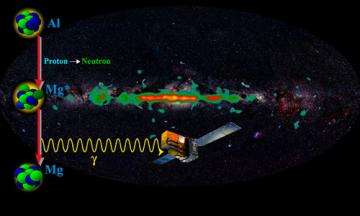
Image: By mapping patches of radioactive aluminum in the Milky Way, scientists could determine the number of stars that are born and die each year in our galaxy. Credit: MPE Garching/Roland Diehl

In an investigation smacking of forensic detective work, scientists have measured the rate of star death and rebirth in our galaxy by combing through the sparse remains of exploded stars from the last few million years.

As reported in the January 5 issue of Nature, the scientists used the European Space Agency's INTEGRAL satellite to explore regions of the galaxy shining brightly from the radioactive decay of aluminum-26, an isotope of aluminum. This aluminum is produced in massive star and in their explosions, called supernovae, and it emits a telltale light signal in the gamma-ray energy range.

The team's multi-year analysis revealed three key findings: The team confirmed that aluminum-26 is found primarily in star-forming regions throughout the galaxy; about once every 50 years a massive star will go supernova in our galaxy (yes, we are overdue); and each year our galaxy creates on average about seven new stars.

NASA Goddard Space Flight Center in Greenbelt, Md., oversees the INTEGRAL U.S. Guest Observer Facility, which funded part of this research. These results will also be presented January 9 at the meeting of the American Astronomical Society in Washington.

"Our galaxy isn't the biggest producer of stars and supernovae in the universe, but there's still plenty of activity," said Dr. Roland Diehl of Max Planck Institute for Extraterrestrial Physics in Garching, Germany, lead author on the Nature report. "A sustained star formation rate of this magnitude is just what one needs to drive its chemical and dynamical evolution, which has led to life on Earth."

These rates also imply that per year about four solar masses of interstellar gas are converted to stars, the team said. About ten billion years into its life, the Milky Way galaxy has now converted about 90 percent of its initial gas content into stars.

Star death is intricately tied to star creation because it provides the raw material --- elements strewn into interstellar space --- as well as the energy in the form of shock waves that prompts cool gas clouds to condense and form stars. Scientists estimate formation rates through observations of supernovae in other galaxies or tracers associated with new stars, such as infrared light from dust production or ultraviolet light from the heat these stars make.

"Determining star formation rates in our galaxy can be difficult because gas and dust in the Milky Way's spiral arms obscure star formation taking place all around us," said Dr. Bonnard Teegarden, INTEGRAL U.S. Project Scientist at NASA Goddard. "Gamma rays, more so than other forms of light, can penetrate this dust. This approach based on gamma rays is the most direct method available to determine the recent history of stellar activity."

"The radioactive isotope aluminum-26 has a half-life of about 750,000 years," said Prof. Dieter Hartmann of Clemson University in Clemson, S.C., a co-author on the Nature report and lead presenter at the AAS meeting. "This means it traces all massive stars that have been lively or perished in the past several million years. More important, we can detect this aluminum everywhere. Visible light is obscured by the dust and gas in the galactic plane, but the gamma rays from aluminum-26 shines through even the dustiest regions."

INTEGRAL provides the resolution necessary to infer the spatial distribution of aluminum-26. Diehl's team could determine, from the Doppler effect, that aluminum-26 rotates with the galaxy. This implies that aluminum-26 is ubiquitous and not local to the solar neighborhood.

The team used a global spatial distribution model to convert the observed gamma-ray flux to a total amount of aluminum-26. It came to about three solar masses in the entire galaxy, which doesn't seem like a lot, but only little aluminum-26 is created in any given star explosion. From this mass and theories of how much material each massive star will eject, it was a straightforward calculation to determine star death and star formation rates.

Source: NASA


print this article email this article download pdf blog this article bookmark this article     Digg this Stumble it share on Facebook share on Reddit add to delicious save to Yahoo! bookmarks
3.9/5 after 7 votes


January 5th, 2006 all stories
Space & Earth /

Comments: 0
Rank: 3.9/5 after 7 votes

  • Stumble this up

  • Digg this

  • Share it:
  • share on Facebook
  • share on MySpace
  • share on Slashdot
  • rss-newsfeed
  • share on Google
  • share on Reddit
  • add to delicious
  • save to Yahoo! bookmarks
  • share on Windows Live
  • Add to Mixx!
Rating: 3.9/5 after 7 votes

  • Related Stories

  • Living fossils hold record of 'supermassive' kick
    created 2 hours ago | popularity not rated yet | comments 0
  • Simulations Illuminate Universe's First Twin Stars (w/ Video)
    created 3 hours ago | popularity not rated yet | comments 0
  • British police probe tabloid phone-hacking claims
    created 7 hours ago | popularity not rated yet | comments 0
  • Astrophysicists solve mystery in Milky Way galaxy
    created 8 hours ago | popularity not rated yet | comments 0
  • Galileo's notebooks may reveal secrets of new planet
    created 9 hours ago | popularity not rated yet | comments 0

Tags


  • Transform a ball into a rock -- or make it invisible -- using transformation optics
    Transform a ball into a rock -- or make it invisible -- using transformation optics
    Physics / General Physics
    created 9 hours ago | popularity 3 / 5 (2) | comments 0
  • Could a quantum motor do work?
    Physics / General Physics
    created Jul 07, 2009 | popularity 4 / 5 (12) | comments 0
  • Physicists Demonstrate Quantum Memory with Matter Qubits
    Physicists Demonstrate Quantum Memory with Matter Qubits
    Physics / General Physics
    created Jul 03, 2009 | popularity 4.5 / 5 (20) | comments 1
  • 'Holey' Nanosheets for Wastewater Dye Removal
    Nanotechnology / Nanomaterials
    created Jul 01, 2009 | popularity 5 / 5 (5) | comments 1
  • Jellyfish Robot Swims Like its Biological Counterpart
    Jellyfish Robot Swims Like its Biological Counterpart
    Electronics / Robotics
    created Jun 26, 2009 | popularity 4.4 / 5 (9) | comments 1
  • Other News

    Living fossils hold record of 'supermassive' kick

    Living fossils hold record of 'supermassive' kick

    Space & Earth / Astronomy

    created 2 hours ago | popularity 4.5 / 5 (2) | comments 1

    The tight cluster of stars surrounding a supermassive black hole after it has been violently kicked out of a galaxy represents a new kind of astronomical object and a fossil record of the kick.


    Methane-eating microbes can use iron and manganese oxides to 'breathe'

    Methane-eating microbes can use iron and manganese oxides to 'breathe'

    Space & Earth / Earth Sciences

    created 5 hours ago | popularity 4.7 / 5 (3) | comments 0

    Iron and manganese compounds, in addition to sulfate, may play an important role in converting methane to carbon dioxide and eventually carbonates in the Earth's oceans, according to a team of researchers ...


    Tremors on southern San Andreas Fault may mean increased quake risk

    Tremors on southern San Andreas Fault may mean increased quake risk

    Space & Earth / Earth Sciences

    created 4 hours ago | popularity not rated yet | comments 0

    (PhysOrg.com) -- Increases in mysterious underground tremors observed in several active earthquake fault zones around the world could signal a build-up of stress at locked segments of the faults and presumably ...


    A Galaxy Collision in Action

    A Galaxy Collision in Action

    Space & Earth / Astronomy

    created 4 hours ago | popularity 4.8 / 5 (4) | comments 1

    This beautiful image gives a new look at Stephan's Quintet, a compact group of galaxies discovered about 130 years ago and located about 280 million light years from Earth. The curved, light blue ridge running ...


    NASA sails through countdown, weather outlook poor (AP)

    NASA sails through countdown, weather outlook poor

    Space & Earth / Space Exploration

    created 2 hours ago | popularity not rated yet | comments 0

    (AP) -- NASA is sailing through the countdown for Saturday's launch of space shuttle Endeavour, with weather the lone concern.