No Solution to Cancer - Have Our Genes Evolved to Turn Against Us?
Cancer is a natural consequence of human evolution. Our genes have not developed to give us long and happy lives. They are optimized to copy themselves into the next generation - irrespective of our personal desires. According to Jarle Breivik, an associate professor at the University of Oslo, Norway, we are therefore unlikely to find a final solution to cancer.
Doing research at the Institute of Basic Medical Sciences, Breivik explores the connection between cancer development and Darwinian evolution. In a recent interview with Scientific American, and the research magazine Apollon, published by the University of Oslo, he concludes that “Cancer is a fundamental consequence of the way we are made. We are temporary colonies made by our genes to propagate themselves to the next generation. The ultimate solution to cancer is that we would have to start reproducing ourselves in a different way.”
Genes that repair genes
As a medical student at the Norwegian Radium Hospital, Breivik discovered a curious phenomenon. He found that cancer cells that developed in the upper colon had other types of mutations than those found in tumours closer to the rectum. This finding was confirmed by other researchers and could be traced to mutations in particular DNA repair genes. Such genes have evolved to prevent mutations in other genes and play a vital role in defending the organism from cancer. But why do cells in the upper region of the intestine lose a different type of repair mechanism than those further down?
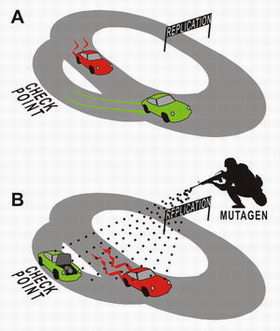
Breivik was determined to find an explanation. After several years of data mining and theoretical modelling, he was able to demonstrate a connection between loss of DNA repair and harmful environmental factors in the intestines. Curiously however, the cancer cells appeared to have lost the repair mechanisms that would protect them from DNA damage in their particular environment. Breivik thus proposed the following hypothesis: Although DNA repair is favourable to the organism; it may not be favourable to the individual cell. The theory was developed in several science papers, including an invited Commentary in the Proceedings of the National Academy of Sciences USA, and may be illustrated as the effect of alternative strategies in a car race (figure 1).
“Deciding when to stop for repairs and when to keep on going is a difficult challenge. Making repairs assures an optimized vehicle, but it also consumes valuable time and resources. At first thought, it may seem obvious that a damaging environment calls for more repair. Paradoxically, however, the effect may be exactly the opposite. Imagine that you are racing through a war zone with constant bombardment. Stopping for repair can then be a fatal strategy, and it is better to keep on going with flat tires and a screaming engine than to stop for repairs,” says Breivik.
This illustration thus explains why genetically unstable cancer cells are favoured in hostile environments—such as in the lungs of a heavy smoker. The model may also be described mathematically and has been experimentally confirmed in cell cultures and animal models by leading research groups in the field.
“Cells exposed to particular carcinogens die if they have the relevant repair mechanism, while genetically unstable cancer cells continued to grow,” Breivik explains.
Evolution within
This research shows how the environment influences the selection of genes inside of the body and is identical to the principle that Darwin found to explain the origin of species.
“The body is not a static system. Our cells are in a constant state of development, and new genetic variants arise every day. Many of these mutants are removed by the immune system but, sooner or later, a cell will break through the defences and develop into a tumour of wild-growing renegades.”
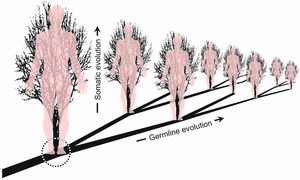
Cancer development is an evolutionary process within the multicellular organism, but it is also related to the general process of evolution through the generations. Life begins when our parent’s genes are united in the zygote. These genes have been selected through millions of generations for their ability to create a functional organism, but few days after fertilization the genes split up in two different directions. Some end up in the germ cells (sperm and ova) that will bring them to the next generation, while the rest end up in the somatic cells that make up our body. The somatic cells are initially programmed to cooperate, but as we age and new mutations arise, the evolutionary process will favour cells that break ranks and propagate freely within the body. Thus, according to Breivik, the division between germ cells and somatic cells represents the Darwinian explanation to cancer (figure 2).
Time bombs
Natural selection favours genes for their ability to replicate in their given environment. Through the course of evolution, they have thereby developed increasingly more complex mechanism for self-replication, first as single celled organisms and later as cells that cooperate in complex colonies.
“This is where humans belong. We are cell colonies developed for propagating our genes from one generation to the next. As soon as our children can take care of themselves, we are irrelevant to the genes. Caring grandparents may be good to have, but dozens of enduring ancestors will not increase a gene’s chance for survival—on the contrary, they may represent a waste of valuable recourses. The entire human genome is therefore probably developed to give us a limited lifespan,” says Breivik.
He believes that many of our genes are constructed such that they protect against cancer in the first part of our lives, but that they are programmed for destruction as we get older.
“We see that DNA repair genes, which protect us from cancer in early life, contain unstable DNA sequences that increase their probability for breakdown as time passes. These sequences are ticking time bombs in our genome and represent a paradox if we consider what is best for the organism. If we take the perspective of the genes’, on the other hand, the phenomenon is quite logical,” says Breivik. He is currently studying the molecular and evolutionary mechanisms that lead to such unstable repair genes.
The next step in evolution
Despite important advances in therapy, all statistics show that the cancer incidence will continue to rise.
“The better we get at treating cancer, the older we become and the more cancer there will be in the population. Additionally, better therapy for children and young people implies that more cancer genes are passed on to the next generation. From what we know about evolutionary dynamics, I believe it’s impossible to find a therapeutic solution to cancer. The basic problem is that we are trapped in a body that the genes have made to be disposable. A solution will therefore be something much more radical than a new drug,” says Breivik.
He argues that cancer therapy is an attempt to counteract the natural decay of the body. If we think about it, however, it is not really the body we care about. After all, most people are more than happy to trade in a defect organ for a new one.
“It's the mind, our thoughts and consciousness that we desperately want to preserve. If we look at technological developments as a whole, that may be exactly what’s happening. The ongoing revolution in information and biotechnology may be interpreted as the mind’s liberation from the genes. It’s difficult to imagine the alternative, but if I could see a thousand years into the future, I would be very surprised if earth is still dominated by two-legged creatures with a limited life span,” says Jarle Breivik.
Source: University of Oslo


