Race From Space: Suni Williams Runs Boston Marathon
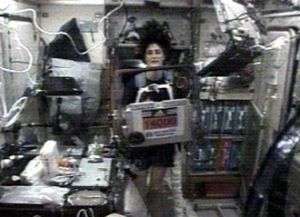
Flight Engineer Suni Williams circled Earth at least twice, running as fast as eight mph but flying more than five miles each second, as she completed the Boston Marathon on a station treadmill. Her unofficial completion time was four hours and 24 minutes as she completed the race at 2:24 p.m. EDT. Williams, an accomplished marathoner, hopes her unique run will serve as an inspiration.
210 miles above Earth, Expedition 15 crew member Sunita Williams attempted something no other astronaut has ever done. She ran the Boston Marathon while in orbit.
Williams circled Earth at least twice, running as fast as eight mph but flying more than five miles each second, as she completed the Boston Marathon on a station treadmill. Her unofficial completion time was four hours and 24 minutes as she completed the race at 2:24 p.m. EDT.
Williams ran under better weather conditions than her Boston counterparts. In Boston, it was 48 degrees with some rain, mist and wind gusts of 28 mph while station weather was 78 degrees with no wind or rain with 50% humidity.
The Boston Athletic Association had issued Williams bib number 14,000. The bib had been sent electronically to NASA, which had forwarded it to Williams. She’s a Needham, Mass., native and says her reason for running the marathon is simple. “I would like to encourage kids to start making physical fitness part of their daily lives. I thought a big goal like a marathon would help get this message out there.”
Regular exercise is essential to maintaining bone density while in space for astronauts. “In microgravity, both of these things start to go away because we don’t use our legs to walk around and don’t need the bones and muscles to hold us up under the force of gravity,” Williams said.
No one knows that better than Steve Hart. For two years, he’s been Williams’ flight surgeon. “There are specific challenges to staying healthy while in space. Sunita wants to make fitness the hallmark of her expedition stay. She wants to educate and motivate others about being physically fit in general.”
Williams, an accomplished marathoner, has been training for the marathon for months while serving a six-month stint as a flight engineer on board the ISS. She runs at least four times a week, 2 longer runs and 2 shorter runs.
Williams qualified for the marathon when she ran a 3:29:57 in the Houston Marathon last year. Her biggest challenge running in space will be staying harnessed to a specially designed treadmill with bungee cords. Williams says running on the TVIS which stands for Treadmill Vibration Isolation System can sometimes be uncomfortable. The machinery puts a strain on the runner's hips and shoulders.
Mitzi Laughlin is an Astronaut Strength, Conditioning and Rehabilitation coach at Johnson Space Center. She’s been involved in planning Williams' rigorous exercise routine for a year and a half. “We’ve done a lot more TVIS work than we would normally prescribe for any astronaut. Suni has a superb fitness level. She’s dedicated and perhaps one of our best runners.”
Here on Earth, Williams has a huge support network. Fellow NASA astronaut, Karen Nyberg, Williams’ sister Dina Pandya, and long-time friend Ronnie Harris will be among the 24,000 other runners participating in the marathon. Harris met Williams during their days together at the Naval Academy in Annapolis, Md. “Anything regarding Boston makes Suni light up. Her running passion is manifested in the best marathon in the world, which happens to be her home town. You need to experience the Boston Marathon to understand why she is gonna do it in orbit.”
Race organizers say this will be their first satellite venture, and they are thrilled about it. "Suni running 26.2 miles in space on Patriots' Day is really a tribute to the thousands of marathoners who are running here on Earth. She is pioneering new frontiers in the running world,” said Jack Fleming, Boston Athletic Association.
Source: NASA's Johnson Space Center, by Eldora Valentine


