Toshiba's breakthrough in SSRM technology will Improve Cutting-Edge LSI
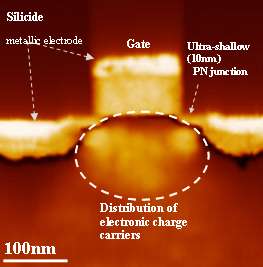
April 16, 2007 SSRM image of 45nm Generation Transistor

The density of distribution of impurity-charge carriers, previously difficult to detect, can now be analyzed in detail. The brighter the image, the higher the conductivity.

Toshiba Corp. today announced that it has achieved a breakthrough in imaging electron-carrier paths and impurities in semiconductors that allows analysis at the 1-nanometer level for the first time. This major advance, based on scanning spreading resistance microscopy (SSRM) is an essential step toward achieving LSI at the 45nm generation and beyond.

Toshiba will introduce its breakthrough approach at the International Reliability Physics Symposium (IRPS), the international conference on semiconductor reliability, which is now being held in Phoenix, Arizona. Toshiba will present the results on April 19th (local time), the last day of the conference.

Scanning spreading resistance microscopy (SSRM) is a preferred technology for two-dimensional profiling of localized resistance on a semiconductor cross-sectional surface, allowing analysis of the distribution of electron carriers and impurities. The demanding tolerances required for 45nm generation LSI makes it essential to understand electron-carrier density in the carrier channel, and to be able to control doping with 1nm-level precision, as slight differences in electrical characteristics can lead to increased current leakage and risk of short circuiting.

SSRM uses a scanning probe to produce two-dimensional images of carriers in semiconductor device. These images reveal impurity induced resistance variation and allow analysis of electron-flow paths. However, the level of precision and repeatable generation of high resolution SSRM images with conventional available probes has remained at around 5 nm.

Problems with SSRM stem from two sources: degraded imaging accuracy due to the influence of water vapor on the sample: and the difficulty of controlling a sufficiently stable contact between the sample and the probe. To overcome these factors, Toshiba installed the SSRM in a vacuum environment and refined the positioning of the probe. This allowed the company to optimize performance and advance to the 1nm level, the highest precision yet achieved. Toshiba has already applied this breakthrough to LSI development with 45 nm generation process technology.

Source: Toshiba Corporation


print this article email this article download pdf blog this article bookmark this article     Stumble it Digg this share on Facebook retweet share on Reddit add to delicious
Rate this story - 4.4 /5 (26 votes)


April 16, 2007 all stories

Comments: 0

4.4 /5 (26 votes)
  • Stumble this up

  • Digg this

  • share this


  • hide
  • Relevant PhysicsForums posts

  • Elliptical Orbits
    created 3 hours ago
  • mass time acceleration => watts
    created 9 hours ago
  • gravitation among individual particles
    created 10 hours ago
  • Tyres - why is wider better for lateral grip?
    created 10 hours ago
  • More from Physics Forums - General Physics

Other News

Magnetic nanoparticles to simultaneously diagnose, monitor and treat

Nanotechnology / Bio & Medicine

created 1hour ago | popularity not rated yet | comments 0

Whether it's magnetic nanoparticles (mNPs) giving an army of 'therapeutically armed' white blood cells direction to invade a deadly tumour's territory, or the use of mNPs to target specific nerve channels and induce nerve-led ...


New Digital 'Electronics' Concept May Continue Moore's Law

New Digital 'Electronics' Concept May Continue Moore's Law

Nanotechnology / Nanophysics

created 20 hours ago | popularity 4.6 / 5 (38) | comments 3

(PhysOrg.com) -- Computers of the future could be operating not on electrons, but on tiny waves traveling through an electron "fluid," if a new proposal is successful. The new circuit design, recently introduced ...


Nanoparticles may cause DNA damage across a cellular barrier

Nanoparticles may cause DNA damage across a cellular barrier

Nanotechnology / Bio & Medicine

created 13 hours ago | popularity 4.1 / 5 (7) | comments 1

(PhysOrg.com) -- Scientists have shown in the laboratory that metal nanoparticles damaged the DNA in cells on the other side of a cellular barrier. The research, by the University of Bristol, is published ...


How Size Matters For Catalysts: Study Links Size, Activity, Electronic Properties

How Size Matters For Catalysts: Study Links Size, Activity, Electronic Properties

Nanotechnology / Nanomaterials

created 15 hours ago | popularity 3.7 / 5 (3) | comments 0

(PhysOrg.com) -- University of Utah chemists demonstrated the first conclusive link between the size of catalyst particles on a solid surface, their electronic properties and their ability to speed chemical ...


Nanotechnology: A risky frontier?

Nanotechnology / Nanomaterials

created 18 hours ago | popularity 5 / 5 (1) | comments 0

Inside a cramped back room at Rushford Hypersonic, a start-up headquartered in southeastern Minnesota, sits a cube-like machine that throws a mean atomic fastball. At the push of a button, the reactor hurls atoms toward a ...