Philips demonstrates feasibility of PolyLED for TV applications
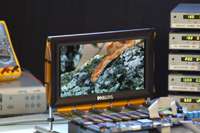
Full colour polymer OLED display technology on track to larger screen sizes.
Philips will demonstrate its first 13-inch PolyLED TV prototype based on polymer OLED (organic light-emitting diode) technology at the Society for Information Display's International Symposium in Seattle, USA from May 23 to 28.
Taking as its reference application the wide-screen 30-inch diagonal display with WXGA ( 1365 x 768 ) resolution, Philips has produced a prototype 13-inch carve-out of this display ( resolution 576 x 324 ) to demonstrate the feasibility of manufacturing large-screen polymer OLED displays using high-accuracy multi-nozzle, multi-head inkjet printers. The excellent and sparkling image quality of Philips' PolyLED TV prototype illustrates the great potential of this new display technology for TV applications. According to current predictions, a polymer OLED-based TV could be a reality in the next five years.
Polymer OLED display technology offers advantages over current LCD displays such as wide viewing angle and fast response time making this technology ideal for moving video. It also offers excellent black-level performance and outstanding picture contrast since a polymer OLED display is an emissive display. This also means that it requires no backlight and can therefore be manufactured in exceptionally thin form-factors, enabling displays no thicker than a pane of glass, with no compromise on display characteristics.
To demonstrate the polymer OLED display's ease of manufacturability in larger sizes, Philips Research has developed an inkjet printing process using a four print-head printer equipped with 256 piezo-driven nozzles. Together with the PolyLED material suppliers and print head manufacturer Spectra, Philips has developed inks, print heads, substrate processes that enable the production of large screen OLED displays with high accuracy and reliability. The system uses a novel printing method in which eac h sub-pixel (R, G or B pixel) is built up from multiple droplets fired from different nozzles. The system is capable of printing displays up to 24 inches. Larger displays are possible simply by increasing the size of the printer.
The PolyLED-TV display employs a number of video processing technologies to enhance the image quality further and take maximum advantage of the excellent video rendering properties of OLED displays. A novel addressing scheme is implemented that varies the duty cycle for each display line depending on the image load: in dark scenes, a high local peak brightness is combined with the perfect black state of OLEDs, while in bright scenes the brightness is kept at an average value. This results in sparkling images that greatly improve the perceived image quality. Colour processing is used to further improve the overall perception of the image.
Philips is already using OLED displays in several new products such as Philips' latest 639 mobile phone with 'Magic Mirror'. In 2002, Philips became the first company to launch polymer-based OLED displays for consumer applications. Since then, Philips has continued to develop the technology, both towards new display options and towards enhanced device performance.
A display based on polymer light-emitting diode (polyLED) technology is a low-weight display that is very flat and thin. It uses a low driving voltage and it offers high resolution and a wide grayscale range. The technology can be used to make segmented as well as matrix displays. A polyLED display is an emissive display and consequently has a perfect viewing angle. It offers high brightness, high contrast, and a fast response time suitable for displaying video. A strong point of a polyLED is its simple layout, which makes processing of these devices relatively easy and cheap.
Detailed information on polyLED technology see here
PolyLED is a trademark belonging to Koninklijke (Royal) Philips Electronics N.V
Original press release is here


