Researchers sequence western H5N1 virus genomes
In a paper in the May issue of Emerging Infectious Diseases, an international team of researchers report the first ever large-scale sequencing of western genomes of the deadly avian influenza virus, H5N1.
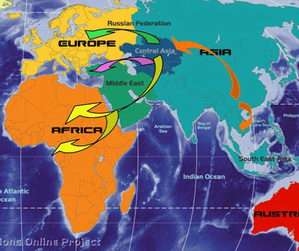
Their study of 36 genomes of the virus collected from wild birds in Europe, the Middle East and Africa (EMA), and Vietnam confirms not only that the virus has very recently spread west from Asia, but that two of the new western strains have already independently combined, or “reassorted,” to create a new strain.
Several samples also contained the mutation associated with the form of the “bird flu” that caused several human deaths in 2006. It is the virus’s ability to rapidly mutate into a pathogen that may eventually be passed between humans that concerns health officials about a worldwide pandemic of H5N1 influenza.
The study also produced some evidence that strengthens the case that humans have had an impact on the movement of the flu out of Asia.
“This is the first time anyone’s looked at all of the H5N1 genomes in the west,” said Steven Salzberg, the study’s lead author and director of the University of Maryland Center for Bioinformatics and Computational Biology. “Until now, the studies have been primarily on samples from the Far East. Our study shows that the virus is spreading west, and that there have been three separate introductions of H5N1 in Europe, the Middle East and Africa.”
New Strains Confirmed
The study’s researchers, an unusual team of scientists from 11 countries that range from U.S. to Iran, collaborated to share data and sequence H5N1 samples taken from birds in a widely dispersed geographic region that includes Nigeria, Niger, Sudan, Egypt, Afghanistan, Iran, Slovenia, Croatia and Italy.
“We found that the EMA strains of the virus are distinct from the Vietnamese and other Asian strains,” said Salzberg, “and that they have already divided into three separate new strains. One of the new strains has been the cause of several fatal human cases in Egypt and Iraq.”
The research showed that the three new strains, called clades, evolved independently and in different regions from a single genetic source. “Our analysis places this source most recently in either Russia or Quinghai Province in China,” Salzberg said.
The study shows that the new Euro-African lineage, which was the cause of fatal human infections in Egypt and Iraq in 2006, has been introduced at least three times into the EMA region and has split into three distinct, independently evolving lineages. Two of those sublineages have recently reassorted.
The broad dispersal of the different forms of the virus throughout the different countries over a relatively short period of time points to the possibility of human movement, rather than wild birds as the reason for the quick spread of the H5N1.
“The migratory pathways of wild birds don’t correspond with the movement of the genomes that we sequenced,” said Salzberg. “Humans carry chickens between many of the countries in our study, often transporting them across great distances. That and the weak biosecurity standards in most rural areas point to human-related movement of live poultry as the source of the introduction of H5N1 in some countries.”
While the study “dramatically increased the number of genomes that have been sequenced, we have to do more surveys,” Salzberg said. “It’s surprising that we found what we did with such a small sample.”
The senior author of the study was Ilaria Capua of the Istituto Zooprofilattico Sperimentale delle Venezie, Padova, Italy. Other authors included researchers from Egypt, England, Côte d'Ivoire, Vietnam, Nigeria, Iran, Afghanistan, Croatia and Slovenia.
“The research team represents an unprecedented collaboration among authors from many remote laboratories,” said Salzberg. "Collaborations like this one are essential if the scientific community is going to keep track of avian flu, but most influenza researchers continue to work in isolation, and to work with a limited and exclusive set of collaborators.
“We have to recognize that the flu knows no boundaries, and we must not only collaborate widely, but also share our data freely with one another, as we have in this study.”
The flu genomes in this study were all deposited in Genbank, a public database, immediately after sequencing.
Source: University of Maryland


