Proteins important in Alzheimer's, Parkinson's disease travel in the slow lane
April 17, 2007 Proteins important in Alzheimer's, Parkinson's disease travel in the slow lane

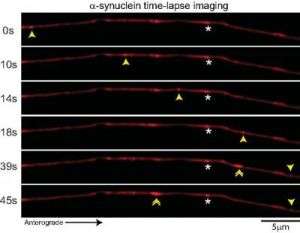
Slow transport protein alpha-synuclein moving along an axon (arrowheads mark movement). Credit: Subhojit Roy, MD, PhD, University of Pennsylvania School of Medicine

Using a novel video-imaging system, researchers at the University of Pennsylvania School of Medicine have been able to observe proteins important in Alzheimer’s and Parkinson’s disease moving along axons, extensions of nerve cells that carry proteins away from the cell body. Understanding this process of axonal transport is important for studying many neurodegenerative diseases. The study appeared in the Journal of Neuroscience.

Axonal transport often breaks down and many neurodegenerative diseases are characterized by defects in this process. Of particular interest is a group of transported proteins called slow component-b that includes synuclein and tau, disease proteins involved in Parkinson’s and Alzheimer’s disease, respectively, in addition to many other proteins critical for axonal growth and regeneration.

"There are two basic transport groups called fast and slow components, with a 200 to 300 fold difference in average velocities," says first author Subhojit Roy, MD, PhD, a neuropathologist and Research Associate in the Department of Pathology and Laboratory Medicine. "While scientists have seen proteins in the fast component move rapidly to the tip of the axon, until now, mechanisms of the slow movement of these disease-related proteins have been unclear as their transport had not been directly visualized."

Roy devised a system to simultaneously visualize the transport of two labeled slow-component-b proteins in living cultured mouse axons. This clarified unique aspects of slow-protein transport. He found that the "slow" proteins actually showed rapid bursts of movement followed by pauses. This intermittent transport behavior of individual cargoes made the overall population slow and suggests that fast and slow proteins use the same basic mechanisms for transport.

Surprisingly, the videos also revealed that multiple slow proteins are transported together as "packets," essentially piggy-backing on each other, possibly on the same specialized proteins called molecular motors. "It makes sense when you think about it – why would the neurons spend so much energy transporting proteins separately when they’re going to the same place anyway, like car pooling" speculates Roy.

"Our study reveals novel aspects of axonal transport of an important class of proteins, namely the slow component-b proteins, and also opens up new avenues for investigating axonal transport defects in neurodegenerative diseases," concludes Roy.

Source: University of Pennsylvania


print this article email this article download pdf blog this article bookmark this article     Stumble it Digg this share on Facebook retweet share on Reddit add to delicious
Rate this story - 4 /5 (3 votes)


April 17, 2007 all stories

Comments: 0

4 /5 (3 votes)
  • Stumble this up

  • Digg this

  • share this

  • hide
  • Related Stories

  • Huntington's disease deciphered
    created Jun 14, 2009 | popularity not rated yet | comments 0
  • Motor proteins may be vehicles for drug delivery
    created Mar 20, 2009 | popularity not rated yet | comments 0
  • Study specifies chemical pathway for ions through the cell membrane
    created Oct 14, 2008 | popularity not rated yet | comments 0
  • Researchers write protein nanoarrays using a fountain pen and electric fields
    created Oct 13, 2008 | popularity not rated yet | comments 0
  • Speed plays crucial role in breaking protein's H-bonds
    created Nov 08, 2007 | popularity not rated yet | comments 0


  • hide
  • Relevant PhysicsForums posts

Other News

Children who lack continuity with a regular health care provider miss needed services

Medicine & Health / Health

created 8 minutes ago | popularity not rated yet | comments 0

Low-income children who don't access health care from the same place or provider over the long term are significantly more likely to have unmet health care needs compared with those do, according to a new study published ...


Moderate-to-heavy exercise may reduce risk of stroke for men

Medicine & Health / Neuroscience

created 4 minutes ago | popularity not rated yet | comments 0

Men who regularly take part in moderate-to-heavy intensity exercise such as jogging, tennis or swimming may be less likely to have a stroke than people who get no exercise or only light exercise, such as walking, golfing, ...


Achieving asthma control in preschoolers

Medicine & Health / Diseases

created 36 minutes ago | popularity not rated yet | comments 0

Asthma is the commonest chronic disease in children and a major reason for admissions to hospital, yet inadequate asthma control is present in 26% to 45% of children, states a review in CMAJ (Canadian Medical Association Journal). ...


Invention will help speed development of drug treatments for heart failure

Medicine & Health / Research

created 26 minutes ago | popularity not rated yet | comments 0

Research conducted by University of Minnesota scientists, in collaboration with Celladon Corporation, has led to the invention of technology to more rapidly identify compounds for the treatment of heart failure.


Researcher produces, ships only H1N1 vaccine available for swine

Medicine & Health / Diseases

created 1hour ago | popularity not rated yet | comments 0

The only swine vaccine available for the H1N1 virus has been sent to vaccinate a swine herd infected with the virus. The vaccination marks the first time vaccine has been sent to a swine herd diagnosed with the pandemic flu.