Physicists tweak zinc to get many model compounds
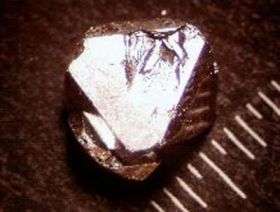
Try as they might, ancient alchemists could never turn lead into gold. Neither can the members of the Novel Materials group at the U.S. Department of Energy's Ames Laboratory. But these physicists do have a way with materials, and they can get them to do some pretty amazing things.
Drs. Paul Canfield and Sergey Bud'ko and their Iowa State University Department of Physics and Astronomy graduate student, Shuang Jia, have discovered a new family of zinc compounds that can be tuned, or manipulated, to take on some of the physical properties and behavior of other materials, ranging from plain old copper to more exotic elements like palladium, to even more complex electronic and magnetic compounds that are on, as Canfield said, "the hairy edge" of becoming magnetic (or even superconducting).
Their versatility makes the new zinc compounds ideal for basic research efforts to observe and learn more about the origins of phenomena such as magnetism. Basic research is the building block. Once scientists understand how these materials work, products and/or processes can follow.
In addition, zinc is very cheap. In 1982, the U.S.Mint switched the composition of the penny to 97.5 percent zinc and only 2.5 percent copper. In a similar manner, this class of compounds is over 85 percent zinc. If technological applications can be found, these compounds will literally only cost pennies to make.
The unique aspect of the RT2Zn20 (R=rare earth, T=transition metal, Zn=zinc) compounds' properties that Canfield, Bud'ko, and Jia discovered lies in the fact that they display extraordinary tunability, even though they are over 85 percent zinc. Indeed, these researchers have been able to make scores of different compounds with this "one rare earth-two transition metals-twenty zincs' formula.
"We can make compounds for up to 10 transition metals, and for each of those we can include between seven and 14 rare earths," said Canfield. "So that's between 70 and 140 compounds."
One of the compounds the researchers made, YFe2Zn20 (Y=yttrium, Fe=iron, Zn=zinc), turned out to be even closer to being ferromagnetic than palladium, a nearly ferromagnetic material that scientists have traditionally studied to better understand magnetism.
Canfield describes palladium as a "runner-up" in terms of band magnetismthe magnetism of the common metals like iron, cobalt or nickel. These metals become ferromagnetic at such high temperatures that it's difficult to study them in detail, so palladium is the next-best option. In addition, palladium acts as a "before" picture to their "after" in terms of ferromagnetism.
"The problem is that as an element, palladium is a little hard to tune," said Canfield. "There is one palladium site, and it's not that versatile. For basic research as well as possible applied materials, you want compounds that allow for the manipulation of their properties. We can tune the rare earth-iron(2)-zinc(20) so we're able to push these compounds even closer to ferromagnetism and try to understand the consequences of this," he explained.
Canfield, Bud'ko, and Jia have also tuned the zinc(20) compounds by substituting on the rare earth side, for example, by exchanging yttrium for gadolinium. Canfield explained, "It's like having a panicky crowd and someone yelling, 'Quick, run this way!' All of a sudden, everyone runs that way. That's what adding the gadolinium does – the compound just suddenly goes ferromagnetic at an unexpectedly high temperature."
The researchers can also tune the zinc(20) compounds by "playing" with the transition metal site. "By substituting cobalt for iron, we can back this material off," said Canfield. The yttrium-cobalt-zinc(20) is about as ferromagnetic as copper, which means it's not. So we can calm the crowd down a little and see what happens."
The remarkable tunability of the new family of zinc(20) compounds is allowing Canfield, Bud'ko and Jia to approach the ferromagnetic transition point from where they hope to achieve another ambition – pushing the material to become ferromagnetic at very low temperatures by tweaking and tuning. "If we could do that," said Canfield, "then we could actually witness the birth of this type of small moment ferromagnetism – instead of just before and after pictures, we could watch the whole film."
As they continue to work toward that goal, Canfield and Bud'ko stress the importance of being able to do materials research at a DOE lab. "There are many different skills and resources available to draw on," said Canfield. "Experimentally, it's very important to have design, synthesis and characterization very tightly linked. "You need to have your intrepid band of explorers able to investigate and contribute. Let me give you two extreme examples. First, being in Ames gives us access to the world's highest purity rare earth elements. We need these to explore the effects of substitution on the rare earth site. On the other extreme, in these nearly ferromagnetic materials, band structure calculations have been very important, and being able to tie into the Ames Lab band structure expertise of German Samolyuk has been incredibly useful in helping us understand it and trying to figure out where the next moves are."
Source: Ames Lab


