April 18, 2007 feature
First use of Deutsch's Algorithm in a cluster state quantum computer
Finding a way to build a quantum computer that works more efficiently than a classical computer has been the holy grail of quantum information processing for more than a decade. “There is quite a strong competition at the moment to realize these protocols,” Mark Tame tells PhysOrg.com.
The latest experiment performed as a collaboration by a Queen’s University theoretical group and an experimental group in Vienna has “allowed us to pick up the pace” of quantum computing.
The joint project’s experiment is reported in Physical Review Letters in an article titled, “Experimental Realization of Deutsch’s Algorithm in a One-Way Quantum Computer.”
“This is the first implementation of Deutsch’s Algorithm for cluster states in quantum computing,” Tame explains. Tame along with members of the Queen’s group in Belfast, including Mauro Paternostro and Myungshik Kim joined a group from the University of Vienna, including Robert Prevedel, Pascal Böhi, and Anton Zeilinger (who is also associated with the Institute for Quantum Optics and Quantum Information at the Austrian Academy of Sciences) to perform this experiment.
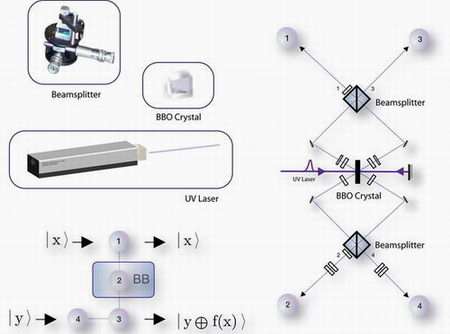
“When performing a quantum algorithm,” says Tame, “the standard approach is based on logical gates that are applied in a network similar to classical computing.” Tame points out that this method of quantum computing is not practical or efficient. “Our quantum computer model uses cluster states, which are highly entangled multi-partite quantum states.” The Irish and Austrian group’s quantum computer makes use of four entangled photons in a cluster state. Tame explains how it works:
“Our setup is completely based on light, where quantum information is encoded on each photon. The information is in the polarization of each photon, horizontal or vertical, and superpositions in between. An ultra-violet laser pumps a crystal and produces an entangled pair of photons in one direction. The laser beam then hits a mirror and bounces back to form another pair of entangled photons on its second passage through the crystal. These four photons are then made to interact at beamsplitters to form the entangled cluster state resource on which we perform the quantum computation.”
Next, Tame says, come the calculations. “We perform Deutsch’s Algorithm as a sequence of the measurements. When you measure in a specific basis, you can manipulate the quantum information in the photons using their shared entanglement.” He continues with an illustration related to classical computing: “You can think of the cluster state as the ‘hardware’, and the measurements as the ‘software’.”
Now that the groups in Belfast and Vienna have proved that Deutsch’s Algorithm works for a cluster-based quantum computer, the next step is to apply it to larger systems. “Right now it’s really just a proof of principle,” explains Tame. “We’ve shown it can be done, but we need to build larger cluster states and perform more useful computations.”
Tame admits that this next step is where it gets trickier. “Quantum systems like this can be influenced by small fluctuations in the environment. It can be difficult to get accurate computations using larger resources.” He says that noise resistant protocols need to be developed in order to maintain the coherence of the quantum information. “There’s not a lot of noise in the lab during the implementation of experiments on small numbers of qubits. But as we increase this number there are physical and technological concerns that need to be solved. This is a key issue.”
And does Tame have any idea how to solve some of these issues? “We have some schemes at the moment. It’s a work in progress.” He pauses. “But for now it’s exciting to have this proof that quantum computing can be efficiently performed with Deutsch’s Algorithm.”
Copyright 2007 PhysOrg.com.
All rights reserved. This material may not be published, broadcast, rewritten or redistributed in whole or part without the express written permission of PhysOrg.com.


