Device Uses Solar Energy to Convert Carbon Dioxide into Fuel (Update)
April 18, 2007
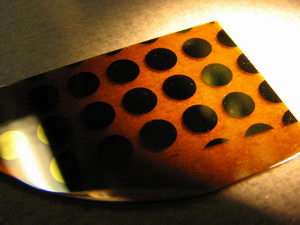
CO2 splitting semiconductor/catalyst device under construction (gallium phosphide wafer with metal contacts) Credit: Aaron Sathrum, UCSD
Chemists at the University of California, San Diego have demonstrated the feasibility of exploiting sunlight to transform a greenhouse gas into a useful product.
Many Earth Week activities will draw attention to the increasing concentration of carbon dioxide in the atmosphere and the resulting impact on global climate. Now Clifford Kubiak, professor of chemistry and biochemistry, and his graduate student Aaron Sathrum have developed a prototype device that can capture energy from the sun, convert it to electrical energy and "split" carbon dioxide into carbon monoxide (CO) and oxygen.
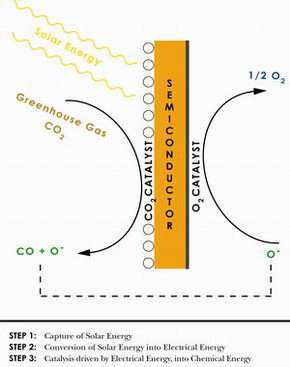
Graphic depicting steps in solar splitting of CO2. Credit: Aaron Sathrum, UCSD
Because their device is not yet optimized, they still need to input additional energy for the process to work. However, they hope that their results, which they presented at last month's meeting of the American Chemical Society, will draw attention to the promise of the approach."For every mention of CO2 splitting, there are more than 100 articles on splitting water to produce hydrogen, yet CO2 splitting uses up more of what you want to put a dent into," explained Kubiak. "It also produces CO, an important industrial chemical, which is normally produced from natural gas. So with CO2 splitting you can save fuel, produce a useful chemical and reduce a greenhouse gas."
Although carbon monoxide is poisonous, it is highly sought after. Millions of pounds of it are used each year to manufacture chemicals including detergents and plastics. It can also be converted into liquid fuel.
"The technology to convert carbon monoxide into liquid fuel has been around a long time," said Kubiak. "It was invented in Germany in the 1920s. The U.S. was very interested in the technology during the 1970s energy crisis, but when the energy crisis ended people lost interest. Now things have come full circle because rising fuel prices make it economically competitive to convert CO into fuel."
The device designed by Kubiak and Sathrum to split carbon dioxide utilizes a semiconductor and two thin layers of catalysts. It splits carbon dioxide to generate carbon monoxide and oxygen in a three-step process. The first step is the capture of solar energy photons by the semiconductor. The second step is the conversion of optical energy into electrical energy by the semiconductor. The third step is the deployment of electrical energy to the catalysts. The catalysts convert carbon dioxide to carbon monoxide on one side of the device and to oxygen on the other side.
Because electrons are passed around in these reactions, a special type of catalyst that can convert electrical energy to chemical energy is required Researchers in Kubiak's laboratory have created a large molecule with three nickel atoms at its heart that has proven to be an effective catalyst for this process.
Choosing the right semiconductor is also critical to making carbon dioxide splitting practical say the researchers. Semiconductors have bands of energy to which electrons are confined. Sunlight causes the electrons to leap from one band to the next creating an electrical energy potential The energy difference between the bands—the band gap—determines how much solar energy will be absorbed and how much electrical energy is generated.
Kubiak and Sathrum initially used a silicon semiconductor to test the merits of their device because silicon is well-studied. However, silicon absorbs in the infrared range and the researchers say it is "too wimpy" to supply enough energy. The conversion of sunlight by silicon supplied about half of the energy needed to split carbon dioxide, and the reaction worked if the researchers supplied the other half of the energy needed.
They are now building the device using a gallium-phosphide semiconductor. It has twice the band gap of silicon and absorbs more energetic visible light. Therefore, they predict that it will absorb the optimal amount of energy from the sun to drive the catalytic splitting of carbon dioxide.
"This project brings together many scientific puzzle pieces," said Sathrum. "Quite a bit of work has been done on each piece, but it takes more science to mesh them all together. Bringing all the pieces together is the part of the problem we are focused on."
Source: University of California - San Diego
-
Building mountains in a bottle
16 minutes ago |
not rated yet |
0
-
Modeling microbes to manage carbon dioxide
Feb 07, 2012 |
not rated yet |
0
-
Climate risk of toxic shock
Feb 06, 2012 |
2.3 / 5 (3) |
1
-
Progress and promise in DIAL LIDAR
Feb 06, 2012 |
5 / 5 (4) |
0
-
Scientists cautious over Russia's Antarctic lake drilling
Feb 06, 2012 |
5 / 5 (3) |
0
-
Engineers build first sub-10-nm carbon nanotube transistor
Feb 01, 2012 |
4.9 / 5 (29) |
30
-
Something old, something new: Evolution and the structural divergence of duplicate genes
Jan 31, 2012 |
4.6 / 5 (7) |
1
-
The hidden nanoworld of ice crystals: Revealing the dynamic behavior of quasi-liquid layers
Jan 30, 2012 |
5 / 5 (3) |
1
-
Stock market network reveals investor clustering
Jan 27, 2012 |
3.9 / 5 (23) |
8
-
Of microchemistry and molecules: Electronic microfluidic device synthesizes biocompatible probes
Jan 26, 2012 |
5 / 5 (1) |
0
More news stories
Engineers find inspiration for new materials in Piranha-proof armor
(PhysOrg.com) -- Its a matchup worthy of a late-night cable movie: put a school of starving piranha and a 300-pound fish together, and who comes out the winner?
52 minutes ago |
5 / 5 (1) |
1
|
Chemists harvest light to create 'green' tool for pharmaceuticals
(PhysOrg.com) -- A team of University of Arkansas researchers, including an Honors College undergraduate student, has created a new, "green" method for developing medicines. The researchers used energy from ...
4 minutes ago |
not rated yet |
0
|
Why staying warm in winter is a bit more complicated if you're a lizard
Recent studies at the ISIS neutron source, the Science and Technology Facilities Councils (STFC) world leading research centre, have given a new insight into the mysterious anti-freeze capabilities ...
27 minutes ago |
not rated yet |
0
Research provides octagonal window of opportunity for carbon capture
(PhysOrg.com) -- Filtering carbon dioxide, a greenhouse gas, from factory smokestacks is a necessary, but expensive part of many manufacturing processes. However, a collaborative research team from the National ...
Feb 08, 2012 |
5 / 5 (1) |
5
|
Carbonized coffee grounds remove foul smells
For coffee lovers, the first cup of the morning is one of life's best aromas. But did you know that the leftover grounds could eliminate one of the worst smells around sewer gas?
23 hours ago |
5 / 5 (4) |
2
|
Borexino Collaboration succeeds in spotting pep neutrinos emitted from the sun
(PhysOrg.com) -- To learn more about how the sun works, scientists study particles that are emitted from it into space due to thermonuclear reactions that occur inside; by applying known physics principles, ...
New Zealand team finds early plant arrivers dominated landscape
(PhysOrg.com) -- It seems intuitive that not all plant species could have taken a foothold on land at the same time all those millions of years ago as conditions on Earth evolved to the point where they could survive; some ...
Samsung can continue selling Galaxy tabs in Germany: court
South Korea's Samsung Electronics can continue to sell its Galaxy Tab 10.1N tablet computer in Germany, a German court ruled Thursday, rejecting a bid by arch-rival Apple to have them banned.
New views show old NASA Mars landers
(PhysOrg.com) -- The High Resolution Imaging Science Experiment (HiRISE) camera on NASA's Mars Reconnaissance Orbiter recorded a scene on Jan. 29, 2012, that includes the first color image from orbit showing ...
Black holes and star formation
(PhysOrg.com) -- It has long been recognized that galaxy mergers or even close interactions can play a vital role in shaping the morphology of galaxies. One way they can do so, it is thought, is by triggering ...
New target for Alzheimer's drugs
(Medical Xpress) -- Biomedical scientists at the University of California, Riverside have identified a new link between a protein called beta-arrestin and short-term memory that could open new doors for the ...
Oct 13, 2007
Rank: 1 / 5 (2)
Please note this post will not allow me to write out my equation. So I will explain. Carbon Dioxide plus Carbon under heat gives 2 Carbon Monoxides.