Robotic surgeon to team up with doctors, astronauts on NASA mission
April 18th, 2007 Robotic surgeon to team up with doctors, astronauts on NASA mission

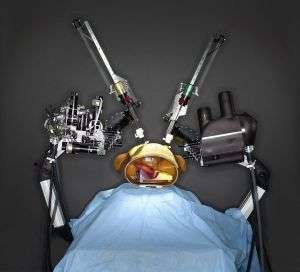
Raven, the mobile surgical robot developed in the UW's BioRobotics Lab, weighs about 50 pounds. Its nimble appendages can suture wounds and perform minimally invasive surgeries. Credit: David Clugston

This week Raven, the mobile surgical robot developed by the University of Washington, leaves for the depths of the Atlantic Ocean. The UW will participate in NASA's mission to submerge a surgeon and robotic gear in a simulated spaceship. For 12 days the surgical robotic system will be put through its paces in an underwater capsule that mimics conditions in a space shuttle. Surgeons back in Seattle will guide its movements.

The 12th NASA Extreme Environment Mission Operations test will take place May 7 to 18 off the coast of Florida. The robot leaves Seattle on Friday. During the mission, Raven will operate in the Aquarius Undersea Laboratory, a submarine-like research pod about 60 feet underwater. This mission will test current technology for sending remote-controlled surgical robotic systems into space.

During the mission, four crew members will assemble the robot and perform experiments. The two larger-than-life black robotic arms will use surgical instruments to suture a piece of rubber and move blocks from one spindle to another on what looks like a delicate children's toy. The brains behind the robot's movements will be three surgeons in front of a computer screen in Seattle: Drs. Mika Sinanan and Andrew Wright of the University of Washington's Medical Center, and Dr. Thomas Lendvay of Children's Hospital and Regional Medical Center in Seattle.

Instructions will travel over a commercial Internet connection from Seattle to Key Largo, Fla., then via a special wireless connection from there to a buoy, and finally via cable underwater. Images of the simulated patient will travel back over the same network.

Raven was built over the past five years in the UW's BioRobotics Lab, co-directed by professor Blake Hannaford and research associate professor Jacob Rosen in the department of electrical engineering, with partners in the UW's department of surgery. The da Vinci surgical robot, which is used at the UW and elsewhere, weighs nearly a half-ton. Raven weighs only 50 pounds.

Lightweight, mobile robots could travel to wounded soldiers on the battlefield to treat combat injuries. Surgical robotic systems also could be used in disaster areas so doctors worldwide could perform emergency procedures. The robots could even travel to remote areas in the developing world so local doctors could get help on difficult procedures. NASA will test the robot's suitability for a mission to space, where it could perform emergency surgery without requiring a surgeon to be onboard.

Raven went on its first road trip last summer to California's Simi Valley. Researchers installed an operating-room tent in gusting winds and temperatures nearing 100 degrees F (40 C), and hooked the equipment up to gasoline-powered generators. Surgeons completed the first field test communicating with the operating tent using an unmanned aircraft equipped with a wireless transmitter.

The NASA mission poses new challenges. Researchers shrank the computers and power supplies that support the robot so they can be carried in dive bags by technical scuba divers and fit into the limited space. Most importantly, the engineers wrote an instructional manual so crew members could reassemble the robot and troubleshoot any problems they encounter.

"When you build a technology as a lab prototype, it takes someone with a Ph.D. six weeks to put it together," Hannaford said. "If you build something for the field, it's got to be repairable, modular and robust."

Once everything is installed in the undersea lab the crew will be alone with the robot. Crew members can communicate by phone with the ground team but they will have to operate the robot and fix any problems on their own. The four-person crew includes research collaborator and surgeon Dr. Tim Broderick of the University of Cincinnati, who will observe the robot's movements and determine its suitability for space travel. Two NASA astronauts and a NASA flight surgeon complete the crew.

Also traveling to the research pod is the M7, a surgical robot developed by SRI International in Menlo Park, Calif. These two robots are the only existing prototypes for a mobile surgical robot, Hannaford said. Currently both robots are research projects and are not yet approved by the Food and Drug Administration for use on humans.

Source: University of Washington


print this article email this article download pdf blog this article bookmark this article     Digg this Stumble it share on Facebook share on Reddit add to delicious save to Yahoo! bookmarks
5/5 after 2 votes


April 18th, 2007 all stories
Medicine & Health / Other

Comments: 0
Rank: 5/5 after 2 votes

  • Stumble this up

  • Digg this

  • Share it:
  • share on Facebook
  • share on MySpace
  • share on Slashdot
  • rss-newsfeed
  • share on Google
  • share on Reddit
  • add to delicious
  • save to Yahoo! bookmarks
  • share on Windows Live
  • Add to Mixx!
Rating: 5/5 after 2 votes

  • Related Stories

  • With Mini in vivo Robots, Anyone Can do Surgery
    created Feb 05, 2008 | popularity not rated yet | comments 0
  • Mars data published in Science this week
    created Jul 02, 2009 | popularity not rated yet | comments 0
  • A glimpse at Intel's futuristic gadgets
    created Jul 01, 2009 | popularity not rated yet | comments 0
  • Autonomous robot detects shrapnel
    created Jun 18, 2009 | popularity not rated yet | comments 0
  • A drone for security and safety (w/Video)
    created May 29, 2009 | popularity not rated yet | comments 0

Tags


  • Physicists Demonstrate Quantum Memory with Matter Qubits
    Physicists Demonstrate Quantum Memory with Matter Qubits
    Physics / General Physics
    created Jul 03, 2009 | popularity 4.4 / 5 (17) | comments 1
  • 'Holey' Nanosheets for Wastewater Dye Removal
    Nanotechnology / Nanomaterials
    created Jul 01, 2009 | popularity 5 / 5 (5) | comments 1
  • Jellyfish Robot Swims Like its Biological Counterpart
    Jellyfish Robot Swims Like its Biological Counterpart
    Electronics / Robotics
    created Jun 26, 2009 | popularity 4.4 / 5 (8) | comments 1
  • Could Maxwell's Demon Exist in Nanoscale Systems?
    Could Maxwell's Demon Exist in Nanoscale Systems?
    Physics / General Physics
    created Jun 24, 2009 | popularity 4.4 / 5 (18) | comments 29
  • Living Safely with Robots, Beyond Asimov's Laws
    Living Safely with Robots, Beyond Asimov's Laws
    Electronics / Robotics
    created Jun 22, 2009 | popularity 4.6 / 5 (52) | comments 40
  • Other News

    Caffeine reverses memory impairment in Alzheimer's mice

    Caffeine reverses memory impairment in Alzheimer's mice

    Medicine & Health / Research

    created 2 hours ago | popularity not rated yet | comments 0

    Coffee drinkers may have another reason to pour that extra cup. When aged mice bred to develop symptoms of Alzheimer's disease were given caffeine - the equivalent of five cups of coffee a day - their memory ...


    Researchers find possible environmental causes for Alzheimer's, diabetes

    Medicine & Health / Diseases

    created 2 hours ago | popularity 5 / 5 (1) | comments 0

    A new study by researchers at Rhode Island Hospital have found a substantial link between increased levels of nitrates in our environment and food with increased deaths from diseases, including Alzheimer's, diabetes mellitus ...


    Variations in 5 genes raise risk for most common brain tumors

    Medicine & Health / Genetics

    created 18 hours ago | popularity not rated yet | comments 1

    Common genetic variations spread across five genes raise a person's risk of developing the most frequent type of brain tumor, an international research team reports online in Nature Genetics.


    Parents' endorsement of vigorous team sports increases children's physical activity, say researchers

    Medicine & Health / Psychology & Psychiatry

    created 1hour ago | popularity not rated yet | comments 0

    Parents who value strenuous team sports are more likely to influence their children to join a team or at least participate in some kind of exercise, and spend less time in front of the TV or computer, a new study says.


    Wind power may have its own environmental problems

    Medicine & Health / Health

    created 18 hours ago | popularity 3.7 / 5 (7) | comments 4

    Wind power generation is expected to be a clean and environmentally friendly natural energy source, but a new kind of environmental problem has surfaced as infrasonic waves caused by windmills are suspected of causing health ...