Astronomers Map Out Planetary Danger Zone
April 18, 2007
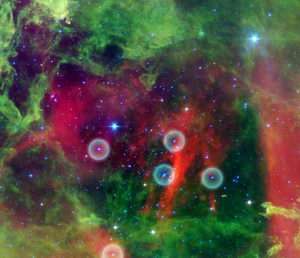
An infrared view of the Rosette nebula, with danger zones highlighted. Image credit: NASA/JPL-Caltech/Univ. of Ariz.
Astronomers have laid down the cosmic equivalent of yellow "caution" tape around super hot stars, marking the zones where cooler stars are in danger of having their developing planets blasted away.
In a new study from NASA's Spitzer Space Telescope, scientists report the first maps of so-called planetary "danger zones." These are areas where winds and radiation from super hot stars can strip other young, cooler stars like our sun of their planet-forming materials. The results show that cooler stars are safe as long as they lie beyond about 1.6 light-years, or nearly 10 trillion miles, of any hot stars. But cooler stars inside the zone are likely to see their potential planets boiled off into space.
"Stars move around all the time, so if one wanders into the danger zone and stays for too long, it will probably never be able to form planets," said Zoltan Balog of the University of Arizona, Tucson, lead author of the new report, appearing May 20 in the Astrophysical Journal.
The findings are helping astronomers pinpoint the types of environments where planets beyond our solar system, including some that might be hospitable to life, are most likely to form.
Planets are born out of a flat disk of gas and dust, called a protoplanetary disk, that swirls around a young star. They are believed to clump together out of the disk over millions of years, growing in size like dust bunnies as they sweep through the dust.
Previous studies revealed that these protoplanetary disks can be destroyed by the most massive, hottest type of star in the universe, called an O-star, over a period of about a million years. Ultraviolet radiation from an O-star heats and evaporates the dust and gas in the disk, then winds from the star blow the material away. Last year, Balog and his team used Spitzer to capture a stunning picture of this "photoevaporation" process at work.
The team's new study is the first systematic survey for disks in and around the danger zone, or "blast radius" of an O-star. They used Spitzer's heat-seeking infrared eyes to look for disks around 1,000 stars in the Rosette Nebula, a turbulent star-forming region 5,200 light-years away in the constellation Monoceros. The stars range between one-tenth and five times the mass of the sun and are between 2 and 3 million years old. They are all near at least one of the region's massive O-stars.
The observations revealed that, beyond 10 trillion miles of an O-star, about 45 percent of the stars had disks - about the same amount as there were in safer neighborhoods free of O-stars. Within this distance, only 27 percent of the stars had disks, with fewer and fewer disks spotted around stars closest to the O-star. In other words, an O-star's danger zone is a sphere whose damaging effects are worst at the core. For reference, our sun's closest star, a small star called Proxima Centauri, is nearly 30 trillion miles away.
In addition, the new study indicates that a protoplanetary disk will boil off faster in the zone's perilous core. For example, a disk two times closer to an O-star than another disk will evaporate twice as fast. "The edges of the danger zone are sharply defined," said Balog. "It is relatively safe for protoplanetary disks outside it, whereas a disk that gets dragged along by its star to be really close to an O-star could disappear in as fast as a hundred thousand years."
Despite this doomsday scenario, there is a chance some planets could survive a close encounter with an O-star. According to one alternative theory of planet formation, some gas giants like Jupiter might form in less than one million years. If such a planet already existed around a young star whose disk is blown away, the gas giant would stay put while any burgeoning rocky planets like Earth would be forever swept away.
Some astronomers think our sun was born in a similarly violent neighborhood studded with O-stars before migrating to its present, more spacious home. If so, it was lucky enough to escape a harrowing ride into any danger zones, or our planets, and life as we know it, wouldn't be here today.
Other paper authors include James Muzerolle, Kate Su, George Rieke and Erick Young of the University of Arizona; and Tom Megeath of the University of Toledo, Ohio.
Source: NASA, by Whitney Clavin
-
Stellar astrophysics explains the behavior of fast rotating neutron stars in binary systems
Feb 02, 2012 |
5 / 5 (7) |
2
-
Gaseous ring around young star raises questions
Jan 19, 2012 |
4.5 / 5 (12) |
34
-
Black hole jets
Jan 16, 2012 |
4.6 / 5 (7) |
6
-
Scientists discover a Saturn-like ring system eclipsing a sun-like star
Jan 11, 2012 |
5 / 5 (5) |
2
-
Not all who wander are lost
Jan 09, 2012 |
4 / 5 (2) |
2
-
Engineers build first sub-10-nm carbon nanotube transistor
Feb 01, 2012 |
4.9 / 5 (31) |
30
-
Something old, something new: Evolution and the structural divergence of duplicate genes
Jan 31, 2012 |
4.6 / 5 (7) |
1
-
The hidden nanoworld of ice crystals: Revealing the dynamic behavior of quasi-liquid layers
Jan 30, 2012 |
5 / 5 (3) |
1
-
Stock market network reveals investor clustering
Jan 27, 2012 |
3.9 / 5 (23) |
8
-
Of microchemistry and molecules: Electronic microfluidic device synthesizes biocompatible probes
Jan 26, 2012 |
5 / 5 (1) |
0
-
Scale of the Universe
2 hours ago
-
Titan's lack of impact craters
Feb 09, 2012
-
Real pictures of black hole eating a star?
Feb 08, 2012
-
Hypothetical way to travel faster than light, but not technically exceed lightspeed
Feb 06, 2012
-
How do scientists monitor the Sun's activity?
Feb 05, 2012
-
Search patterns in observational studies
Feb 05, 2012
- More from Physics Forums - General Astronomy
More news stories
NASA sees wide-eyed cyclone Jasmine
Cyclone Jasmine's eye has opened wider on NASA satellite imagery, as it moves through the Southern Pacific Ocean.
Space & Earth / Earth Sciences
1 hour ago |
not rated yet |
0
NASA sees Giovanna reach cyclone strength, threaten Madagascar
Tropical Storm 12S built up steam and became a cyclone on February 10, 2012 as NASA's Terra satellite passed overhead. Residents of east-central Madagascar should prepare for this cyclone to make landfall ...
Space & Earth / Earth Sciences
1 hour ago |
not rated yet |
0
Humans may have helped the decline of African rainforests 3000 years ago
(PhysOrg.com) -- Large areas of rainforests in Central Africa mysteriously disappeared over three thousand years ago, to be replaced by savannas. The prevailing theory has been that the cause was a change ...
Could Venus be shifting gear?
(PhysOrg.com) -- ESAs Venus Express spacecraft has discovered that our cloud-covered neighbour spins a little slower than previously measured. Peering through the dense atmosphere in the infrared, the ...
Space & Earth / Space Exploration
9 hours ago |
5 / 5 (7) |
7
|
Mars Science Laboratory computer issue resolved
(PhysOrg.com) -- Engineers have found the root cause of a computer reset that occurred two months ago on NASA's Mars Science Laboratory and have determined how to correct it.
Space & Earth / Space Exploration
10 hours ago |
4.7 / 5 (6) |
3
|
Google users warned of threat to smartphone wallets
Users of Google smartphone wallets were being warned on Friday that there is a way to crack pass codes intended to thwart thieves from going on illicit shopping sprees.
CIA website offline, Anonymous takes credit
The website of the Central Intelligence Agency was unresponsive on Friday after the hacker group Anonymous claimed to have knocked it offline.
Complex wiring of the nervous system may rely on a just a handful of genes and proteins
Researchers at the Salk Institute have discovered a startling feature of early brain development that helps to explain how complex neuron wiring patterns are programmed using just a handful of critical genes. ...
Putting the squeeze on planets outside our solar system
(PhysOrg.com) -- Using high-powered lasers, scientists at Lawrence Livermore National Laboratory and collaborators discovered that molten magnesium silicate undergoes a phase change in the liquid state, abruptly ...
The power of estrogen -- male snakes attract other males
A new study has shown that boosting the estrogen levels of male garter snakes causes them to secrete the same pheromones that females use to attract suitors, and turned the males into just about the sexiest ...
New error-correcting codes guarantee the fastest possible rate of data transmission
Error-correcting codes are one of the triumphs of the digital age. Theyre a way of encoding information so that it can be transmitted across a communication channel such as an optical fiber o ...