An incredibly sensitive Cornell STM probes the mystery of a high-temperature superconductor
With equipment so sensitive that it can locate clusters of electrons, Cornell University and University of Tokyo physicists have -- sort of -- explained puzzling behavior in a much-studied high-temperature superconductor, perhaps leading to a better understanding of how such superconductors work.
It turns out that under certain conditions the electrons in the material pretty much ignore the atoms to which they are supposed to be attached, arranging themselves into a neat pattern that looks like a crystal lattice. The behavior occurs in a phase physicists have called a "pseudogap," but because the newly discovered arrangement looks like a checkerboard in scanning tunneling microscope (STM) images, J.C. Seamus Davis, Cornell professor of physics, calls the phenomenon a "checkerboard phase."
Davis, Hidenori Takagi, professor of physics at the University of Tokyo, and co-workers describe the observations in the Aug. 26, 2004, issue of the journal Nature. An article about the work also is scheduled to appear in the September issue of Physics Today.
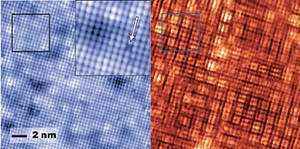
Image: In a standard scanning tunneling microscope image, left, the atoms in a cuprate crystal the bright blobs) are not in a particularly orderly arrangement. But an image of the probable distribution of electrons, right, shows that clouds of them have arranged themselves in what amounts to an electronic crystal. The brighter areas seem to contain more electrons, but the reason for this is unknown.
"In at least one cuprate high-temperature superconducting material that phase is an electronic crystal," Davis reports. "We don't understand what we've found, but we have moved into unknown territory that everyone has wanted to explore. Many people have believed that to understand high-temperature superconductivity we have to look in this territory."
A superconductor is a material capable of conducting electricity with virtually no resistance. Modified crystals of copper oxide, known as cuprates, can become superconductors at temperatures up to about 150 Kelvin (-123 degrees Celsius or --253 degrees Fahrenheit) when they are doped with other atoms that create "holes" in the crystal structure where electrons would ordinarily be. These superconductors are widely used in industry, although there is still no clear explanation of how they work. Their superconducting behavior begins when about 10 percent of the electrons have been removed, but for over a decade physicists have been puzzled by what happens when somewhat fewer electrons are removed: The material conducts electricity, but just barely. In theory it shouldn't conduct at all.
Davis has now been able to observe this phase with a specially modified STM that measures, in effect, the quantum wave functions of the electrons in a sample.
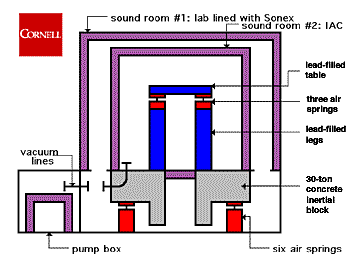
The famous Heisenberg uncertainty principle says that we can never tell exactly where an electron is. Rather than thinking of electrons orbiting the nuclei of atoms like little planets, scientists today imagine "clouds" of electrons somewhere in the vicinity. An STM uses a needle so fine that its tip consists of just one atom, scanning across a small surface and measuring current flow between the surface and the tip. Conventional STMs scan with enough precision to image individual atoms. Davis has increased the scanning precision to a point where he can resolve details smaller than atoms. His new instrument, located in the basement of the Clark Hall of Science on the Cornell campus, is so sensitive that it has been built in a room mounted on heavy concrete pillars and isolated by air springs. For these experiments, it scans a sample and reads the probability that electrons are in certain locations, based on current flow through the STM tip.
Davis's team studied a copper oxide containing calcium and chlorine that was doped by replacing some of the calcium atoms with sodium to remove, in various samples, from 8 to 12 percent of the electrons. The material was cooled to about 100 milliKelvins, or a hundredth of a degree above absolute zero.
What they found was that the electrons in the sample arranged themselves in tiny squares, all in turn arranged in a neat checkerboard pattern. The same pattern was found at the highest level of doping tested, where the material begins to become superconducting. Whether or not it continues at higher levels remains to be seen, Davis says.
The discovery only leads to more questions. Theoretically, Davis says, this arrangement should not conduct electricity at all, because the electrons are locked into their crystal-like pattern. "It's always been a mystery, how do you get from an insulator through a tiny change to a superconductor," he notes. "Having empirical knowledge of what this phase is may help us to get from here to there."
The Nature paper is titled "Discovery of a 'Checkerboard' Electronic Crystal State in Lightly Hole-Doped Ca2-xNaxCuO2Cl2." Along with Davis and Takagi, co-authors include Cornell post-doctoral researchers Christian Lupien and Yuki Kohsaka; Dung-Hai Lee, University of California-Berkeley professor of physics; and Tetsuo Hanaguri of the RIKEN Institute in Japan. The cuprate material used in the experiments were prepared by Yuki Kohsaka at the University of Tokyo in collaboration with the scientists who developed it in 1995, Masaki Azuma and Mikio Takano of Kyoto University.
Source: Cornell University


