Iowa astrophysicists provide the eyes for new gamma ray telescope system
April 19, 2007
500 Photon Detectors

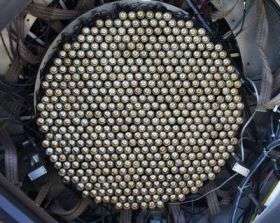
Iowa State University astrophysicists designed and built four of these cameras for the VERITAS gamma ray telescope system. Each camera contains 500 tube-shaped photo detectors. Credit: Photo contributed by Frank Krennrich/Iowa State University

There's a "First Light Fiesta" in the works at Mt. Hopkins near Amado, Ariz. And Iowa State University astrophysicists will be among those enjoying the celebration of a new telescope system and all the science it will produce.

The $20 million VERITAS telescope system – that's the Very Energetic Radiation Imaging Telescope Array System – at the Fred Lawrence Whipple Observatory south of Tucson doesn't look like the telescope you used in high school. It's made of four reflectors 12 meters across that look like satellite dishes. The reflectors are covered with mirrors that direct light into cameras attached to the front of each dish. Each camera is about 7 feet across and contains 500 tube-shaped photon detectors or pixels. The telescope system is based on techniques Iowa State researchers Richard Lamb and David Carter-Lewis helped develop in the 1980s.

All those detectors for the VERITAS system were built in a laboratory on the fourth floor of Iowa State's Zaffarano Physics Addition. It took about $1 million and a lot of work by Iowa State post-doctoral researchers Tomoyuki Nagai and Martin Schroedter to do it.

Frank Krennrich, an Iowa State professor of physics and astronomy and leader of Iowa State's work on the VERITAS project, said the telescope system will be looking for gamma rays from space.

VERITAS is the northern hemisphere's most sensitive instrument for finding that high energy electromagnetic radiation. And gamma rays do have lots of energy: the energy of visible light is one electron volt; gamma rays have energies of one million to one trillion electron volts.

Even with all that energy, the rays can't penetrate the earth's atmosphere. But when they hit the atmosphere they create showers of electrons and positrons that create a blue light known as Cerenkov radiation. The showers move very fast. And they're not very bright.

So it takes a powerful instrument to find them. The astronomers say VERITAS is proving to be as sensitive as they expected.

"The quality of the data is so much better," Krennrich said. "The more telescopes you have, the higher the resolution for these measurements."

That's good news to Martin Pohl, an Iowa State assistant professor of physics and astronomy who's working to analyze and explain the data from the VERITAS observations, and Asif Imran, an Iowa State doctoral student whose dissertation includes the analysis of VERITAS data.

"Being able to see more precisely allows you to ask more precise questions," Pohl said.

Astrophysicists now know that gamma rays are produced by supermassive black holes, supernova remnants, pulsars, gamma ray bursts and other space objects. The crab Nebula is one source of gamma rays.

Researchers believe more knowledge of gamma rays could help them explore distant regions of space, help them look for evidence of dark matter, determine how much electromagnetic radiation the universe has produced, answer questions about the formation of stars and help explain the origins of the most energetic radiation in the universe.

Without the improvements in data now being produced by VERITAS, "You're like a fish on the beach," Pohl said.

And so these Iowa State astrophysicists have good reason to celebrate the telescope system's first light April 27-29 in the Arizona mountains.

"This is a pretty big deal," Krennrich said. "We have worked 10 years on this."

Source: Iowa State University


Rank 4 /5 (2 votes)
Tags

Relevant PhysicsForums posts
  • Never ending outer space.....
    created4 hours ago
  • Neutron Star fragments?
    created6 hours ago
  • stationary or not?
    created10 hours ago
  • Scale of the Universe
    createdFeb 10, 2012
  • Titan's lack of impact craters
    createdFeb 09, 2012
  • Real pictures of black hole eating a star?
    createdFeb 08, 2012
  • More from Physics Forums - General Astronomy

More news stories

Europe stakes billion-dollar bet on new rocket

A pencil-slim rocket is scheduled to lift into space from South America on Monday, carrying a billion-dollar bet that Europe can grab a juicy slice of the market to place satellites in low orbit.

Space & Earth / Space Exploration

created 17 hours ago | popularity 3.5 / 5 (2) | comments 0

Political leaders play key role in how worried Americans are by climate change: study

More than extreme weather events and the work of scientists, it is national political leaders who influence how much Americans worry about the threat of climate change, new research finds.

Space & Earth / Environment

created Feb 06, 2012 | popularity 5 / 5 (6) | comments 72

NASA budget will axe Mars deal with Europe: scientists

US President Barack Obama's budget proposal to be submitted next week for 2013 will cut NASA's budget by 20 percent and eliminate a major partnership with Europe on Mars exploration, scientists said Thursday.

Space & Earth / Space Exploration

created Feb 10, 2012 | popularity 5 / 5 (3) | comments 48

Humans may have helped the decline of African rainforests 3000 years ago

(PhysOrg.com) -- Large areas of rainforests in Central Africa mysteriously disappeared over three thousand years ago, to be replaced by savannas. The prevailing theory has been that the cause was a change ...

Space & Earth / Environment

created Feb 10, 2012 | popularity 4.1 / 5 (14) | comments 19 | with audio podcast report

High planetary tilt lowers odds for life?

Highly-tilted worlds would have extreme seasons, subjecting life to alternating periods of scorching and subzero temperatures. This could make the development of all but hardiest, simplest creatures a long ...

Space & Earth / Space Exploration

created Feb 06, 2012 | popularity 4.8 / 5 (12) | comments 14 | with audio podcast


Walney offshore wind farm is world's biggest (for now)

(PhysOrg.com) -- The Walney wind farm on the Irish Sea--characterized by high tides, waves and windy weather--officially opened this week. The farm is treated in the press as a very big deal as the Walney ...

GPS court ruling leaves US phone tracking unclear

A US Supreme Court decision requiring a warrant to place a GPS device on the car of a criminal suspect leaves unresolved the bigger issue of police tracking using mobile phones, legal experts say.

Europeans protest controversial Internet pact

Tens of thousands of people marched in protests in more than a dozen European cities Saturday against a controversial anti-online piracy pact that critics say could curtail Internet freedom.

Study finds that anti-diabetic medication can prevent the long-term effects of maternal obesity

In a study to be presented today at the Society for Maternal-Fetal Medicine's annual meeting, The Pregnancy Meeting, in Dallas, Texas, researchers will report findings that show that short therapy with the anti-diabetic medication ...

Netflix settlement trims 14 pct off 4Q earnings

(AP) -- Netflix pressed the rewind button on its fourth-quarter earnings after settling allegations that the video subscription service violated a consumer-privacy law.

Navy to begin tests on electromagnetic railgun prototype launcher

The Office of Naval Research (ONR)'s Electromagnetic (EM) Railgun program will take an important step forward in the coming weeks when the first industry railgun prototype launcher is tested at a facility ...