UD scientist wins NSF career award for tissue engineering research
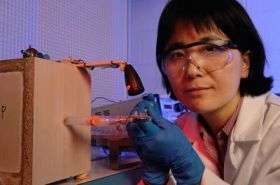
Xinqiao Jia will never forget a visitor to her professor's lab at Fudan University in Shanghai, China, when she was working on her master's degree in polymer chemistry and physics. The lab was working to synthesize polymers for carrying cancer-fighting drugs in the human body.
"One day, a farmer from a remote area in northeast China appeared in the lab, desperate to find a cure for his wife's cancer," Jia said. "We felt so bad for him," she noted. "That experience made me determined to pursue a career in biomedical research."
Jia, an assistant professor of materials science and engineering at the University of Delaware, recently received a National Science Foundation Faculty Early Career Development Award. The highly competitive award is bestowed on those scientists deemed most likely to become the academic leaders of the 21st century.
Over the next five years, the $500,000 award will support Jia's research to develop strong, yet soft and flexible biomaterials that can be used to engineer damaged tissues, particularly the vocal folds. This basic research is essential to advancing the highly interdisciplinary field of tissue engineering, in which scientists someday hope to provide synthetic tissues for repairing or replacing damaged human organs.
"Xinqiao Jia is a wonderful scientist and teacher who is doing innovative research on biomaterials," Eric Kaler, the Elizabeth Inez Kelley Professor of Chemical Engineering and dean of UD's College of Engineering, said. "We are delighted that she has received this prestigious award."
Building on her previous research, Jia's goal is to develop hybrid materials that can respond rapidly and reversibly to mechanical forces for long periods. Mechanically active tissue is found in many areas of the human body--the heart, for example, beats an average of 70 times a minute when you are resting, and the vocal folds vibrate more than 100 times a second when you are speaking.
"To repair damaged vocal folds, we need 'filler' or scaffold material that's very soft, but very strong. It's very challenging to create material with both properties," Jia noted. "We need to match not only the elasticity of the natural tissue, but also its ability to withstand prolonged mechanical stress."
Jia's research focuses on building tissue scaffolds made from hydrogel biomaterials consisting of synthetic polymers and peptides. By modeling the composition, structure and behavior of the hydrogels after the structural material, or extracellular matrix, of natural tissues, she hopes to also capture the natural resiliency of human tissues.
"If someone hits you in the arm, titin--the protein molecules in your muscle--unfolds or becomes stretched out," Jia noted. "As the energy from the force dissipates, the protein molecules recover and fold back up."
Jia is working to mimic this responsiveness to force by combining spring-like, coiled polymers with noncovalent interactions, which can be disrupted temporarily by force, yet have the ability to re-form once the force is removed. Once the design of these novel polymers is perfected, they can be used as building blocks for artificial tissue.
Assisting her in the research are undergraduate student Meghan Woods and graduate students Amit Kumar Jha, Alexandra Farran and Sarah Grieshaber. Grieshaber is co-advised by Kristi Kiick, assistant professor of materials science and engineering.
"This is very basic research that is many steps from actual application," Jia said. "However, eventually our goal is to develop a set of materials for engineering mechanically active tissues."
Jia credits two people for inspiring her to pursue a career in science: her father, a self-taught electrical and mechanical engineer, and her high-school chemistry teacher. She hopes to have a similar impact on students through the educational component to her research, which she is developing with the assistance of Michael Vaughan, senior assistant dean of engineering, and Kathy Werrell, assistant dean of engineering.
Jia will be introducing students at Morgan State University, a historically black college in Baltimore, to her biomedical research. Middle- and high-school students from across Delaware also will be involved in hands-on research demonstrations in her lab through programs such as the Lego League and the Governor's School for Excellence.
"Last year, the Lego League students who visited our lab made hydrogels in different shapes, and then we subjected the gels to high-frequency vibrations. Using a homemade strobe light, we showed the students how these gels 'dance,'" Jia said, smiling. "Through this demonstration, students were able to see how we measure the mechanical properties of the gels at high frequencies," she noted.
Jia received her bachelor's degree in applied chemistry and master's degree in polymer chemistry and physics from Fudan University in Shanghai, and master's and doctoral degrees in polymer science and engineering from the University of Massachusetts at Amherst.
After earning her Ph.D., she did postdoctoral research with Robert Langer, a pioneer in tissue engineering at the Massachusetts Institute of Technology.
She says she was fortunate to have the opportunity to join the UD faculty in 2005.
"This is a wonderful department and campus," Jia said. "I have tremendous collaborators across the University. Everyone has welcomed me with open arms, offering their equipment and sharing their advice. I feel very lucky to be in this environment," she added. "Here, we are all committed to helping each other."
Source: University of Delaware


