Black Holes May Fill the Universe with Seeds of Life
April 20, 2007 Black Holes May Fill the Universe with Seeds of Life

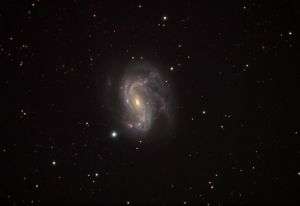
The black hole at the center of the NGC 4051 galaxy emits a hot wind of chemical elements, including elements like carbon and oxygen that are critical for life. The hot wind originates very close to the black hole, at a distance about five times the size of Neptune's orbit. Although speedy, the wind is weaker than expected and ejects only 2 to 5 percent of accreting material. Credit: George Seitz/Adam Block/NOAO/AURA/NSF

New research shows that black holes are not the ultimate destroyers that are often portrayed in popular culture. Instead, warm gas escaping from the clutches of enormous black holes could be one source of the chemical elements that make life possible.

Immediately after the Big Bang, the universe contained only hydrogen and helium. Heavier chemical elements had to be cooked up inside the first stars, then scattered throughout space to be incorporated in next-generation stars and their planets. Black holes may have helped to distribute those elements across the cosmos.

Black holes are not all-consuming monsters. Until gas crosses the boundary known as the event horizon, it can still escape if it is heated sufficiently.

“One of the big questions in cosmology is how much influence massive black holes exert on their surroundings,” said co-author Martin Elvis of the Harvard-Smithsonian Center for Astrophysics (CfA). “This research helps answer that question.”

An international team of astronomers has found that hot winds from giant black holes in galactic centers may blow heavy elements like carbon and oxygen into the vast tracts of space between galaxies.

The team, led by Yair Krongold of the Universidad Nacional Autonoma de Mexico, studied the supermassive black hole at the center of the galaxy NGC 4051. They found that gas was escaping from much closer to the black hole than previously thought. The outflow source is located about 2,000 Schwarzschild radii from the black hole, or about five times the size of Neptune’s orbit. (The Schwarzschild radius is the black hole’s “point of no return” – about 4 million miles for the black hole in NGC 4051.)

The team could also determine the fraction of gas that was avoiding being swallowed. That fraction ended up being smaller than earlier studies suggested.

“We calculate that between 2 to 5 percent of the accreting material is flowing back out,” says team member Fabrizio Nicastro of the CfA.

Winds from black holes have been clocked at speeds of up to 4 million miles per hour. Over thousands of years, the chemical elements such as carbon and oxygen in those winds can travel immense distances, eventually becoming incorporated into the cosmic clouds of gas and dust, called nebulae, that will form new stars and planets.

This research, which used data from the European Space Agency’s XMM-Newton satellite, is being reported in the April 20 issue of The Astrophysical Journal.

Source: Harvard-Smithsonian Center for Astrophysics


print this article email this article download pdf blog this article bookmark this article     Stumble it Digg this share on Facebook retweet share on Reddit add to delicious
Rate this story - 4.3 /5 (87 votes)


April 20, 2007 all stories

Comments: 0

4.3 /5 (87 votes)
  • Stumble this up

  • Digg this

  • share this

  • hide
  • Related Stories


  • hide
  • Relevant PhysicsForums posts

  • Question about 2-body gravity
    created 17 hours ago
  • life on Mars
    created 19 hours ago
  • Semi-major axis from cartesian co-ordinates
    created Nov 23, 2009
  • Primary Mirror grinding
    created Nov 23, 2009
  • More from Physics Forums - General Astronomy

Other News

Cassini Captures Ghostly Dance of Saturn's Northern Lights

Cassini Captures Ghostly Dance of Saturn's Northern Lights (w/ Video)

Space & Earth / Space Exploration

created 9 hours ago | popularity 5 / 5 (3) | comments 0

(PhysOrg.com) -- In the first video showing the auroras above the northern latitudes of Saturn, Cassini has spotted the tallest known "northern lights" in the solar system, flickering in shape and brightness ...


First black holes may have incubated in giant, starlike cocoons, says CU-Boulder study

First black holes may have incubated in giant, starlike cocoons

Space & Earth / Astronomy

created 12 hours ago | popularity 4.4 / 5 (10) | comments 7

(PhysOrg.com) -- The first large black holes in the universe likely formed and grew deep inside gigantic, starlike cocoons that smothered their powerful x-ray radiation and prevented surrounding gases from ...


ET: Check your voicemail

ET: Check your voicemail

Space & Earth / Space Exploration

created 9 hours ago | popularity 3.4 / 5 (5) | comments 5

(PhysOrg.com) -- Alien beings on faraway planets may not have noticed, but it’s been 35 years since human beings made the first deliberate effort to send them a message.


Infrared Image of Circumstellar Disk Illuminates Massive Star Formation Process

Infrared Image of Circumstellar Disk Illuminates Massive Star Formation Process

Space & Earth / Astronomy

created 8 hours ago | popularity 4.5 / 5 (2) | comments 0

(PhysOrg.com) -- A team of astronomers from Ibaraki University, Japan Aerospace Exploration Agency, Kanagawa University, University of Tokyo, Academica Sinica, and National Astronomical Observatory of Japan ...


Humanity would need five Earths to create the resources needed if everyone lived as like Americans, a report has stated

Mankind using Earth's resources at alarming rate

Space & Earth / Environment

created 18 hours ago | popularity 3.3 / 5 (12) | comments 19

Humanity would need five Earths to produce the resources needed if everyone lived as profligately as Americans, according to a report issued Tuesday.