Laser Acceleration of Electrons Excites Physicists
April 20, 2007
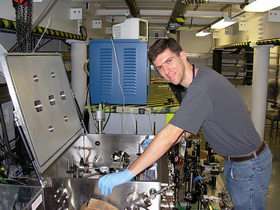
Chris Sears leans over the experimental chamber where researchers hope to accelerate electrons with laser light.
A new experiment aims to accelerate electrons using dark red light.
Physicists on experiment E163 are replacing microwave power from klystrons with laser-generated visible light to boost the energy of particles. The laser could give particles up to 30 times more energy per meter than they gain from microwave power in the SLAC linac.
What's more, the researchers aspire to revolutionize accelerator design by one day placing major components—the laser and the accelerator structures in which particles travel—on mass-produced silicon chips. This accelerator-on-a-chip idea would allow for shorter and cheaper accelerators.
"This is a distant dream, it's not something we even know how to do in 10 years," said experiment spokesman Eric Colby. "But companies already know how to deposit microscopic lasers on silicon, and they can write optics and mirrors onto chips, too. A microscopic accelerator structure could be printed out of the silicon itself."
LLined up, tens of thousands of these chips could potentially accelerate a particle beam on its way to a conventionally sized detector.
For now, researchers have set up a full-sized laser whose beam is focused down to fit through the prototype accelerator structure—a tiny photonic crystal fiber, similar to telecommunications optical fibers, ordered from a catalog that Colby describes as the K-Mart of optics. Electrons and light pulses will travel through a hole in the photonic crystal that is 10,000 times narrower than the accelerator structures at SLAC.
Housed in End Station B, the experiment uses the first part of the Next Linear Collider Test Accelerator (NLCTA) plus new laser and experiment rooms. This laser acceleration research originated 12 years ago with Stanford Professor Robert Byer. SLAC's Advanced Accelerator Research group joined in when the need for complex instruments grew.
Earlier experiments on campus showed that acceleration with visible light is possible using very simple accelerator structures. These experiments also met the difficult challenge of making micron-sized laser and electron beams, and of synchronizing them with each other within a trillionth of a second. Unfortunately, these structures used the laser power inefficiently.
The challenge now is to examine structures, such as photonic crystals, which can operate much more efficiently. "No one's ever shown that you can really accelerate particles in these photonic crystals. We hope to show proof of principle, and to demonstrate efficient energy transfer," Colby said.
The laser both generates electrons—which are first accelerated in the NLCTA—and also pushes the electrons once they reach the experimental chamber, which is slightly bigger than a cooler. A miniature undulator and chicane—types of magnets that wiggle and bend electron bunches to break them into smaller pulses—make the electrons short enough to catch a ride on each laser pulse, which only lasts one trillionth of a second.
Approved for operation on March 1, the experiment just finished its commissioning phase. Starting in May, E163 will run one week a month for the next two and a half years. The facility in End Station B is now available to users working on advanced accelerator research and development. The NLCTA Operations Group provided indispensable support to get E-163 and the user facility ready.
Source: by Heather Rock Woods, Stanford Linear Accelerator Center
-
Researchers at SLAC test collider closer to creating fully coherent X-rays
Feb 01, 2012 |
5 / 5 (3) |
0
-
Scientists X-ray key enzyme of common pathogen crystallized in living cells
Jan 30, 2012 |
5 / 5 (1) |
0
-
Fifth X-ray instrument at LCLS debuts, with a bead on disorderly structures
Dec 14, 2011 |
not rated yet |
0
-
Timing particle flight
Oct 12, 2011 |
4.5 / 5 (2) |
0
-
Car Talk: LISA develops smart cars to make safer drivers
Oct 12, 2011 |
not rated yet |
0
-
Engineers build first sub-10-nm carbon nanotube transistor
Feb 01, 2012 |
4.9 / 5 (31) |
30
-
Something old, something new: Evolution and the structural divergence of duplicate genes
Jan 31, 2012 |
4.6 / 5 (7) |
1
-
The hidden nanoworld of ice crystals: Revealing the dynamic behavior of quasi-liquid layers
Jan 30, 2012 |
5 / 5 (3) |
1
-
Stock market network reveals investor clustering
Jan 27, 2012 |
3.9 / 5 (23) |
8
-
Of microchemistry and molecules: Electronic microfluidic device synthesizes biocompatible probes
Jan 26, 2012 |
5 / 5 (1) |
0
-
Question about Newton's laws
1 hour ago
-
Gravity Question (I think) with mass and speed
3 hours ago
-
Can you manipulate any formula in Physics?
4 hours ago
-
I have a quiz -_-
6 hours ago
-
Understanding Antennas based on GPS
6 hours ago
-
Parallel plate capacitor's charge
6 hours ago
- More from Physics Forums - General Physics
More news stories
Explained: Sigma
It's a question that arises with virtually every major new finding in science or medicine: What makes a result reliable enough to be taken seriously? The answer has to do with statistical significance -- but ...
Feb 09, 2012 |
5 / 5 (18) |
65
Quantum physicist explains $100K offer for proof scaled-up quantum computing is impossible
(PhysOrg.com) -- MIT researcher Scott Aaronson has certainly riled the physics community with his offer this past Friday, of $100,000 to anyone who can prove that scaled-up quantum computing is impossible. ...
Diamond light, brighter than the sun
Its the size of five football pitches and generates light 10 billion times brighter than the sun. As the Diamond Light Source celebrates its tenth anniversary this year, Penny Bailey visits one of the ...
Feb 07, 2012 |
4.3 / 5 (7) |
15
|
Physicists 'record' magnetic breakthrough
An international team of scientists has demonstrated a revolutionary new way of magnetic recording which will allow information to be processed hundreds of times faster than by current hard drive technology.
Feb 07, 2012 |
4.5 / 5 (41) |
14
|
Hints of the Higgs - papers are submitted
Back in December 2011, the ATLAS and CMS experiments at CERN presented some exciting results that provided tantalising hints of the Higgs boson.
Feb 08, 2012 |
4.1 / 5 (7) |
10
Walney offshore wind farm is world's biggest (for now)
(PhysOrg.com) -- The Walney wind farm on the Irish Sea--characterized by high tides, waves and windy weather--officially opened this week. The farm is treated in the press as a very big deal as the Walney ...
Europeans protest controversial Internet pact
Tens of thousands of people marched in protests in more than a dozen European cities Saturday against a controversial anti-online piracy pact that critics say could curtail Internet freedom.
GPS court ruling leaves US phone tracking unclear
A US Supreme Court decision requiring a warrant to place a GPS device on the car of a criminal suspect leaves unresolved the bigger issue of police tracking using mobile phones, legal experts say.
Europe stakes billion-dollar bet on new rocket
A pencil-slim rocket is scheduled to lift into space from South America on Monday, carrying a billion-dollar bet that Europe can grab a juicy slice of the market to place satellites in low orbit.
Study finds that anti-diabetic medication can prevent the long-term effects of maternal obesity
In a study to be presented today at the Society for Maternal-Fetal Medicine's annual meeting, The Pregnancy Meeting, in Dallas, Texas, researchers will report findings that show that short therapy with the anti-diabetic medication ...
Netflix settlement trims 14 pct off 4Q earnings
(AP) -- Netflix pressed the rewind button on its fourth-quarter earnings after settling allegations that the video subscription service violated a consumer-privacy law.