Looking Down The Mouth Of An Interstellar Cavern
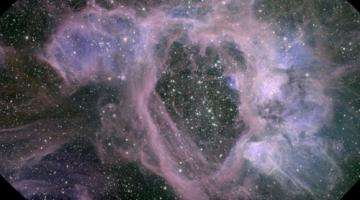
A storm of billowing clouds blown by the winds from massive stars, and set aglow by their light, is the focus of a striking image released today by Gemini Observatory.
Known as the N44 superbubble complex, this cloudy tempest is dominated by a vast bubble about 325 by 250 light-years across. A cluster of massive stars inside the cavern has cleared away gas to form a distinctive mouth-shaped hollow shell.
While astronomers do not agree on exactly how this bubble has evolved for up to the past 10 million years, they do know that the central cluster of massive stars is responsible for the cloud's unusual appearance. It is likely that the explosive death of one or more of the cluster's most massive and short-lived stars played a key role in the formation of the large bubble.
"This region is like a giant laboratory providing us with a glimpse into many unique phenomena," said Sally Oey of the University of Michigan, who has studied this object extensively. "Observations from space have even revealed x-ray-emitting gas escaping from this superbubble, and while this is expected, this is the only object of its kind where we have actually seen it happening."
One of the mysteries surrounding this object points to the role that supernova explosions (marking the destruction of the most massive of the central cluster's stars) could have played in sculpting the cloud.
Philip Massey of Lowell Observatory, who studied this region along with Oey, adds "When we look at the speed of the gases in this cloud we find inconsistencies in the size of the bubble and the expected velocities of the winds from the central cluster of massive stars. Supernovae, the ages of the central stars, or the orientation and shape of the cloud might explain this, but the bottom line is that there's still lots of exciting science to be done here and these new images will undoubtedly help."
The Gemini data used to produce this image are being released to the astronomical community for further research and follow- up analysis. The image provides one of the most detailed views ever obtained of this relatively large region in the Large Magellanic Cloud, a satellite galaxy to the Milky Way, located some 150,000 light- years away and visible from the Southern Hemisphere.
The images captured light of specific colors that reveal the compression of material and the presence of gases (primarily excited hydrogen gas and lesser amounts of oxygen and "shocked" sulfur) in the cloud.
Multiple smaller bubbles appear in the image as bulbous growths clinging to the central superbubble. Most of these regions were probably formed as part of the same process that shaped the central cluster. Their formation could also have been "sparked" by compression as the central stars pushed the surrounding gas outward. Our view into this cavern could really be like looking through an elongated tube, which lends the object its monstrous mouth-like appearance.
The images used to produce the color composite were obtained with the Gemini Multi-object Spectrograph (GMOS) at the Gemini South Telescope on Cerro Pachón in Chile. The color image was produced by Travis Rector of the University of Alaska Anchorage.
Source: Gemini Observatory


