Prehistoric mystery organism verified as giant fungus
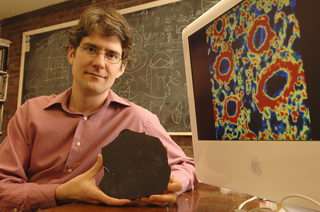
Scientists at the University of Chicago and the National Museum of Natural History in Washington, D.C., have produced new evidence to finally resolve the mysterious identity of what they regard as one of the weirdest organisms that ever lived.
Their chemical analysis indicates that the organism was a fungus, the scientists report in the May issue of the journal of Geology, published by the Geological Society of America. Called Prototaxites (pronounced pro-toe-tax-eye-tees), the organism went extinct approximately 350 million years ago.
Prototaxites has generated controversy for more than a century. Originally classified as a conifer, scientists later argued that it was instead a lichen, various types of algae or a fungus. Whatever it was, it stood in tree-like trunks more than 20 feet tall, making it the largest-known organism on land in its day.
"No matter what argument you put forth, people say, well, that’s crazy. That doesn’t make any sense," said C. Kevin Boyce, an Assistant Professor in Geophysical Sciences at Chicago. "A 20-foot-tall fungus doesn’t make any sense. Neither does a 20-foot-tall algae make any sense, but here’s the fossil."
The Geology paper adds a new line of evidence indicating that the organism is a fungus. The fungus classification first emerged in 1919, with Francis Hueber of the National Museum of Natural History in Washington, D.C., reviving the idea in 2001. His detailed studies of internal structure have provided the strongest anatomical evidence that Prototaxites is not a plant, but a fungus.
"Fran Hueber has contributed more to our understanding of Prototaxites than anyone else, living or dead," said Carol Hotton, also of the National Museum of Natural History. "He built up a convincing case based on the internal structure of the beast that it was a giant fungus, but agonized over the fact that he was never able to find a smoking gun in the form of reproductive structures that would convince the world that it was indeed a fungus," Hotton said.
Co-authoring the Geology paper with Boyce, Hotton and Hueber himself were Marilyn Fogel, George Cody and Robert Hazen of the Carnegie Institution of Washington, and Andrew Knoll of Harvard University. Their work was funded by NASA’s Astrobiology Institute and by the American Chemical Society Petroleum Fund.
Prototaxites lived worldwide from approximately 420 million to 350 million years ago. During this period, which spans part of the Silurian and Devonian periods of geologic time, terrestrial Earth looked quite alien in comparison to the modern world.
Simple vascular plants, the ancestors of the familiar conifers, ferns and flowering plants of today, began to diversify on land during the Devonian Period. "Initially, they’re just stems. They don’t have roots. They don’t have leaves. They don’t have anything like that," Boyce said.
Millipedes, wingless insects and worms were among the other organisms making a living on land by then, but no backboned animals had yet evolved out of the oceans. "That world was a very strange place," Boyce said.
Although vascular plants had established themselves on land 40 million years before the appearance of Prototaxites, the tallest among them stood no more than a couple feet high. By the end of the Devonian, approximately 345 million years ago, large trees, ferns, seeds, leaves and roots had all evolved. "They’re all there. They just exploded over this one time period," Boyce said.
Canadian paleontologist Charles Dawson published the first research on Prototaxites in 1859, based on specimens found along the shores of Gaspé Bay in Quebec, Canada. Hueber pored through Dawson’s field notebooks, written "in a completely illegible scrawl," Hotton said.
"Fran spent months deciphering them for clues about the localities where specimens had been collected, how Dawson interpreted them and other information that helped understand this humongous fungus," she said.
Hueber also traveled to Canada, Australia and Saudi Arabia to collect specimens. He tediously sliced them into hundreds of thin sections and made thousands of images taken through microscopes to determine the organism’s identity.
Now Boyce, Hotton and their colleagues have produced independent evidence that supports Hueber’s case. The team did so by analyzing two varieties—isotopes—of carbon contained in Prototaxites and the plants that lived in the same environment approximately 400 million years ago.
The metabolism of plants is limited by photosynthesis. Deriving their energy from the sun and their carbon from carbon dioxide in the air, any given type of plant will typically contain a similar ratio of carbon-12 to carbon-13 as another plant of the same type. "But if you’re an animal, you will look like whatever you eat," Boyce said. And Prototaxites displayed a much wider variation in its ratio of carbon-12 to carbon-13 content than would be expected in any plant.
Geological processes can alter the isotopic composition of fossils, but Boyce and his colleagues conducted tests to verify that the carbon isotopic composition of the specimens they analyzed stemmed from organic rather than geologic factors.
As for why these bizarre organisms grew so large, "I’ve wondered whether it enabled Prototaxites to distribute its spores widely, allowing it to occupy suitable marshy habitats that may have been patchily distributed on the landscape," Hotton said.
The relatively simple Devonian ecosystems certainly seemed to contain nothing to prevent them from growing slowly for a long time. Plant-eating animals had not yet evolved, Boyce said. But even if Prototaxites hadn’t been eaten by the dinosaurs and elephants that came much later, they probably grew too slowly to rebuild from regular disturbances of any kind, Boyce said.
"It’s hard to imagine these things surviving in the modern world," he said.
Source: University of Chicago


