Earth's First Rainforest Unearthed
April 23, 2007
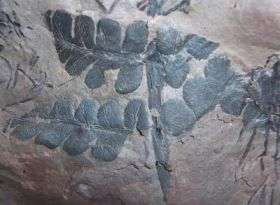
Detail of a Pteridosperm

Detail of a pteridosperm, an extinct seed-producing fern-like plant. Width across image about six centimeters. Credit: Dr. Howard Falcon-Lang

A spectacular fossilised forest has transformed our understanding of the ecology of the Earth’s first rainforests. It is 300 million years old.

The forest is composed of a bizarre mixture of extinct plants: abundant club mosses, more than 40 metres high, towering over a sub-canopy of tree ferns, intermixed with shrubs and tree-sized horsetails. Nowhere elsewhere on the planet is it possible to (literally) walk through such an extensive swathe of Carboniferous rainforest.

It was discovered by Dr Howard Falcon-Lang from the University of Bristol, UK, and US colleagues, in the underground workings of a coalmine, in Illinois, USA. The results of this work are published online today in Geology, by the Geological Society of America.

The fossilized forest was preserved following a major earthquake 300 million years ago. The quake caused the whole region to drop below sea level whereupon the forest became buried in mud, preserving it forever.

Dr Howard Falcon-Lang said: "It was an amazing experience. We drove down the mine in an armoured vehicle, until we were a hundred metres below the surface. The fossil forest was rooted on top of the coal seam, so where the coal had been mined away the fossilized forest was visible in the ceiling of the mine.

"We walked for miles and miles along pitch-black passages with the fossil forest just above our heads. We were able to make a map of the forest by the light of our miner’s lamps."

The fossil forest is the largest ever found, covering over 10,000 hectares, an area 10 km by 10 km (which would cover the city of Bristol, UK). The fossils preserve a unique snapshot of what tropical rainforests were like 300 million year ago.

Dr Falcon-Lang added: "As there is nothing like it around today, before our work we knew very little about the ecological preferences and community structure of these ancient plants. This spectacular discovery allows us to track how the species make-up of the forest changed across the landscape, and how that species make-up is effected by subtle differences in the local environment."

The study reconstructs a Carboniferous rainforest at the largest spatial scale ever attempted. The fossils show that the Earth's first rainforests were highly diverse and that the kinds of tree species changed across the ancient landscape. The forest dates from the Carboniferous period, 300 million years ago, when most of the world's coal resources were formed.

Source: University of Bristol

4.5 /5 (50 votes)  

Rank 4.5 /5 (50 votes)
Tags

Related Stories
Relevant PhysicsForums posts
  • Pertubance in a model
    created4 hours ago
  • Cancer drugs and Alzheimer's, Oh my!
    created12 hours ago
  • Squishing cells
    created13 hours ago
  • Any books/articles for evolutionary stable strategy models in humans?
    createdFeb 09, 2012
  • Science behind the bore feeling?
    createdFeb 09, 2012
  • Homo Sapien vs. Chimpanzee - Divergence Timeline
    createdFeb 09, 2012
  • More from Physics Forums - Biology

More news stories

Sonic Cradle lands spot in TED exhibition

A Simon Fraser University graduate student project that melds music, meditation and modern technology has landed a rare spot as an exhibit at TEDActive 2012 in Palm Springs, California this month.

Other Sciences / Other

created 34 minutes ago | popularity not rated yet | comments 0

A frank discussion of the power law and linking correlation to causation

(PhysOrg.com) -- Michael Stumpf a mathematics professor at Imperial College in London, and Mason Porter a lecturer at Oxford have teamed together to write and publish a perspective piece in Science regarding the in ...

Other Sciences / Mathematics

created 4 hours ago | popularity 5 / 5 (1) | comments 2 | with audio podcast report

The question of life in the ancient world

There’s a general feeling that we don’t get the Greeks – ancient or modern. Many, including heads of state like Angela Merkel, visibly shake their head in exasperation, rightly or wrongly, at ...

Other Sciences / Archaeology & Fossils

created 4 hours ago | popularity 1 / 5 (1) | comments 2

Chilean miners' rescue capsule on show in London

The capsule used to rescue Chilean miners trapped underground for two months goes on display Saturday at the Science Museum in London -- the first time it has been seen in Europe.

Other Sciences / Other

created 3 hours ago | popularity not rated yet | comments 0

US workers are 'giving away the store,' costing firms billions

Nearly 70 percent of the nation's service employees give away free goods and services – from hamburgers to cable TV – costing companies billions of dollars a year, according to a groundbreaking study.

Other Sciences / Economics & Business

created 22 hours ago | popularity 4.5 / 5 (2) | comments 9


New understanding of DNA repair could eventually lead to cancer therapy

A research group in the Faculty of Medicine & Dentistry at the University of Alberta is hoping its latest discovery could one day be used to develop new therapies that target certain types of cancers.

Zuckerberg's focus drives Facebook's ascent

When Mark Zuckerberg showed up to rent Judy Fusco's Los Altos, Calif., house in the fall of 2004, soon after he'd arrived in Silicon Valley, the landlord was immediately struck by his confidence.

Both maternal and paternal age linked to autism

Older maternal and paternal age are jointly associated with having a child with autism, according to a recently published study led by researchers at The University of Texas Health Science Center at Houston (UTHealth).

Night, weekend delivery OK for babies with birth defects

Weekday delivery is no better than night or weekend delivery for infants with birth defects, according to a new study presented today at The Pregnancy Meeting, the Society for Maternal-Fetal Medicine's annual conference. ...

Drug halts organ damage in inflammatory genetic disorder

A new study shows that Kineret (anakinra), a medication approved for the treatment of rheumatoid arthritis, is effective in stopping the progression of organ damage in people with neonatal-onset multisystem inflammatory disease ...

Cochlear implants may be safe, effective for organ transplant patients

Cochlear implants may be a safe, effective option for some organ transplant patients who've lost their hearing as an unfortunate consequence of their transplant-related drug regime, researchers report.