Study links faulty DNA repair to Huntington's disease onset
April 23, 2007
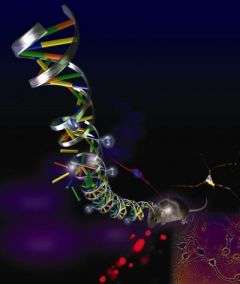
Artistic rendering of a broken DNA helix emanating from a mouse nerve cell. Researchers recently uncovered evidence that faulty DNA repair may be to blame for the onset of Huntington's disease symptoms. Credit: Cynthia McMurray
Huntington’s disease, an inherited neurodegenerative disorder that affects roughly 30,000 Americans, is incurable and fatal. But a new discovery about how cells repair their DNA points to a possible way to stop or slow the onset of the disease.
"As so often happens, basic research on a fundamental biological process—in this case, enzymes involved in DNA repair—leads to new insights about how diseases arise and new approaches for treating or preventing them," said NIH Director Elias A. Zerhouni, M.D.
The study was published April 22 as an Advanced Online Publication in Nature and led by Cynthia T. McMurray, Ph.D., a professor of pharmacology at the Mayo Clinic in Rochester, Minnesota.
Unlike most inherited diseases, Huntington’s disease symptoms usually don’t appear until middle age, leading scientists to wonder what triggers the disease onset and whether it can be halted—or at least slowed down.
People with the disease have a version of a gene called huntingtin that carries an extra segment with a particular sequence of repeated subunits. If the segment is too large, the gene produces a faulty protein that has a destructive effect in the brain.
"Huntington’s disease is a progressive disease, but nobody knows exactly why," said McMurray. "Our work supports the idea that the disease progresses when the extra segment expands over time in non-dividing cells such as nerve cells."
McMurray’s study shows that the inserted segment grows when cells try to remove oxidative lesions, which are caused by byproducts of the oxygen we breathe. DNA repair enzymes initially keep oxidative lesions in check, but over time, increasing numbers of lesions overwhelm the repair systems. Oxidative lesions also accumulate in people who do not have Huntington’s disease, but because their huntingtin gene lacks the extra segment it is not prone to expansion.
While scientists have long suspected that oxidative lesions play a role in Huntington’s disease, the specific role of the lesions has remained elusive until now.
"Nobody has connected the dots before," said McMurray.
To show that the extra segment enlarges with age, the researchers engineered mice to carry a version of the human huntingtin gene with an inserted segment—one large enough to cause Huntington’s disease in humans. After a few months—when the mice had aged—the scientists analyzed the gene and found that the segment had expanded. They also observed an increase in oxidative lesions in the mouse DNA.
To see if the oxidative lesions played a role in expansion of the extra DNA segment, the researchers next deleted OGG1, a key enzyme in oxidative lesion repair. Without OGG1, the bulk of the DNA’s oxidative lesions remained untouched, and the inserted segment did not grow at all or it grew far less than in mice carrying a working version of OGG1.
These findings show that while doing its part in removing oxidative lesions, OGG1 triggers a far more damaging effect—the DNA expansion associated with Huntington’s disease.
"The effect is much like what might happen if a technician came to repair a minor defect in your computer but was called away by a more urgent problem midway through the process. Now your computer is lying in pieces and you’re unable to use it," said McMurray.
The study suggests that OGG1 might offer a target for the development of new Huntington’s disease treatments. McMurray’s team is already pursuing this path and is screening for small molecules that block OGG1 function. This work may also be relevant to research on other diseases, such as Alzheimer’s and Parkinson’s, in which oxidative lesions are believed to play a role.
The research was funded by the National Institutes of Health (NIH).
Source: National Institute of General Medical Sciences
-
Corn gene helps fight Multiple Leaf Diseases
Feb 02, 2012 |
not rated yet |
0
-
Cocoa could prevent intestinal pathologies such as colon cancer
Jan 24, 2012 |
5 / 5 (3) |
0
-
Blueberries help fight artery hardening, lab animal study indicates
Sep 29, 2010 |
5 / 5 (1) |
0
-
Get the world on its feet: The role of exercise training
Aug 31, 2009 |
4 / 5 (1) |
2
-
Genetically engineered mice yield clues to 'knocking out' cancer
Jul 01, 2009 |
5 / 5 (1) |
1
-
Engineers build first sub-10-nm carbon nanotube transistor
Feb 01, 2012 |
4.9 / 5 (31) |
30
-
Something old, something new: Evolution and the structural divergence of duplicate genes
Jan 31, 2012 |
4.6 / 5 (7) |
1
-
The hidden nanoworld of ice crystals: Revealing the dynamic behavior of quasi-liquid layers
Jan 30, 2012 |
5 / 5 (3) |
1
-
Stock market network reveals investor clustering
Jan 27, 2012 |
3.9 / 5 (23) |
8
-
Of microchemistry and molecules: Electronic microfluidic device synthesizes biocompatible probes
Jan 26, 2012 |
5 / 5 (1) |
0
-
Is Everyday Technology Killing Us?
Feb 08, 2012
-
Exercise and weight loss
Feb 08, 2012
-
Why do we have head aches? Our brains can't feel anything.
Feb 07, 2012
-
"The end of diseases" by David Agus, interview from Daily Show with Jon Stewart
Feb 04, 2012
-
Oncolytic adenovirus
Feb 04, 2012
-
Nutrition label stuffs and diets
Feb 02, 2012
- More from Physics Forums - Medical Sciences
More news stories
Study finds that anti-diabetic medication can prevent the long-term effects of maternal obesity
In a study to be presented today at the Society for Maternal-Fetal Medicine's annual meeting, The Pregnancy Meeting, in Dallas, Texas, researchers will report findings that show that short therapy with the anti-diabetic medication ...
13 hours ago |
5 / 5 (1) |
1
Steroid injections prove effective in treatment of lumbar disc herniations
The use of epidural steroid injections may be a more efficient treatment option for lumbar disc herniations, according to research presented today at the American Orthopaedic Society for Sports Medicine's Specialty Day in ...
13 hours ago |
not rated yet |
0
Amateur football players not always keen on returning to play after ACL injuries
Despite the known success rates of reconstructive Anterior Cruciate Ligament (ACL) surgery, the number of high school and collegiate football players returning to play may not be as high as anticipated, say researchers presenting ...
13 hours ago |
not rated yet |
0
Study finds elevated levels of cell-free DNA in first trimester do not predict preeclampsia
In a study to be presented today at the Society for Maternal-Fetal Medicine's annual meeting, The Pregnancy Meeting, in Dallas, Texas, researchers will report findings that indicate that elevated levels of cell-free DNA in ...
13 hours ago |
not rated yet |
0
PRP treatment aids healing of elbow injuries say researchers
As elbow injuries continue to rise, especially in pitchers, procedures to help treat and get players back in the game quickly have been difficult to come by. However, a newer treatment called platelet rich plasma (PRP) may ...
13 hours ago |
5 / 5 (1) |
0
Walney offshore wind farm is world's biggest (for now)
(PhysOrg.com) -- The Walney wind farm on the Irish Sea--characterized by high tides, waves and windy weather--officially opened this week. The farm is treated in the press as a very big deal as the Walney ...
GPS court ruling leaves US phone tracking unclear
A US Supreme Court decision requiring a warrant to place a GPS device on the car of a criminal suspect leaves unresolved the bigger issue of police tracking using mobile phones, legal experts say.
Europeans protest controversial Internet pact
Tens of thousands of people marched in protests in more than a dozen European cities Saturday against a controversial anti-online piracy pact that critics say could curtail Internet freedom.
Europe stakes billion-dollar bet on new rocket
A pencil-slim rocket is scheduled to lift into space from South America on Monday, carrying a billion-dollar bet that Europe can grab a juicy slice of the market to place satellites in low orbit.
Netflix settlement trims 14 pct off 4Q earnings
(AP) -- Netflix pressed the rewind button on its fourth-quarter earnings after settling allegations that the video subscription service violated a consumer-privacy law.
Elbow position not a predictor of injury
Elbow position alone appeared to not affect injury rates and performance in college-level, male pitchers say researchers presenting at the American Orthopaedic Society for Sports Medicine's Specialty Day in San Francisco, ...