Hubble's 17th anniversary -- extreme star birth in the Carina Nebula
April 24, 2007
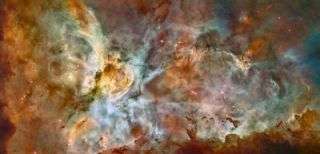
Hubble's view of the Carina Nebula shows star birth in a new level of detail. The fantasy-like landscape of the nebula is sculpted by the action of outflowing winds and scorching ultraviolet radiation from the monster stars that inhabit this inferno. In the process, these stars are shredding the surrounding material that is the last vestige of the giant cloud from which the stars were born. The immense nebula is an estimated 7,500 light-years away in the southern constellation Carina the Keel (of the old southern constellation Argo Navis, the ship of Jason and the Argonauts, from Greek mythology). This image is a mosaic of the Carina Nebula assembled from 48 frames taken with Hubble Space Telescope's Advanced Camera for Surveys. The Hubble images were taken in the light of neutral hydrogen. Color information was added with data taken at the Cerro Tololo Inter-American Observatory in Chile. Red corresponds to sulfur, green to hydrogen, and blue to oxygen emission. Credit: NASA, ESA, N. Smith (University of California, Berkeley), and The Hubble Heritage Team (STScI/AURA)
Hubble's new view of the Carina Nebula shows the process of star birth at a new level of detail. The bizarre landscape of the nebula is sculpted by the action of outflowing winds and scorching ultraviolet radiation from the monster stars that inhabit this inferno. These stars are shredding the surrounding material that is the last vestige of the giant cloud from which the stars were born.
This immense nebula contains a dozen or more brilliant stars that are estimated to be at least 50 to 100 times the mass of our Sun. The most opulent is the star eta Carinae, seen at far left. Eta Carinae is in the final stages of its brief eruptive lifespan, as shown by two billowing lobes of gas and dust that presage its upcoming explosion as a titanic supernova.
The fireworks in the Carina region started three million years ago when the nebula's first generation of newborn stars condensed and ignited in the middle of a huge cloud of cold molecular hydrogen. Radiation from these stars carved out an expanding bubble of hot gas. The island-like clumps of dark clouds scattered across the nebula are nodules of dust and gas that have so far resisted being eaten away by photoionisation.
The hurricane-strength blast of stellar winds and blistering ultraviolet radiation within the cavity is now compressing the surrounding walls of cold hydrogen. This is triggering a second stage of new star formation.
Our Sun and Solar System may have been born inside such a cosmic crucible 4.6 billion years ago. In looking at the Carina Nebula we are seeing star formation as it commonly occurs along the dense spiral arms of a galaxy.
This immense nebula is an estimated 7,500 light-years away in the southern constellation Carina, the Keel of the old southern constellation Argo Navis, the ship of Jason and the Argonauts from Greek mythology.
This image is an immense (29,566 x 14,321 pixels) mosaic of the Carina Nebula assembled from 48 frames taken with Hubble's Advanced Camera for Surveys. The Hubble images were taken in the light of neutral hydrogen. Colour information was added with data taken at the Cerro Tololo Inter-American Observatory in Chile. Red corresponds to sulphur, green to hydrogen, and blue to oxygen emission.
Source: Hubble Information Centre
-
VLT takes most detailed infrared image of the Carina Nebula
Feb 08, 2012 |
5 / 5 (6) |
3
-
A pocket of star formation
Feb 01, 2012 |
not rated yet |
0
-
The cool clouds of Carina
Nov 16, 2011 |
5 / 5 (1) |
2
-
Space image: Carina Nebula: 14,000+ Stars
Oct 17, 2011 |
4.3 / 5 (3) |
3
-
Nearby supernova factory ramps up
May 24, 2011 |
5 / 5 (4) |
1
-
Engineers build first sub-10-nm carbon nanotube transistor
Feb 01, 2012 |
4.9 / 5 (31) |
30
-
Something old, something new: Evolution and the structural divergence of duplicate genes
Jan 31, 2012 |
4.6 / 5 (7) |
1
-
The hidden nanoworld of ice crystals: Revealing the dynamic behavior of quasi-liquid layers
Jan 30, 2012 |
5 / 5 (3) |
1
-
Stock market network reveals investor clustering
Jan 27, 2012 |
3.9 / 5 (23) |
8
-
Of microchemistry and molecules: Electronic microfluidic device synthesizes biocompatible probes
Jan 26, 2012 |
5 / 5 (1) |
0
-
stationary or not?
4 hours ago
-
Scale of the Universe
Feb 10, 2012
-
Titan's lack of impact craters
Feb 09, 2012
-
Real pictures of black hole eating a star?
Feb 08, 2012
-
Hypothetical way to travel faster than light, but not technically exceed lightspeed
Feb 06, 2012
-
How do scientists monitor the Sun's activity?
Feb 05, 2012
- More from Physics Forums - General Astronomy
More news stories
Europe stakes billion-dollar bet on new rocket
A pencil-slim rocket is scheduled to lift into space from South America on Monday, carrying a billion-dollar bet that Europe can grab a juicy slice of the market to place satellites in low orbit.
Space & Earth / Space Exploration
11 hours ago |
3.5 / 5 (2) |
0
Political leaders play key role in how worried Americans are by climate change: study
More than extreme weather events and the work of scientists, it is national political leaders who influence how much Americans worry about the threat of climate change, new research finds.
Feb 06, 2012 |
5 / 5 (6) |
72
NASA budget will axe Mars deal with Europe: scientists
US President Barack Obama's budget proposal to be submitted next week for 2013 will cut NASA's budget by 20 percent and eliminate a major partnership with Europe on Mars exploration, scientists said Thursday.
Space & Earth / Space Exploration
Feb 10, 2012 |
5 / 5 (3) |
42
Humans may have helped the decline of African rainforests 3000 years ago
(PhysOrg.com) -- Large areas of rainforests in Central Africa mysteriously disappeared over three thousand years ago, to be replaced by savannas. The prevailing theory has been that the cause was a change ...
Could Venus be shifting gear?
(PhysOrg.com) -- ESAs Venus Express spacecraft has discovered that our cloud-covered neighbour spins a little slower than previously measured. Peering through the dense atmosphere in the infrared, the ...
Space & Earth / Space Exploration
Feb 10, 2012 |
5 / 5 (8) |
10
|
Walney offshore wind farm is world's biggest (for now)
(PhysOrg.com) -- The Walney wind farm on the Irish Sea--characterized by high tides, waves and windy weather--officially opened this week. The farm is treated in the press as a very big deal as the Walney ...
GPS court ruling leaves US phone tracking unclear
A US Supreme Court decision requiring a warrant to place a GPS device on the car of a criminal suspect leaves unresolved the bigger issue of police tracking using mobile phones, legal experts say.
Europeans protest controversial Internet pact
Tens of thousands of people marched in protests in more than a dozen European cities Saturday against a controversial anti-online piracy pact that critics say could curtail Internet freedom.
Study finds that anti-diabetic medication can prevent the long-term effects of maternal obesity
In a study to be presented today at the Society for Maternal-Fetal Medicine's annual meeting, The Pregnancy Meeting, in Dallas, Texas, researchers will report findings that show that short therapy with the anti-diabetic medication ...
Netflix settlement trims 14 pct off 4Q earnings
(AP) -- Netflix pressed the rewind button on its fourth-quarter earnings after settling allegations that the video subscription service violated a consumer-privacy law.
Steroid injections prove effective in treatment of lumbar disc herniations
The use of epidural steroid injections may be a more efficient treatment option for lumbar disc herniations, according to research presented today at the American Orthopaedic Society for Sports Medicine's Specialty Day in ...