Study of Planarians Offers Insight into Germ Cell Development
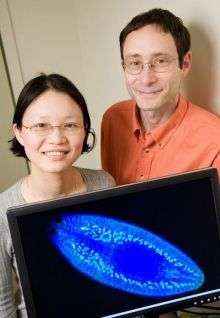
The planarian is not as well known as other, more widely used subjects of scientific study – model creatures such as the fruit fly, nematode or mouse. But University of Illinois cell and developmental biology professor Phillip Newmark thinks it should be. As it turns out, the tiny, seemingly cross-eyed flatworm is an ideal subject for the study of germ cells, precursors of eggs and sperm in all sexually reproducing species.
The planarian Newmark studies, Schmidtea mediterranea, is a tiny creature with a lot of interesting traits. Cut it in two (lengthwise or crosswise) and each piece will regenerate a new planarian, complete with brains, guts and – in most cases – gonads. Even when the planarian’s brain is severed from its body, it can regenerate all that is removed, including the reproductive organs.
In a new study published this month in the Proceedings of the National Academy of Sciences, Newmark and his colleagues at the U. of I. report that planarians share some important characteristics with mammals that may help scientists tease out the mechanisms by which germ cells are formed and maintained. Newmark’s team made a few discoveries related to a gene, called nanos, which was previously known to play a critical role in germ cell development in several other model organisms.
Unlike fruit flies and nematodes, which show signs of germ cell initiation in the earliest stages of their embryonic development, planarians do not generally express nanos or produce germ cells until several days after hatching. This delayed initiation of germ cell growth is called inductive specification, and is common to mammals and a number of other animals.
Graduate student Yuying Wang and the other team members were able to show that nanos is essential for inductive specification in planarians. Blocking nanos expression by means of RNA interference immediately after the planarians hatched prevented the emergence and development of germ cells. Blocking nanos in mature adults caused their ovaries and testes to disappear. And when the researchers blocked nanos expression in planarians that had had their bodies and reproductive organs detached from their brains, the planarians regenerated new bodies, but with no reproductive cells.
"This is the first time that nanos gene function has been studied in a non-traditional model organism," Newmark said. "This is important because planarians, like mammals, seem to make their germ cells by an inductive mechanism. So we’re hoping that we can use the molecular biological tools available for studying planarians to get at the mechanisms that tell a cell: ‘You’re going to be a germ cell.’ "
S. mediterranea also has the ability to reproduce asexually: It clones itself by means of fission. In looking at nanos in asexual individuals of this species, the researchers made the surprising discovery that these asexual individuals also express nanos and produce germ cells. Some other mechanism, as yet unknown, prevents these germ cells from developing into functional testes and ovaries.
"Having a simple organism that also uses inductive signaling is going to help us tease apart the more conserved mechanisms (of germ cell development and maintenance)," Newmark said. "We hope that this information will also prove informative for understanding these processes in higher organisms."
Source: University of Illinois at Urbana-Champaign


