April 24, 2007 feature
H2CAR could fuel entire U.S. transportation sector
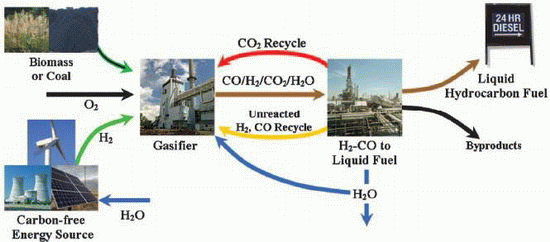
In a recent study, scientists have demonstrated that a hybrid system of hydrogen and carbon can produce a sufficient amount of liquid hydrocarbon fuels to power the entire U.S. transportation sector. Using biomass to produce the carbon, and solar energy to produce hydrogen, the process requires only a fraction of the land area needed by other proposed methods.
According to Purdue University scientists Rakesh Agrawal, Navneet Singh, Fabio Ribeiro, and Nicholas Delgass, this appealing scenario is well within reach of current or near-future technology.
“Enough technology exists to build the main concept of this process today,” Agrawal told PhysOrg.com. “H2CAR could also endure sustainably for thousands of years. [We hope that] this process will lead to the birth of a new economy, a ‘hybrid hydrogen-carbon economy.’”
The hybrid hydrogen-carbon (H2CAR) process takes advantage of the energy density of liquid hydrocarbons (currently provided from oil), but it uses a sustainable and environmentally-friendly method. Because the fuel is essentially the same, though, the H2CAR process could conveniently merge into the existing infrastructure and bypass delivery problems associated with other alternative energy carriers.
In their paper published in PNAS, Agrawal et al. analyzed and compared different variations of the H2CAR process. They found that an optimal method would use biomass (such as switchgrass or corn) to provide the carbon. The main source of energy driving the process would come from hydrogen. The hydrogen could be generated from solar energy or another carbon-free energy source, such as nuclear or wind power.
“Conventional processes treat biomass as a source of carbon atoms as well as a source of energy,” Agrawal explained. “This leads to the formation of a large amount of CO2 during the conversion process. The significance of the H2CAR process, on the other hand, lies in the fact that we are treating carbon in biomass or coal as primarily a source of carbon atoms and not a source of energy. This preserves all the carbon in the biomass and converts it to liquid fuel.”
The scientists explain how the gasification and liquid conversion processes work: In a conventional process biomass, O2 and steam are fed together to a gasifier, where they are transformed to gaseous products—primarily CO, CO2 and H2—through a gasification and combustion process. In this gasification gives CO plus H2 and a huge amount of CO2.
The next step is to transform the gas to a liquid fuel in a Fischer-Tropsch process, where an additional quantity of CO2 is produced. Usually, this large quantity of CO2 formed is released in the atmosphere and requires large amounts of land for the biomass-to-liquid process.
“The H2CAR method has a solution to these problems,” Agrawal explained. “H2 from a carbon-free energy source, along with CO2 from the gas to liquid conversion step, is co-fed to the gasifier. The presence of excess H2 in the gasifier not only suppresses formation of CO2 but also reacts with some of the recycled CO2. The same happens with CO and H2, which are unreacted in a ‘gas to liquid fuel process’ and also recycled. As a result, we don't lose any carbon atoms as CO2, a greenhouse gas, from the H2CAR.”
One concern about the use of biomass to produce fuel is the estimated amount of land area: in conventional methods, biomass would require 25-58% of the total U.S. land area to provide fuel for the country. Based on the current scenario of growth rates and gasifier efficiencies, the scientists estimate the H2CAR process to require about 15% of the land—and with reasonable future projections, just 6%. Significantly, this scenario would avoid the land competition with food growth.
This study comes nearly on the heels of the 2005 “Billion Ton Biomass Study,” which estimated that the current amount of recoverable biomass could meet just 30% of the U.S. transportation needs. But because the H2CAR process supplements biomass with hydrogen, the same amount of biomass could provide liquid fuels for nearly 100% of U.S. transportation needs, according to Agrawal et al.’s estimates.
“The reason for significant decrease in land area requirement for the H2CAR process as compared to conventional processes is that hydrogen production from solar energy is an order of magnitude more efficient than biomass growth, which typically grows with an average energy efficiency of less than 1%,” Agrawal explained. “This decreases the land area required to produce same quantity of liquid fuel by a factor of nearly one-third.”
As the scientists conclude, H2CAR solves many problems simultaneously.
“One is that it eliminates the need for CO2 sequestration from the chemical processing system,” Agrawal said. “The second is that it solves the grand challenge associated with hydrogen storage problem by storing the carbon-free hydrogen at a much higher storage density than currently known methods available. The third advantage is it needs nearly one-third biomass and, hence, land area to produce the same quantity of liquid fuel.”
As amazing as that sounds, the scientists also suggest that, when combined with other technologies such as plug-in hybrid electric vehicles—which can run short distances on electricity and solar cells—the H2CAR process would provide the greatest value. Liquid fuels would only need to provide for less than half of the total driving distance in the U.S., bringing up the possibility that excess biomass could be used for residential and commercial power. The scientists also point out that, in this scenario, the U.S. could even become an exporter of oil.
“The question that remains is of economics and not feasibility,” said Agrawal. “We are currently looking into the economics of the process. Major obstacles are attracting funding for research because gasification routes are generally capital intensive. Other obstacles include decreasing the price of hydrogen available from renewable sources such as solar, etc.” Another of Agrawal’s research areas is on making cost-effective solar cells.
Citation: Agrawal, Rakesh, Singh, Navneet R., Ribeiro, Fabio H., and Delgass, W. Nicholas. “Sustainable fuel for the transportation sector.” Proceedings of the National Academy of Sciences. March 20, 2007, vol. 104, no. 12, 4828-2833.
Free access to the article is available at www.pnas.org/cgi/content/full/104/12/4828 .
Copyright 2007 PhysOrg.com.
All rights reserved. This material may not be published, broadcast, rewritten or redistributed in whole or part without the express written permission of PhysOrg.com.


