Study shows hibernating bears conserve more muscle strength than humans on bed rest do
April 24, 2007 Ursus arctos

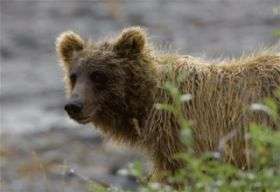
North American grizzly bear (Ursus arctos) in Denali National Park, Alaska. Credit: Photograph by Mark Chappell

A fascinating new study from the May/June 2007 issue of Physiological and Biochemical Zoology quantifiably measures the loss of strength and endurance in black bears during long periods of hibernation. T.D. Lohuis (Alaska Department of Fish and Game) and his coauthors find that black bears in hibernation lose about one-half as much skeletal muscle strength as humans confined to bed rest for similar periods of time do.

"Fasting, unweighting, or immobility results in compromised muscle function," explain the authors. They continue, "Because bears are confined and anorexic for several months during winter but can still retain muscle protein and display sustained activity if disturbed, we measured skeletal muscle strength, fatigue resistance, and in vivo contractile properties of intact muscles in bears within their natural dens."

Adapting a system used for the evaluation of neuromuscular disease progression in humans, the researchers tested black bears from Middle Park, Colorado, both early and late in the hibernation cycle. After sampling, bears were placed back in their den, and the entrance was covered with pine boughs and snow.

The researchers found that after 110 days of anorexia and confinement in the den, bears lost about 29% of their muscle strength. In comparison, humans on a balanced diet but confined to bed for 90 days have been reported to lose 54% of their strength. Other studies have shown that human astronauts in a weightless environment lose 9%–11% of their strength during a 17-day spaceflight.

Black bears also sustained only a moderate loss of fatigue resistance, the researchers found: "After 110 days of fasting and limited mobility imposed by denning, bears still exhibited a fatigue profile similar to that of healthy, active, fed humans."

In contrast to other, smaller hibernating mammals such as prairie dogs and squirrels, black bears also conserved muscle protein and size. The researchers found no loss in the fiber cross-sectional area of the bears’ thighs or calves, a drop of only about 10% in the protein content of the thighs, and no reduction in protein content in the calves or quadriceps of the bears.

"Bears in this study exhibited remarkable conservation of muscle function," write the authors. "In spite of a size difference of almost three orders of magnitude and a 30 degree Celsius difference in torpor body temperature, the black bear may conserve muscle function to the extent of or perhaps better than small-mammal hibernators."

Source: University of Chicago


print this article email this article download pdf blog this article bookmark this article     Stumble it Digg this share on Facebook retweet share on Reddit add to delicious
Rate this story - 5 /5 (1 vote)


April 24, 2007 all stories

Comments: 0

5 /5 (1 vote)
  • Stumble this up

  • Digg this

  • share this

  • hide
  • Related Stories

  • Physical therapists test mechanical arm to help patients recover from stroke, traumatic brain injury
    created Jan 28, 2009 | popularity not rated yet | comments 0
  • Floundering El Ninos Make for Fickle Forecasts
    created Sep 29, 2009 | popularity not rated yet | comments 0
  • Dynamic changes in DNA linked to human diabetes
    created Sep 01, 2009 | popularity not rated yet | comments 0
  • New tracking approach will help protect polar bears
    created Jun 18, 2009 | popularity not rated yet | comments 0
  • Muscle atrophy through thick but not thin
    created Jun 08, 2009 | popularity not rated yet | comments 0


Other News

neuron

To make memories, new neurons must erase older ones

Biology / Cell & Microbiology

created 11 hours ago | popularity 4 / 5 (4) | comments 0

Short-term memory may depend in a surprising way on the ability of newly formed neurons to erase older connections. That's the conclusion of a report in the November 13th issue of the journal Cell that provid ...


New study describes connections between Circadian and metabolic systems

Biology / Other

created 7 hours ago | popularity 1 / 5 (1) | comments 0

A paper by University of Notre Dame biologist Giles Duffield and a team of researchers offers new insights into a gene that plays a key role in modulating the body's Circadian system and may also simultaneously modulate its ...


New explanation for nature's hardiest life form

Biology / Cell & Microbiology

created 14 hours ago | popularity 4.3 / 5 (3) | comments 0

Got food poisoning? The cause might be bacterial spores, en extremely hardy survival form of bacteria, a nightmare for health care and the food industry and an enigma for scientists. Spore-forming bacteria, present almost ...


With Help from a Bacterium, Cockroaches Develop Way to Store Excess Uric Acid

With Help from a Bacterium, Cockroaches Develop Way to Store Excess Uric Acid

Biology / Plants & Animals

created 9 hours ago | popularity 5 / 5 (2) | comments 0

(PhysOrg.com) -- What life form can use materials as nutrients that we, and most other animals, would consider waste products?


Longer toes eyed as sprinters' edge

Biology / Other

created 10 hours ago | popularity 4.5 / 5 (2) | comments 0

(PhysOrg.com) -- Longer toes may give sprinters a leg up on other runners, according to a new study.