Water flows like molasses on the nanoscale
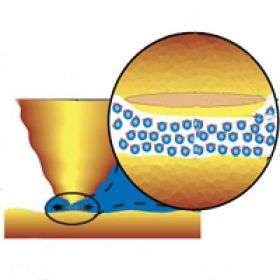
A Georgia Tech research team has discovered that water exhibits very different properties when it is confined to channels less than two nanometers wide – behaving much like a viscous fluid with a viscosity approaching that of molasses. Determining the properties of water on the nanoscale may prove important for biological and pharmaceutical research as well as nanotechnology. The research appears in the March 15 issue of the journal Physical Review B.
In its bulk liquid form, water is a disordered medium that flows very readily. When most substances are compressed into a solid, their density increases. But water is different; when it becomes ice, it becomes less dense. For this reason, many scientists reasoned that when water is compressed (as it is in a nanometer-sized channel), it should maintain its liquid properties and shouldn't exhibit properties that are akin to a solid. Several earlier studies came to that very conclusion – that water confined in a nano-space behaves just like water does in the macro world. Consequently, a number of scientists considered the case to be closed.
But when Georgia Tech experimental physicist Elisa Riedo and her team directly measured the force of pure water in a nanometer-sized channel, they found evidence suggesting that water was organized into layers. Riedo conducted these measurements by recording the force placed on a silicon tip of an atomic force microscope as it compressed water. The water was confined in a nanoscale thin film on top of a solid surface.
"Since water usually has a low viscosity, the force you would expect to feel as you compress it should be very small," said Riedo, assistant professor in Georgia Tech's School of Physics. "But when we did the experiment, we found that when the distance between the tip and the surface is about one nanometer, we feel a repulsive force by the water that is much stronger than what we would expect."
As the tip compresses the water even more, the repulsive force oscillates, indicating that the water molecules are forming layers. As the tip continues to increase its pressure on a layer, the layer collapses and the water flows out horizontally.
"In effect, the confined water film behaves effectively like a solid in the vertical direction by forming layers parallel to the confining tip and surface, while maintaining it's liquidity in the horizontal direction where it can flow out – resembling some phases of liquid crystals," said Uzi Landman, director of the Center for Computational Materials Science, Regents' and Institute professor, and Callaway Chair of Physics at Georgia Tech.
A theoretical physicist, Landman conducted the first-ever computer simulations of these forces for tip-confined water films and found good correspondence between his team's theoretical predictions and the experiments.
So why did Riedo and Landman's results differ from their peers? According to Landman, most previous studies on confined water were limited by technology at the time and could not directly measure the behavior in the last two nanometers. Instead they had to measure other properties and infer the forces acting in films of one nanometer thickness or less.
"If you want force, it is preferable to measure it," he said. "This is the first experiment to directly measure the force and it's the first simulation done of these forces. The fact that we have direct measurements married with theoretical results is rather conclusive."
Riedo and Landman conducted their experiments in several different environments. They found that the layering effect was more pronounced when water was placed on top of hydrophilic surfaces that allow water to wet the solid surface, such as glass. When the water was confined by hydrophobic surfaces where water tends to bead up, like graphite, the effect was still present, but less pronounced.
At the same time, Riedo's team was measuring the vertical force exerted on the tip by the confined water film, they also measured the film viscosity by measuring the lateral force. They found that when water was placed on a hydrophilic surface, the viscosity began to increase dramatically as the thickness of the confined film reached the 1.5 nanometer range. As they continued to compress the water and measure the lateral forces, the viscosity increased by a factor of 1,000 to 10,000.
On hydrophobic surfaces, they did not see such an increase in viscosity. The results of the molecular dynamics simulations support these findings, showing a dramatically decreased mobility for sub-nanometer thick water films under hydrophilic confinement.
"Water is a wonderful lubricant," said Riedo, "but it flows too easily for many applications. At the one nanometer scale, water is a viscous fluid and could be a much better lubricant."
Understanding the properties of water at this scale could also be important for biological and pharmaceutical research, especially in understanding processes that depend on hydrated ionic transport through nanoscale channels and pores.
Riedo and Landman's next steps are to introduce impurities in the water to study how that affects its properties.
Source: Georgia Institute of Technology


