Satellites play vital role in understanding the carbon cycle
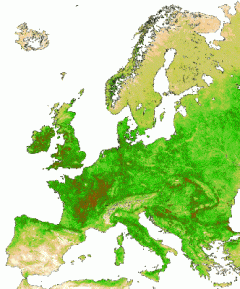
The global carbon cycle plays a vital role in climate change and is of intense importance to policy makers, but significant knowledge gaps remain in our understanding of it. Several scientists at the Envisat Symposium this week have highlighted research projects using ESA satellites to understand better this complex process.
The total number of carbon atoms on Earth is fixed – they are exchanged between the ocean, atmosphere, land and biosphere. The fact that human activities are pumping extra carbon dioxide into the atmosphere, by fossil fuel burning and deforestation, is well known. Because of this, atmospheric carbon dioxide concentrations are higher today than they have been over the last half-million years or so. Scientists are now using satellite instruments to locate sinks and sources of CO2 in the ocean and land.
Across land and sea, our world's plant life uses the process called photosynthesis to convert incoming sunlight into chemical energy. Plants accumulate carbon dioxide during photosynthesis and store it in their tissues, making them carbon sinks.
Dr Nadine Gobron of the European Commission's Joint Research Centre (EC-JRC) in Ispra, Italy, is combining daily multispectral observations from Envisat's Medium Resolution Imaging Spectrometer (MERIS) instrument with a sophisticated processing algorithm to reveal global photosynthesis activity on land.
The fraction of incoming solar radiation useful for photosynthesis that is actually absorbed by vegetation – a value known as the Fraction of Absorbed Photosynthetically Active Radiation (FAPAR) – is recognised as an essential climate variable by international organisations including the Global Climate Observing System (GCOS). FAPAR is regularly used in diagnostic and predictive models to compute the primary productivity of the vegetation canopies.
The operational FAPAR MERIS product is derived with the JRC-FAPAR algorithm, which has been designed to exploit the daily MERIS spectral measurements in the blue, red and near-infrared bands with no prior knowledge on the land cover.
This methodology involves a physically-based approach which can be adopted for generating this biophysical product from various optical medium resolution sensors. The algorithm used allows scientists to derive the equivalent biophysical product from other optical satellite sensors, even retired ones, to ensure the availability of a long-time series of global FAPAR, which is essential to assess environmental trends, guide policy making and support sustainable development activities.
"Demonstration products at the global scale are now available and are ready to be used in state-of-the-art carbon data assimilation systems (CCDAS) for better understanding the role of the biosphere in the global carbon cycle," Gobron said.
Phytoplankton, microscopic marine plants that drift on or near the surface of the sea, absorb atmospheric carbon dioxide through photosynthesis just as their terrestrial ‘cousins’ do. While individually microscopic, phytoplankton chlorophyll collectively tints the surrounding ocean waters, providing a means of detecting these tiny organisms from space with dedicated ocean colour sensors, such as MERIS.
Dr Michael Buchwitz from the Institute of Environmental Physics (IUP) at the University of Bremen in Germany presented global carbon dioxide measurements based on observations from Envisat’s SCIAMACHY instrument from 2003 to 2005.
The SCIAMACHY (Scanning Imaging Absorption Spectrometer for Atmospheric Chartography) instrument is the first space sensor capable of measuring the most important greenhouse gases with high sensitivity down to the Earth’s surface because it observes the spectrum of sunlight shining through the atmosphere in ‘nadir’ looking operations on a global scale.
Buchwitz explained that he and his colleagues first measure the absolute carbon dioxide (CO2) column in number of CO2 molecules per area above the Earth’s surface. Then, they measure the oxygen (O2) column that can be easily converted into an ‘air column’.
As seen in the image above, both figures are essentially identical, as he had expected.
"There are, however, tiny differences and this is the CO2 source/sink information we are interested in," Buchwitz said. "To see this we compute the CO2/O2 ratio which can be converted into a column averaged CO2 mixing ratio."
Dr Paul Monks from the University of Leicester is using SCIAMACHY data to measure how much CO2 is being taken up by plants. Using 20,000 individual measurements a month, he is monitoring CO2 drawn down over Siberia, North America and Northern Europe.
According to Monks, this view from space is providing the first evidence of the Earth ‘breathing’ by allowing scientists to witness the biology drawing down CO2 during the growing season and then releasing some of it back.
"The exciting new area breaking from this sort of data is that we begin to be able to look at the tropics, which are the ‘lungs’ of the atmospheric system," Monks said. "Using this data, we are going to be able to assess how efficient the tropics are at modulating carbon as well as how that is changing with time as climate change effects the tropical biosystem."
By comparing the satellite data to aircraft data and to remote-sensing sites on the surface, Monks learned the method he and his colleagues are using is approaching a precision of around 1%, giving them confidence in what they see from space.
By better understanding all of the parameters involved in the carbon cycle, scientists can better predict climate change as well as better monitor international treaties aimed at reducing greenhouse gas emissions, such as the Kyoto Protocol which addresses the reduction of six greenhouse gases including carbon dioxide.
Source: European Space Agency


