Scientists Unveil Internet-Controlled Robots That Anyone Can Build
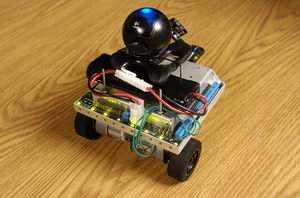
Carnegie Mellon University researchers have developed a new series of robots that are simple enough for almost anyone to build with off-the-shelf parts, but are sophisticated machines that wirelessly connect to the Internet.
The robots can take many forms, from a three-wheeled model with a mounted camera to a flower loaded with infrared sensors. They can be easily customized and their ability to wirelessly link to the Internet allows users to control and monitor their robots’ actions from any Internet-connected computer in the world.
The new tools that make this possible are a single piece of hardware and a set of "recipes" that people follow to build their ’bots. Both are part of the Telepresence Robot Kit (TeRK) developed by Associate Professor of Robotics Illah Nourbakhsh and members of his Community Robotics, Education and Technology Empowerment (CREATE) Lab. Their goal is to make highly capable robots accessible and affordable for college and pre-college students, as well as anyone interested in robots.
Unlike other educational robot kits on the market, TeRK is not sold as a complete set of parts. The CREATE Lab’s recipes allow for a variety of robots to be built with parts commonly available through hardware and hobbyist outlets.
At the heart of each TeRK robot is a unique controller called Qwerk that combines a computer with the software and electronics necessary to control the robot’s motors, cameras and other devices. Qwerk, developed by the CREATE Lab and Charmed Labs of Austin, Texas, also connects the robot automatically and wirelessly to the Internet so it can be controlled by any Internet-connected computer.
"The Internet connection means the robots are much more global," Nourbakhsh said. Not only can the robot be operated remotely at any location with a wireless Internet connection, but it can also send photos or video, respond to RSS feeds, or access the Internet to find information. That combination opens a wide range of possibilities. "We’re hoping people notice that the sky’s the limit," he added.
Among the TeRK recipes already available is a small, wheeled robot with a video camera that people might use to keep an eye on their home or pet while they are at work or school. Another recipe under development includes environmental sensors for air quality and sound pollution. A less conventional recipe will produce a robotic, six-petaled flower that can open and close based on moods or use its petals to play a game of catch.
"We want robots that don’t just subscribe to geeky notions of what robots should be," Nourbakhsh said. One recipe under development, for instance, can control a stuffed teddy bear.
"Once people have followed a recipe and become acquainted with robots, they can build on their experience," said Emily Hamner, a senior research associate in the CREATE Lab. "Not only can they customize the recipes to their liking, they can also design new robot types using the Qwerk controller."
Qwerk itself is a full-fledged computer with a Linux operating system that can use any computer language. It features a field programmable gate array (FPGA) to control motors, servos, cameras, amplifiers and other devices. It also accepts USB peripheral devices, such as Web cameras and GPS receivers. "We leveraged several low-cost, yet high-performance components that were originally developed for the consumer electronics industry when we designed Qwerk," said Rich LeGrand, president of Charmed Labs. "The result is a cost-effective robot controller with impressive capabilities."
Building such a capable robot only five years ago would have been all but impossible, Nourbakhsh said. Using the Internet to provide telepresence on a routine basis, he explained, is practical today because of widespread broadband Internet access and the ubiquity of wireless hotspots in both public and residential settings.
Recipes, software, technical support and other information are available free at the TeRK Web site, www.terk.ri.cmu.edu . The Qwerk controller is available for sale from Charmed Labs, www.charmedlabs.com/ .
Source: Carnegie Mellon University


