A Massive Explosion on the Sun
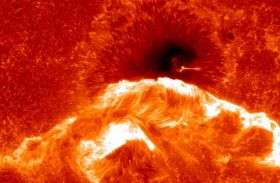
Astronomers are calling the Japanese Hinode spacecraft a "Hubble for the sun." Watch this movie and you'll see why.
The footage, gathered by Hinode's Solar Optical Telescope (SOT) on Dec. 13, 2006, shows sunspot 930 unleashing a powerful X-class solar flare. It's one of the most detailed movies of a flare solar physicists have ever seen. The SOT has a resolution of 0.2 arcseconds or 0.00006 degrees. Putting those numbers into perspective, the telescope can see features on the sun as small as 90 miles wide from its orbit 93 million miles away.
But resolution is only part of the story. What makes Hinode truly special as a solar telescope "is its unique ability to see the sun's magnetic field," says John Davis, NASA's project scientist for Hinode at the Marshall Space Flight Center. It's an ability Hinode used to reveal the magnetic underpinnings of the Dec. 13th flare.
"Solar flares are essentially magnetic," Davis explains. In the maelstrom above a sunspot, lines of magnetic force are twisted and stretched until the tension reaches a certain point—and then the whole thing explodes.
A rubber band provides a good analogy. Take one from your desk, hold one end in each hand: stretch and twist. If you twist, twist and twist to extremes, the tormented band will eventually snap, painfully releasing all the energy you just put into it.
Magnetic fields behave a lot like rubber bands, and "Hinode was able to see the twisting and stretching that preceded the Dec. 13th solar flare," he says.
Regard the animation at right. It looks like a rampaging hurricane--about twice as wide as Earth! In fact, it is a magnetic map of the flare zone on the southern flanks of sunspot 930. Red arrows indicate the direction of the sunspot's magnetic field. White areas have positive polarity (N); black areas are negative (S). The movie begins on Dec. 10th, three days before the flare, and ends on Dec. 14th, one day after the flare.
"These data were recorded by Hinode's spectro-polarimeter, a device which can sense magnetic fields by analyzing the polarization of light coming from iron ions in the sun's atmosphere," explains Davis.
The hurricane, he says, is actually a giant tube of magnetic flux emerging from beneath the sun's surface. As it spins, lines of magnetic force become twisted and stretched, while N and S polarities are shoved together in close proximity. "This causes a build-up of tension and energy in the magnetic field."
On Dec. 13, 2006, at precisely 0234 UT, the energy was released in the form of an X3-category solar flare. The explosion hurled a coronal mass ejection (CME: a billion-ton cloud of gas) into space, which sparked Northern Lights as far south as Arizona when it hit Earth a day later. Shock waves in the CME accelerated heavy ions to near-light speed, and these ions coursed around the Earth and Moon for more than a day. This is called a "radiation storm." If astronauts had been on the Moon at the time, they may have been forced to stay indoors—inside their spaceships or habitats—to avoid exposure.
Astronomers have been struggling to predict solar flares since flares were discovered in 1859 by Lord R.C. Carrington and R. Hodgson. But they have been stymied, in part, by the difficulties of mapping the sun's magnetic field. Magnetograms on Earth must look through our planet's turbulent atmosphere, which blurs the little red arrows we see so clearly in the Hinode movie. Hinode's ability to examine magnetic fields from Earth orbit is a new and crucial development.
"The kind of data we're getting from Hinode is just what we need to sort out how flares work," says Davis. "All we need now is some more explosions."
Hinode is a joint mission of the Japan Aerospace Exploration Agency (JAXA), the National Astronomical Observatory of Japan (NAOJ), the National Aeronautics and Space Administration (NASA) and the Particle Physics and Astronomy Research Council (PPARC). The Marshall Space Flight Center managed the NASA instrument component integration for NASA Headquarters, is managing the science operations for NASA and is also supporting science operations in Japan.
Source: by Dr. Tony Phillips, Science@NASA


