NASA's AIM Cloud Mission Launches
April 26, 2007
NASA's AIM Cloud Mission Launches

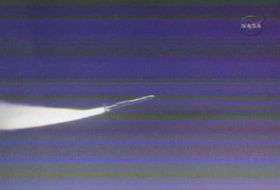
The Pegasus rocket ignites to launch the AIM spacecraft into orbit. Photo credit: NASA

NASA's AIM spacecraft began its two-year mission April 25, 2007 after a flawless ride to Earth orbit aboard an Orbital Sciences Pegasus XL rocket. Launch took place at 1:26 PDT. Launch operations at Vandenberg Air Force Base in California ran smoothly, with no technical or weather issues causing concern.

The AIM mission is the first dedicated to exploring mysterious ice clouds that dot the edge of space in Earth's polar regions. These clouds have grown brighter and more prevalent in recent years and some scientists suggest that changes in these clouds may be the result of climate change.

"The successful AIM launch initiates an exciting new era in understanding how noctilucent clouds form and why they vary," said Principal Investigator James M. Russell, III, of Hampton University in Hampton, Va. "The coordinated AIM measurements will provide the first focused and comprehensive data set needed to unravel the mysteries of these clouds."

Noctilucent clouds are increasing in number, becoming brighter and are occurring at lower latitudes than ever before. "Such variations suggest a connection with global change," said Russell. "If true, it means that human influences are affecting the entire atmosphere, not just the region near the Earth's surface."

The Stargazer L-1011 aircraft released a Pegasus XL rocket at a drop point over the Pacific Ocean, 100 miles offshore west-southwest of Point Sur, Calif. AIM was launched at an azimuth of 192.5 degrees into a circular polar orbit of 375 miles with an inclination of 97.7 degrees.

At approximately 1:36 p.m., communications from a Tracking Data and Relay Satellite confirmed spacecraft separation, and the solar arrays deployed autonomously soon thereafter.

The spacecraft was declared operating nominally at approximately 2:44 p.m., when it passed over the Svalbard, Norway, ground station. Spacecraft bus commissioning activities will be performed during the next six days while controllers verify satisfactory performance of all spacecraft subsystems.

Throughout a 30-day check-out period, all the spacecraft subsystems and instruments will be evaluated and compared to their performance during ground testing to ensure satisfactory operation in the space environment. The instruments will maintain their protective covers to shield the near pristine optical surfaces from contamination while the spacecraft outgases volatile materials. Fourteen days after launch, the optical covers will be removed in sequence by ground commands, and the instruments will begin scientific operations.

During the next two years, AIM scientists will methodically address each of six fundamental objectives that will provide critical information needed to understand cloud formation and behavior.

"This mission has many firsts, including that Hampton University is the first historically black college and university to have the principle investigator and total mission responsibility for a NASA satellite mission," said Program Executive Victoria Elsbernd, NASA Headquarters, Washington.

NASA's Kennedy Space Center, Fla., is responsible for launch vehicle/spacecraft integration and launch countdown management. NASA's Goddard Space Flight Center, Greenbelt, Md., is responsible for the overall AIM mission management in collaboration with Hampton University, the University of Colorado, Boulder, and Virginia Polytechnic Institute and State University, Blacksburg. Orbital Sciences Corporation, Dulles, Va., is responsible for providing the Pegasus XL launch service to NASA.

AIM is the ninth small-class mission under NASA's Explorer Program, which provides frequent flight opportunities for world-class scientific investigations from space within the heliophysics and astrophysics science areas.

Source: NASA


Rank 5 /5 (1 vote)
Tags

Related Stories
Relevant PhysicsForums posts
  • Never ending outer space.....
    created7 hours ago
  • Neutron Star fragments?
    created9 hours ago
  • stationary or not?
    created13 hours ago
  • Scale of the Universe
    createdFeb 10, 2012
  • Titan's lack of impact craters
    createdFeb 09, 2012
  • Real pictures of black hole eating a star?
    createdFeb 08, 2012
  • More from Physics Forums - General Astronomy

More news stories

Latin America mining boom clashes with conservation

Latin America is experiencing a mining boom as prices rise fuelled by a hike in global demand, but the region is also being hit by a wave of violent protests, strikes and rallies by environmentalists.

Space & Earth / Environment

created 35 minutes ago | popularity not rated yet | comments 0

Europe stakes billion-dollar bet on new rocket

A pencil-slim rocket is scheduled to lift into space from South America on Monday, carrying a billion-dollar bet that Europe can grab a juicy slice of the market to place satellites in low orbit.

Space & Earth / Space Exploration

created 20 hours ago | popularity 4 / 5 (3) | comments 0

Political leaders play key role in how worried Americans are by climate change: study

More than extreme weather events and the work of scientists, it is national political leaders who influence how much Americans worry about the threat of climate change, new research finds.

Space & Earth / Environment

created Feb 06, 2012 | popularity 5 / 5 (6) | comments 72

NASA budget will axe Mars deal with Europe: scientists

US President Barack Obama's budget proposal to be submitted next week for 2013 will cut NASA's budget by 20 percent and eliminate a major partnership with Europe on Mars exploration, scientists said Thursday.

Space & Earth / Space Exploration

created Feb 10, 2012 | popularity 5 / 5 (3) | comments 48

Humans may have helped the decline of African rainforests 3000 years ago

(PhysOrg.com) -- Large areas of rainforests in Central Africa mysteriously disappeared over three thousand years ago, to be replaced by savannas. The prevailing theory has been that the cause was a change ...

Space & Earth / Environment

created Feb 10, 2012 | popularity 4.1 / 5 (14) | comments 20 | with audio podcast report


Love a click away in Indonesia's Twitter Republic

He was a geeky kid from Yogyakarta, she a glamorous city girl in Jakarta. In a country with one of the world's most vibrant social networking scenes they fell in love on Twitter.

Walney offshore wind farm is world's biggest (for now)

(PhysOrg.com) -- The Walney wind farm on the Irish Sea--characterized by high tides, waves and windy weather--officially opened this week. The farm is treated in the press as a very big deal as the Walney ...

GPS court ruling leaves US phone tracking unclear

A US Supreme Court decision requiring a warrant to place a GPS device on the car of a criminal suspect leaves unresolved the bigger issue of police tracking using mobile phones, legal experts say.

Europeans protest controversial Internet pact

Tens of thousands of people marched in protests in more than a dozen European cities Saturday against a controversial anti-online piracy pact that critics say could curtail Internet freedom.

Study finds that anti-diabetic medication can prevent the long-term effects of maternal obesity

In a study to be presented today at the Society for Maternal-Fetal Medicine's annual meeting, The Pregnancy Meeting, in Dallas, Texas, researchers will report findings that show that short therapy with the anti-diabetic medication ...

Netflix settlement trims 14 pct off 4Q earnings

(AP) -- Netflix pressed the rewind button on its fourth-quarter earnings after settling allegations that the video subscription service violated a consumer-privacy law.