April 26, 2007 feature
Microorganisms act as tiny machines in future MEMS devices
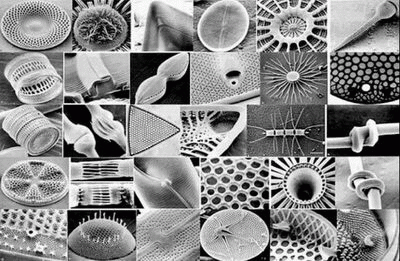
The single-celled Spirostomum is a tiny brown worm that can contract its 500-micrometer-long body to 25% of its length in a millisecond, making this protozoan the fastest-contracting microorganism known. Scientists think of microorganisms like this as tiny functional machines. After all, many of them have capabilities far surpassing the current state-of-the-art in MEMS (Microelectromechanical Systems) technology.
The integration of microorganisms with MEMS, resulting in “biotic-MEMS,” is a hot topic for scientists designing micron-level machines. Recently, researcher Xiaorong Xiong of Intel, microbiologist Mary Lidstrom, and electrical engineer Babak Parviz (both of the University of Washington) have catalogued a large number of the most promising microorganisms for different areas of MEMS systems. They show that many of these microorganisms can offer capabilities beyond the limits of conventional MEMS technology.
“Traditionally, it has always been technology that has come to the aid of biology,” Parviz told PhysOrg.com. “Historically, new technological developments have resulted in the creation of new capabilities to conduct biological studies. Recently, tools and concepts have been increasingly borrowed from biology to solve technology problems. Biological concepts such as self-assembly are under serious consideration by technologists now for making highly integrated nano and micro systems.”
The scientists grouped the microorganisms into four areas of use: material synthesis, precise structure formation, as functional devices, and integrated into controllable systems. All the microorganisms studied were less than 1 millimeter in size, and made of one or just a few cells.
As the scientists showed, microorganisms have the ability to synthesize at least 64 different inorganic materials used in MEMS technology, in a process called “biomineralization.” Scientists have fossil evidence of this process dating back more than 700 million years. By genetically modifying this process, scientists might be able to produce MEMS materials such as silicon dioxide, biogenic calcite, and magnets.
For example, magnetic bacteria naturally synthesize magnetosome crystals, which act as a compass needle inside the bacteria aligning with the earth’s magnetic field. These bacteria always swim in one direction and accumulate in one side of the water, depending on the hemisphere; however, they can also be controlled by an external magnetic field.
Compared with conventional MEMS synthesis methods, which often involve high temperatures, corrosive gases, vacuums and plasma, synthesis using microorganisms could be done at room temperature, at near-neutral pH, and in aqueous solutions.
Other microorganisms can form intricate structures—such as gold or silver crystals—using a simpler process than conventional photolithography systems. These structures can grow up to three dimensions and be modified with nanoscale precision. Microorganisms can even generate structures a few orders of magnitude larger than themselves, offering the opportunity to interface with the macroscopic world. The scientists mentioned how the spicules in one deep-sea sponge demonstrate excellent fiber-optical properties.
Then there are the microorganisms—like the contracting Spirostomum—that scientists consider as functional devices. One of the most promising areas is in chemical and biological sensors, which use microorganisms that have been evolutionary tailored to detect specific agents—one of the major challenges in MEMS sensor design. Some of these have already been investigated, for purposes such as food and environmental monitoring.
“One of the most interesting applications of MOs [microorganisms] in MEMS is to directly use them for detecting chemicals,” said Parviz. “MOs can be genetically engineered to have various receptors. All the transduction and amplification machinery is already in MOs. I think integration of these MOs into MEMS platforms can generate extremely powerful chemical/biological analysis systems.”
Other microorganisms can convert chemical energy to generate mechanical forces, such as bacteria that act as free-standing propellers. Others can convert chemical energy to generate electrical energy, such as environmentally-friendly Microbial Fuel Cells for powering robotics and biomedical devices, and for economic hydrogen production. Biotic-MEMS fuel cells may eliminate the difficult task of fabricating and integrating small conventional batteries in MEMS devices.
While MEMS technology has had success in fabricating single devices, the scientists explained that a larger challenge is how to integrate these devices into controllable micron-scale systems. Microorganisms offer a unique opportunity as assembled functional systems, if scientists can learn how to take advantage of them, usually by interfacing with microelectronic devices. Scientists have investigated this interface with slightly larger organisms, such as implanting electrodes in the brain of a cockroach to control the insect’s motion, and implants in a rat brain that can enable the rodent to control external devices by transmitting its brain signals.
While fascinating, such interfacing work is yet to be explored with microorganisms, where the electronics must be miniaturized even further. The ability to interface with micron-scale robots—i.e. the microorganisms that perform functions—could have significant potential for biotic-MEMS, the scientists predicted.
“Our ability to manipulate small organisms and produce platforms that can interface with them one cell at a time is brand new,” said Parviz. “It is yet to be seen how researchers will take advantage of these new capabilities.”
Citation: Xiong, Xiaorong, Lidstrom, Mary E., and Parviz, Babak A. “Microorganisms for MEMS.” Journal of Microelectromechanical Systems, Vol. 16, No. 2, April 2007.
Copyright 2007 PhysOrg.com.
All rights reserved. This material may not be published, broadcast, rewritten or redistributed in whole or part without the express written permission of PhysOrg.com.


