Chemical probes beat antibodies at own game
April 26, 2007
Chemical probes beat antibodies at own game

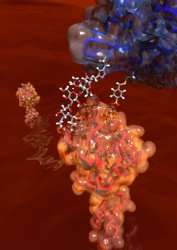
An interpretation of the binding of the synthetic proteins to proteins inside blood vessels. Credit: Karl Harrison.

A new way of detecting biological structures could help in the fight against disease. The new method, developed by scientists at Oxford University, uses chemistry to assemble proteins into ‘protein probes’ that can be sent into the body to, for instance, detect inflammation and disease in the brain.

The human body’s immune system uses its own ‘protein probes’ – antibodies – to seek out foreign objects such as bacteria and viruses. These antibodies are proteins shaped to ‘fit’ around parts of a target structure rather like a hand gripping a door handle. Scientists managed to replicate this process for the first time in 1975 with the creation of monoclonal antibodies now widely used in vaccines and biotechnology.

‘We think of antibodies as natural but the ones we use for detection are not always that great at binding to certain structures and in some ways the binding of antibodies to their targets is pretty unrepresentative of other protein-to-protein interactions,’ said Professor Ben Davis of Oxford’s Department of Chemistry who led the work, ‘our protein probes, created using chemical rather than biological techniques, are sometimes better at binding with targets than antibodies because they can mimic natural protein partners more closely.’ By attaching themselves to binding proteins on target cells, such as chronically inflamed brain cells, the probes stain the tissue and this staining can then be detected with a microscope or other methods.

A report on the research, entitled ‘Expanding the diversity of chemical protein modification allows post-translational mimicry’, has just been published in the journal Nature.

It details how Oxford scientists used chemistry to control the modification of proteins from simple chains of amino acids to complex structures similar to those seen in nature. By combining these structures with ready-made protein scaffolds the research team were then able to produce and test protein probes designed to target specific biological structures. In some cases they found that their protein probes were better at binding with some protein partners than monoclonal antibodies.

‘The strategy behind these probes could be useful for making synthetic proteins in many areas of medicine and science’ said Professor Davis ‘but the real goal behind making these modified protein structures using chemistry is that we hope it could enable us to find clues as to how we have ended up with such complex life forms from surprisingly few genes.’

Source: University of Oxford

3.5 /5 (6 votes)  

Rank 3.5 /5 (6 votes)
Tags

Relevant PhysicsForums posts

More news stories

Entire genome of extinct human decoded from fossil

(PhysOrg.com) -- In 2010, Svante Pääbo and his colleagues presented a draft version of the genome from a small fragment of a human finger bone discovered in Denisova Cave in southern Siberia. The ...

Biology / Biotechnology

created Feb 07, 2012 | popularity 4.7 / 5 (58) | comments 44 | with audio podcast

Why are there so few fish in the Earth's oceans?

(PhysOrg.com) -- A Stony Brook University researcher has found that, contrary to popular belief, there are not plenty of fish in the sea.

Biology / Plants & Animals

created Feb 08, 2012 | popularity 4.3 / 5 (17) | comments 25 | with audio podcast

Miami battling invasion of giant African snails

No one knows how they got there. But an invasion of African giant snails has southern Florida in a panic over potential crop damage, disease and general yuckiness surrounding the slimy gastropods.

Biology / Ecology

created Feb 10, 2012 | popularity 4.5 / 5 (2) | comments 5

The power of estrogen -- male snakes attract other males

A new study has shown that boosting the estrogen levels of male garter snakes causes them to secrete the same pheromones that females use to attract suitors, and turned the males into just about the sexiest ...

Biology / Plants & Animals

created Feb 10, 2012 | popularity 4.8 / 5 (6) | comments 2 | with audio podcast

Deciding to go left or right: Researchers use device to determine that lower animals can navigate too

For decades, scientists have associated binary decision making — opting to go left or right — with higher-ranking animals, including humans. A team of Harvard researchers, however, is rewriting that ...

Biology / Plants & Animals

created Feb 09, 2012 | popularity 4 / 5 (1) | comments 4 | with audio podcast


Walney offshore wind farm is world's biggest (for now)

(PhysOrg.com) -- The Walney wind farm on the Irish Sea--characterized by high tides, waves and windy weather--officially opened this week. The farm is treated in the press as a very big deal as the Walney ...

GPS court ruling leaves US phone tracking unclear

A US Supreme Court decision requiring a warrant to place a GPS device on the car of a criminal suspect leaves unresolved the bigger issue of police tracking using mobile phones, legal experts say.

Europeans protest controversial Internet pact

Tens of thousands of people marched in protests in more than a dozen European cities Saturday against a controversial anti-online piracy pact that critics say could curtail Internet freedom.

Europe stakes billion-dollar bet on new rocket

A pencil-slim rocket is scheduled to lift into space from South America on Monday, carrying a billion-dollar bet that Europe can grab a juicy slice of the market to place satellites in low orbit.

Study finds that anti-diabetic medication can prevent the long-term effects of maternal obesity

In a study to be presented today at the Society for Maternal-Fetal Medicine's annual meeting, The Pregnancy Meeting, in Dallas, Texas, researchers will report findings that show that short therapy with the anti-diabetic medication ...

Netflix settlement trims 14 pct off 4Q earnings

(AP) -- Netflix pressed the rewind button on its fourth-quarter earnings after settling allegations that the video subscription service violated a consumer-privacy law.