Sponging up the evolutionary past
April 27, 2007 Sponging up the evolutionary past

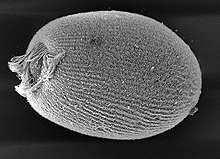
The larvae of the sponge Amphimedon queenslandica expresses similar developmental genes to those in humans.

University of Queensland researchers are exploring the evolution of what has been termed the “Rosetta Stone” of the gene world, by tracing the development of the humble sea sponge.

A team led by Professor Bernie Degnan, from UQ's School of Integrative Biology, has found sea sponges don't have Hox genes – the genes responsible in flies, animals, and even humans, for where the head and bottom should go.

“Sea sponges are basically living fossils and haven't changed since before the Cambrian explosion – the time when most of the major groups of animals first appear,” Professor Degnan said.

“They are one of the simplest animals and yet their genome (their genetic information) is remarkably similar to our own.

“What we have found is as sponges don't have this gene, it must have evolved after sponges split from our evolutionary path, and it corresponds with a big jump in the rise of complex organisms.”

Professor Degnan said the research, published recently in the scientific journal Current Biology, adds another piece of the evolutionary puzzle to how life evolved on Earth.

“Sea sponges are fascinating animals and offer us a window into the past,” he said.

“But they are also showing us a window into the future as they are an immense source of bio-active compounds that could have pharmaceutical and industrial benefits.”

He said one example of potential benefit is being explored by looking at the way sponges develop a glass skeleton.

“They grow this ornate and intricate skeleton which is made out of glass,” he said.

“Their genome encodes the amazing ability to take silica out of sea water and turn it into glass, so we are looking at that for the future environmentally-benign bio-fabrication of glass.

“And other researchers are looking at the sponge for novel drug development.”

He said his team was continuing its research into sponges to further unlock the potential of such a simple yet amazing creature.

Source: University of Queensland


print this article email this article download pdf blog this article bookmark this article     Stumble it Digg this share on Facebook retweet share on Reddit add to delicious
Rate this story - 4.6 /5 (16 votes)


April 27, 2007 all stories

Comments: 0

4.6 /5 (16 votes)
  • Stumble this up

  • Digg this

  • share this

  • hide
  • Related Stories


Other News

UK starts study on using human DNA in animals

Biology / Biotechnology

created 24 minutes ago | popularity not rated yet | comments 0

(AP) -- British scientists begin a new study on Tuesday to consider how human DNA is used in animal experiments and to determine what the boundaries of such controversial science might be.


Scientists successfully reprogram blood cells

Biology / Cell & Microbiology

created 3 hours ago | popularity 5 / 5 (1) | comments 0

Researchers have transplanted genetically modified hematopoietic stem cells into mice so that their developing red blood cells produce a critical lysosomal enzyme -preventing or reducing organ and central nervous system damage ...


New discovery allows scientists for the first time to experimentally annotate genomes

New discovery allows scientists for the first time to experimentally annotate genomes

Biology / Biotechnology

created 2 hours ago | popularity 5 / 5 (3) | comments 0

Over the last 20 years, the sequencing of the human genome, along with related organisms, has represented one of the largest scientific endeavors in the history of mankind. The information collected from genome ...


Wasp

Well-traveled wasps provide hope for vanishing species

Biology / Plants & Animals

created 3 hours ago | popularity not rated yet | comments 0

They may only be 1.5mm in size, but the tiny wasps that pollinate fig trees can travel over 160km in less than 48 hours, according to research from scientists at the University of Leeds. The fig wasps are transporting ...


Study shows that some malignant tumors can be shut down after all

Biology / Cell & Microbiology

created 7 hours ago | popularity 5 / 5 (3) | comments 1

Oncologists have had their hands tied because more than half of all human cancers have mutations that disable a protein called p53. As a critical anti-cancer watchdog, p53 masterminds several cancer-fighting operations within ...