Female ticks have market on gluttony
April 27th, 2007 Amblyomma variegatum

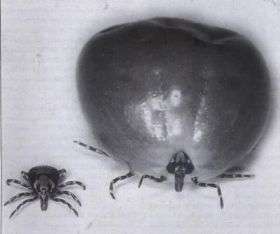
Unfed and engorged tick. Credit: Professor Frans Jongejan, University of Utrecht, Netherlands, and University of Pretoria, Republic of South Africa.

Sex makes you fat. If you're a female tick, that is. The "truly gluttonous" female ixodid tick increases her weight an astounding 100 times her original size after she mates, so a University of Alberta researcher investigated what it is about copulation that triggers such a massive weight gain.

In a new research paper published in the Journal of Insect Physiology, Dr. Reuben Kaufman, from the Department of Biological Sciences, suggests several differences between the ixodid tick and her blood-sucking counterparts that help explain the weight gain. Using mosquitoes, tsetse flies, bed bugs and kissing bugs as comparison, Kaufman found that no one compared to this female African tick when it came to weight gain following mating.

Kaufman suggests that the ixodid tick displays a significant difference in lifestyle from the other insects and that it is adaptive for the virgin to remain small before mating.

First, this species of tick remain on the host for a number of days, rather than minutes. "In this family of ticks, mating takes place on the host," says Kaufman. "Most other insects mate before or after their brief blood meal —the two acts are totally separate, but not with these ticks."

Female ticks require six to 10 days to engorge fully. First, she attaches herself to the skin. Then she feeds to 10 times her unfed weight and finally, after copulation she increases her weight a further tenfold.

On the other hand, the virgin tick rarely exceeds the critical weight necessary for laying eggs. It will hang on to the host for weeks, waiting for a male to find her, says Kaufman. If the virgin gains too much weight and is groomed off the host, it won't reattach itself to another host and continue feeding. "However, if she remains small she still has a chance to reattach itself to another host—hopefully infested with some feeding males-- continuing feeding and potentially mate," says Kaufman. "If a male eventually copulates with her, she will engorge normally and then be able to lay eggs. This is one reason why it might be adaptive for the virgin to remain small until mated."

In terms of what causes the female to become so engorged, Kaufman says that when a tick does copulate, the male's seminal fluid contains two engorgement factor proteins that together act as a signal to tell her to complete engorgement.

Kaufman's future research will look toward the potential to produce an anti-tick vaccine. Some experiments have already suggested that normal, mated ticks are unable to fully engorge when feeding on a host that has been immunized against the engorgement factor proteins. If these observations can be confirmed and extended, an effective anti-tick vaccine to protect livestock and pets could be on the horizon.

Source: University of Alberta


print this article email this article download pdf blog this article bookmark this article     Digg this Stumble it share on Facebook share on Reddit add to delicious save to Yahoo! bookmarks
4/5 after 2 votes


April 27th, 2007 all stories
Biology /

Comments: 0
Rank: 4/5 after 2 votes

  • Stumble this up

  • Digg this

  • Share it:
  • share on Facebook
  • share on MySpace
  • share on Slashdot
  • rss-newsfeed
  • share on Google
  • share on Reddit
  • add to delicious
  • save to Yahoo! bookmarks
  • share on Windows Live
  • Add to Mixx!
Rating: 4/5 after 2 votes

  • Related Stories

  • Lessons from the vaccine-autism wars
    created May 27, 2009 | popularity not rated yet | comments 0
  • Environmental regulators warn flea treatments may be toxic to pets
    created May 12, 2009 | popularity not rated yet | comments 0
  • New human study reinforces antioxidant benefits of tart cherries
    created Apr 19, 2009 | popularity not rated yet | comments 0
  • Protein from tick saliva studied for potential myasthenia gravis treatment
    created Mar 26, 2009 | popularity not rated yet | comments 0
  • Big, old mice spread hantavirus
    created Jan 07, 2009 | popularity not rated yet | comments 0

Tags


  • Physicists Demonstrate Quantum Memory with Matter Qubits
    Physicists Demonstrate Quantum Memory with Matter Qubits
    Physics / General Physics
    created Jul 03, 2009 | popularity 4.4 / 5 (17) | comments 1
  • 'Holey' Nanosheets for Wastewater Dye Removal
    Nanotechnology / Nanomaterials
    created Jul 01, 2009 | popularity 5 / 5 (5) | comments 1
  • Jellyfish Robot Swims Like its Biological Counterpart
    Jellyfish Robot Swims Like its Biological Counterpart
    Electronics / Robotics
    created Jun 26, 2009 | popularity 4.4 / 5 (8) | comments 1
  • Could Maxwell's Demon Exist in Nanoscale Systems?
    Could Maxwell's Demon Exist in Nanoscale Systems?
    Physics / General Physics
    created Jun 24, 2009 | popularity 4.4 / 5 (18) | comments 29
  • Living Safely with Robots, Beyond Asimov's Laws
    Living Safely with Robots, Beyond Asimov's Laws
    Electronics / Robotics
    created Jun 22, 2009 | popularity 4.6 / 5 (52) | comments 40
  • Other News

    Researchers uncover the potential for super-sized abalone

    Biology / Microbiology

    created 1hour ago | popularity not rated yet | comments 0

    (PhysOrg.com) -- Designer abalone could be an option in the foreseeable future, thanks to a project conducted at UQ's Heron Island Research Station and the St Lucia campus.


    California water plan aims to save Puget Sound orcas

    Biology / Ecology

    created 17 hours ago | popularity not rated yet | comments 0

    A plan to restore salmon runs on California's Sacramento River also could help revive killer whale populations 700 miles to the north in Puget Sound, as federal scientists struggle to protect endangered species in a complex ...


    Scientists 'rebuild' giant moa using ancient DNA

    Biology / Plants & Animals

    created Jul 01, 2009 | popularity 5 / 5 (10) | comments 12

    (PhysOrg.com) -- Scientists have performed the first DNA-based reconstruction of the giant extinct moa bird, using prehistoric feathers recovered from caves and rock shelters in New Zealand.


    Pacific Giant Salamander (Dicamptodon tenebrosus)

    Salamanders, regenerative wonders, heal like mammals, people

    Biology / Microbiology

    created Jul 01, 2009 | popularity 5 / 5 (20) | comments 11

    The salamander is a superhero of regeneration, able to replace lost limbs, damaged lungs, sliced spinal cord -- even bits of lopped-off brain. But it turns out that remarkable ability isn't so mysterious after ...


    Genetically modified trees

    Anti-biotech groups obstruct forest biotechnology

    Biology / Biotechnology

    created Jun 30, 2009 | popularity 3.7 / 5 (7) | comments 5

    The potential of forest biotechnology to help address significant social and environmental issues is being "strangled at birth" by the rigid opposition of some groups and regulations that effectively preclude ...