Tracking Genes for Self-pollination in Arabidopsis
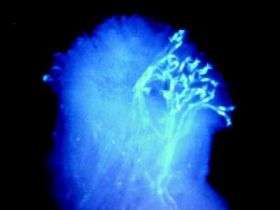
Some plants need a partner to reproduce. Pollen from one plant pollinates the stigma of another, and a seed is formed. But other plants can self-pollinate, a handy survival mechanism for a lonely plant.
The ability to self-pollinate turns up in cultivated tomatoes and canola, among other important crops, and sometimes it can be a nuisance for plant breeders and seed producers who want to develop highly desirable hybrid varieties and produce hybrid seed on a commercial scale. To get hybrid seed, they plant two different varieties in the same field to allow them to cross-pollinate. But if one or both varieties can self-pollinate, workers must remove the pollen sacs (anthers) from the flowers by hand to prevent "selfing." This is so labor-intensive that it is usually only done in countries where labor is cheap.
Now Cornell researchers are zeroing in on genes that turn a plant's ability to self-pollinate on and off. Their work is described in the May 1 issue of the journal Current Biology and in the journal's online edition.
"The long-term goal is to understand how self-pollination is inhibited in self-incompatible plants, which are unable to self-pollinate because their stigmas can recognize and reject their own pollen. Then you could transfer this ability to any plant and use it to make hybrids," said June Nasrallah, the Barbara McClintock Professor of Plant Biology at Cornell.
Nasrallah's research group is working with Arabidopsis thaliana , a plant related to cabbage and mustard that is widely used in plant genetic research and whose genome has been sequenced. Previously, the group showed that two genes known as SCR and SRK are the key to self-incompatibility. SCR codes for a protein on the surface of pollen grains, and SRK codes for a receptor in the cell membranes of stigma cells. When these two proteins come from the same plant, the stigma rejects the pollen, and fertilization does not occur.
A. thaliana is highly self-fertile, but the Nasrallah group inserted SCR and SRK genes from another species, A. lyrata , which is self-incompatible, and created A. thaliana varieties that ranged from self-incompatible to "pseudo self-compatible," where a plant resists self-pollination for a while, but if it is not pollinated from another plant it will eventually accept its own pollen. In nature, pseudo self-compatibility is a best-of-two-worlds mating strategy, Nasrallah said, because it maintains the benefits of out-crossing while providing reproductive assurance when mates or pollinators are scarce.
In the latest research, Pei Liu, a postdoctoral researcher in Nasrallah's laboratory, and colleagues mapped the genomes of several varieties of transgenic A. thaliana in fine detail and isolated a gene known as PUB8 that seems to regulate the expression of SRK -- that is, whether or not it is turned on to manufacture its protein. The PUB8 gene shows some variation from one variety of A. thaliana to another, i.e., the DNA sequence contains a few different bases here and there. The degree to which self-incompatibility is turned on in the plant seems to correlate with these variations. PUB8-mediated pseudo self-compatibility might have been a transitional phase in the evolutionary switch from self-incompatibility to selfing in A. thaliana , Nasrallah speculates.
PUB8 is very close to SCR and SRK on the genome. It is unusual to find a regulatory gene so close to the gene it regulates, the researchers noted. PUB8 is expressed in other parts of the plant and probably has other functions, they said, adding that still other genes are probably involved in self-incompatibility.
Source: Cornell University


