Revolutionizing prosthetics 2009 team delivers first DARPA limb prototype
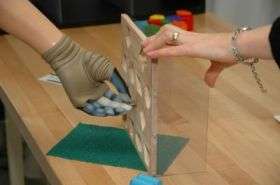
An international team led by the Johns Hopkins University Applied Physics Laboratory in Laurel, Md., has developed a prototype of the first fully integrated prosthetic arm that can be controlled naturally and provide sensory feedback, and allows for eight degrees of freedom -- a level of control far beyond the current state of the art for prosthetic limbs.
Proto 1, developed for the Defense Advanced Research Projects Agency Revolutionizing Prosthetics Program, is a complete limb system that also includes a virtual environment used for patient training, clinical configuration, and to record limb movements and control signals during clinical investigations.
The DARPA prosthetics program is an ambitious effort to provide the most advanced medical and rehabilitative technologies for military personnel injured in the line of duty. Over the last year, the APL-led Revolutionizing Prosthetics 2009 (RP 2009) team has worked to develop a prosthetic arm that will restore significant function and sensory perception of the natural limb. Proto 1 and its virtual environment system were delivered to DARPA ahead of schedule, and Proto 1 was fitted for clinical evaluations conducted by team partners at the Rehabilitation Institute of Chicago in January and February.
“This progress represents the first major step in a very challenging program that spans four years and involves more than 30 partners, including government agencies, universities, and private firms from the United States, Europe, and Canada,” says APL’s Stuart Harshbarger, who leads the program. “The development of this first prototype within the first year of this program is a remarkable accomplishment by a highly talented and motivated team and serves as validation that we will be able to implement DARPA’s vision to provide, by 2009, a mechanical arm that closely mimics the properties and sensory perception of a biological limb.”
Making Use of Residual Nerves
The advanced degree of natural control and integrated sensory feedback demonstrated with Proto 1 are enabled by Targeted Muscle Reinnervation, a technique pioneered by Dr. Todd Kuiken at RIC that involves the transfer of residual nerves from an amputated limb to unused muscle regions in appropriate proximity to the injury. In this case, the nerves were transferred to the pectoral area of the patient’s chest. This procedure provides for a more intuitive use of a prosthetic arm and allows for the natural sensation of grip strength and touch.
During clinical evaluation of the limb at RIC, Jesse Sullivan, a patient of Dr. Kuiken, demonstrated substantial improvements in functional testing, such as the ability to reposition his thumb for different grips, remove a credit card from a pocket, stack cups while controlling his grip force using sensory feedback verses vision, and to walk using the free swing mode of the limb for a more natural gait. Harshbarger says that critical to Proto 1’s development was closely working with patients such as Sullivan to help the team understand the attributes patients look for in new prosthetic limbs. The limb system also includes a natural-looking artificial covering that was created using photographs of the patient’s native limb taken before the accident.
“The Rehabilitation Institute of Chicago continues to advance this applied research and bring the application of the Targeted Reinnervation technique to the forefront to benefit our nation's service men and women,” says Dr. Kuiken, the director of the Neural Engineering Center for Bionic Medicine at RIC. “The results we are achieving in this highly collaborative project are very exciting and I am confident that these discoveries will bring more natural control of prostheses, better artificial limbs and make a difference in the lives of amputees worldwide.”
More Advanced Prototype Within Reach
APL, which was responsible for much of the design and fabrication of Proto 1, and other team members are already hard at work on a second prototype, expected to be unveiled in late summer. It will have more than 25 degrees of freedom and the strength and speed of movement approaching the capabilities of the human limb, combined with more than 80 individual sensory elements for feedback of touch, temperature, and limb position.
“There is still significant work to be done to determine how best to control this number of degrees of freedom, and ultimately how to incorporate sensory feedback based on these sensory inputs within the human nervous system,” Harshbarger says. “The APL team is already driving a virtual model of Proto 2 with data recorded during the clinical evaluation of Proto 1, and the team is working to identify a robust set of grasps that can be controlled by a second patient later this year.”
Another exciting development is the functional demonstration of Injectable MyoElectric Sensor (IMES) devices—very small injectable or surgically implantable devices used to measure muscle activity at the source verses surface electrodes on the skin that were used during testing of the first prototype.
“The IMES devices, coupled with TMR procedures, promise to increase the fidelity of control and can be used in certain injury scenarios to provide a significant improvement on their own merit,” Harshbarger notes. Further neural integration work includes fabrication of early devices to integrate directly with the peripheral nervous system and the cortex.
“APL and DARPA are united in the mission to improve technology and quality of life for our injured warfighters,” Harshbarger continues. “There are a lot of people working very hard to accomplish DARPA’s vision of a final limb system that approaches the natural appearance and control of the native limb. It remains a significant challenge, but the progress to date should give hope that the performance of the final RP 2009 limb will significantly improve the capabilities of upper extremity prosthetic limbs.”
As the team prepares for further evaluations this summer, Proto 1 is already generating considerable interest from government agencies wanting to transition the prototype for use with other patients.
Source: Johns Hopkins University


