Placing single nanowires: NIST makes the connection
April 27, 2007 Nanowire Schematic

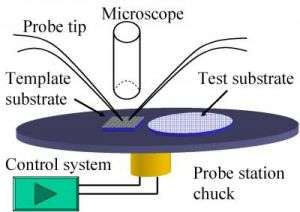
Schematic of NIST single nanowire manipulation system. Credit: NIST

Researchers at the National Institute of Standards and Technology have devised a system for manipulating and precisely positioning individual nanowires on semiconductor wafers. Their technique, described in a recent paper, allows them to fabricate sophisticated test structures to explore the properties of nanowires, using only optical microscopy and conventional photolithographic processing in lieu of advanced (and expensive) tools such as focused ion or electron beams.

Nanowires and nanotubes are being studied intensively as essential elements for future nanoscale electronics, but some fundamentals remain to be worked out—among them, how to put wires only a handful of atoms in diameter where you want them. The smallest-diameter nanowires today are built in a “bottom-up” fashion, assembled atom-by-atom through a chemical growth process such as chemical vapor deposition.
NIST Nanowire Manipulation Technique

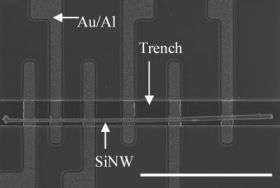
Scanning electron microscope image shows a single silicon nanowire positioned in an etched trench using NIST's nanowire manipulation technique. The trench helps keep the nanowire in position during the fabrication of the rest of the test structure, which measures metal/nanowire contact resistance. The scale bar is 20 micrometers long. Credit: NIST

This is essentially a bulk process; it produces haystacks of jumbled nanowires of varying lengths and diameters. “The normal research approach,” explains NIST electronics engineer Curt Richter, “is to throw a whole bunch of these down on the test surface, hunt around with a microscope until you find a good-looking wire in about the right place, and use lithography to attach electrical contacts to it.”

To achieve better control, the NIST engineers modified a standard probe station used to test individual components in microelectronic circuits. The station includes a high-resolution optical microscope and a system for precisely positioning work surfaces under a pair of customized titanium probes with tips less than 100 nanometers in diameter.

In a two-step process, silicon nanowires suspended in a drop of water are deposited on a special staging wafer patterned with a grid of tiny posts, and dried. Resting on the tops of the posts, selected nanowires can be picked up by the two probe tips, which they cling to by static electricity. The test structure wafer is positioned under the probes, the nanowire is oriented by moving either the probe tips or the wafer, and then placed on the wafer in the desired position.

Although not at all suited to mass production, the technique’s fine level of control allows NIST engineers to place single nanowires wherever they want to create elaborate structures for testing nanowire properties. They’ve demonstrated this by building a multiple-electrical-contact test structure for measuring the resistance of a nanowire independent of contact resistance, and a simple electromechanical “switch” suitable for measuring the flexibility of nanowires. They’ve used the technique successfully with nanowires greater than about 60 nm in diameter, and say sharper probe tips and high-resolution microscopes could push the limit lower.

Citation: Q. Li, S. Koo, C.A. Richter, M.D. Edelstein, J.E. Bonevich, J.J. Kopanski, J.S. Suehle and E.M. Vogel. Precise alignment of single nanowires and fabrication of nanoelectromechanical switch and other test structures. IEEE Transactions on Nanotechnology. V.6, No.2. March 2007.

Source: National Institute of Standards and Technology


print this article email this article download pdf blog this article bookmark this article     Stumble it Digg this share on Facebook retweet share on Reddit add to delicious
Rate this story - 4.6 /5 (17 votes)


April 27, 2007 all stories

Comments: 0

4.6 /5 (17 votes)
  • Stumble this up

  • Digg this

  • share this

  • hide
  • Related Stories

  • NIST Demos Industrial-Grade Nanowire Device Fabrication
    created Oct 26, 2007 | popularity not rated yet | comments 0
  • Scientists Hand-Make Devices Smaller than 10 Nanometers
    created Apr 27, 2007 | popularity not rated yet | comments 0
  • Roadrunner supercomputer simulates nanoscale material failure
    created Oct 29, 2009 | popularity not rated yet | comments 0
  • Nanowire biocompatibility in the brain: So far so good
    created Oct 22, 2009 | popularity not rated yet | comments 0
  • Running electronics using light
    created Oct 19, 2009 | popularity not rated yet | comments 0


  • hide
  • Relevant PhysicsForums posts

  • Coulomb's Law
    created 4 hours ago
  • Laser spots
    created 8 hours ago
  • Do you know elementary physics?
    created 10 hours ago
  • Bicycles and their mad skillz
    created 11 hours ago
  • More from Physics Forums - General Physics

Other News

Nanoparticles used in common household items caused genetic damage in mice

Nanotechnology / Bio & Medicine

created Nov 16, 2009 | popularity 4.8 / 5 (24) | comments 11

Titanium dioxide (TiO2) nanoparticles, found in everything from cosmetics to sunscreen to paint to vitamins, caused systemic genetic damage in mice, according to a comprehensive study conducted by researchers at UCLA's Jonsson ...


Nanotube defects equal better energy and storage systems

Nanotube defects equal better energy and storage systems

Nanotechnology / Nanomaterials

created Nov 19, 2009 | popularity 4.4 / 5 (10) | comments 2

(PhysOrg.com) -- Most people would like to be able to charge their cell phones and other personal electronics quickly and not too often. A recent discovery made by UC San Diego engineers could lead to carbon ...


Using superconducting probes to get a picture of what it's like inside CNTs

Nanotechnology / Nanophysics

created Nov 20, 2009 | popularity 4.9 / 5 (8) | comments 0

(PhysOrg.com) -- "Carbon nanotubes are exciting for fundamental physics, and for potential technological applications," Nadya Mason tells PhysOrg.com. "However, we are generally limited in the way that we can study them. ...


New study confirms exotic electric properties of graphene

New study confirms exotic electric properties of graphene

Nanotechnology / Nanomaterials

created Nov 17, 2009 | popularity 4.8 / 5 (23) | comments 1

(PhysOrg.com) -- First, it was the soccer-ball-shaped molecules dubbed buckyballs. Then it was the cylindrically shaped nanotubes. Now, the hottest new material in physics and nanotechnology is graphene: ...


Small optical force can budge nanoscale objects

Small optical force can budge nanoscale objects

Nanotechnology / Nanophysics

created Nov 17, 2009 | popularity 4.8 / 5 (12) | comments 0

(PhysOrg.com) -- Engineering researchers have used a very tiny beam of light with as little as 1 milliwatt of power to move a silicon structure up to 12 nanometers.