New nanocomposites may mean more durable tooth fillings
April 27, 2007 New nanocomposites may mean more durable tooth fillings

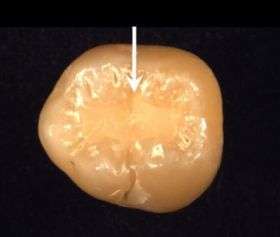
A calcium phosphate nanocomposite filling in a tooth. The nanocomposite can "smartly" release decay-fighting agents to buffer against acids produced by bacteria, and rebuild the lost tooth minerals by releasing ions into the mineral-deficient area of the tooth. Credit: NIST

The mouth is a tough environment—which is why dentists do not give lifetime guarantees. Despite their best efforts, a filling may eventually crack under the stress of biting, chewing and teeth grinding, or secondary decay may develop where the filling binds to the tooth. Fully 70 percent of all dental procedures involve replacements to existing repairs, at a cost of $5 billion per year in the United States alone.

Now, however, scientists at the American Dental Association’s Paffenbarger Research Center, a joint research program at the National Institute of Standards and Technology, have shown that nanotechnology has the potential to lessen that toll by producing tooth restorations that are both stronger than any decay-fighting fillings available today, and more effective at preventing secondary decay. They report their findings in a recent issue of The Journal of Dental Research.

The researchers’ new technique solves a problem with the standard composite resin filling, a natural-looking restoration that is the method of choice when appearance is an issue. A dentist creates the filling by mixing the pure liquid resin with a powder that contains coloring, reinforcement and other materials, packing the resulting paste into the cavity, and illuminating the tooth with a light that causes the paste to polymerize and harden. For decay-fighting composite fillings, the problem arises from an additive that is included in the powder to provide a steady release of calcium and phosphate ions.

These ions are essential to the long-term success of the filling because they not only strengthen the crystal structure of the tooth itself, but buffer it against the decay-causing acid produced by bacteria in the mouth. Yet the available ion-releasing compounds are structurally quite weak, to the point where they weaken the filling as a whole.

To get around this conundrum, the Paffenbarger researchers have devised a spray-drying technique that yields particles of several such compounds, one of which being dicalcium phosphate anhydrous, or DCPA, that are about 50 nanometers across—20 times smaller than the 1-micrometer particles in a conventional DCPA powder.

Because these nanoscale particles have a much higher surface to volume ratio, they are much more effective at releasing ions, which means that much less of the material is required to produce the same effect. That, in turn, leaves more room in the resin for reinforcing fibers that strengthen the final filling. To exploit that opportunity, the Paffenbarger researchers also have developed nanoscale silica-fused fibers that produce a composite resin nearly twice as strong as the currently available commercial variety.

Citation: H.H.K. Xu, M.D. Weir, L. Sun, S. Takagi and L.C. Chow. Effects of calcium phosphate nanoparticles on Ca-PO4 composite, J Dent Res 86(4):378-383m 2007.

Source: National Institute of Standards and Technology


print this article email this article download pdf blog this article bookmark this article     Stumble it Digg this share on Facebook retweet share on Reddit add to delicious
Rate this story - 4.4 /5 (17 votes)


April 27, 2007 all stories

Comments: 0

4.4 /5 (17 votes)
  • Stumble this up

  • Digg this

  • share this

  • hide
  • Related Stories

  • Hybrid composite for root canal treatment
    created Nov 03, 2009 | popularity not rated yet | comments 0
  • FDA concludes mercury in dental fillings not risky
    created Jul 28, 2009 | popularity not rated yet | comments 0
  • Nanotechnology may increase longevity of dental fillings
    created Jul 01, 2009 | popularity not rated yet | comments 0
  • Form of Mercury in Older Dental Fillings Unlikely to be Toxic: Study
    created Nov 11, 2009 | popularity not rated yet | comments 0
  • Look ma, no mercury in fillings!
    created Nov 09, 2009 | popularity not rated yet | comments 0


  • hide
  • Relevant PhysicsForums posts

  • Super quick question about Starling forces?
    created Nov 22, 2009
  • Questions about diffusion
    created Nov 22, 2009
  • Human Leukocyte Antigen (HLA) typing
    created Nov 21, 2009
  • Breeding program
    created Nov 20, 2009
  • More from Physics Forums - Biology

Other News

Nanoparticles used in common household items caused genetic damage in mice

Nanotechnology / Bio & Medicine

created Nov 16, 2009 | popularity 4.8 / 5 (24) | comments 11

Titanium dioxide (TiO2) nanoparticles, found in everything from cosmetics to sunscreen to paint to vitamins, caused systemic genetic damage in mice, according to a comprehensive study conducted by researchers at UCLA's Jonsson ...


Nanotube defects equal better energy and storage systems

Nanotube defects equal better energy and storage systems

Nanotechnology / Nanomaterials

created Nov 19, 2009 | popularity 4.4 / 5 (10) | comments 2

(PhysOrg.com) -- Most people would like to be able to charge their cell phones and other personal electronics quickly and not too often. A recent discovery made by UC San Diego engineers could lead to carbon ...


Using superconducting probes to get a picture of what it's like inside CNTs

Nanotechnology / Nanophysics

created Nov 20, 2009 | popularity 4.9 / 5 (8) | comments 0

(PhysOrg.com) -- "Carbon nanotubes are exciting for fundamental physics, and for potential technological applications," Nadya Mason tells PhysOrg.com. "However, we are generally limited in the way that we can study them. ...


New study confirms exotic electric properties of graphene

New study confirms exotic electric properties of graphene

Nanotechnology / Nanomaterials

created Nov 17, 2009 | popularity 4.8 / 5 (23) | comments 1

(PhysOrg.com) -- First, it was the soccer-ball-shaped molecules dubbed buckyballs. Then it was the cylindrically shaped nanotubes. Now, the hottest new material in physics and nanotechnology is graphene: ...


Small optical force can budge nanoscale objects

Small optical force can budge nanoscale objects

Nanotechnology / Nanophysics

created Nov 17, 2009 | popularity 4.8 / 5 (12) | comments 0

(PhysOrg.com) -- Engineering researchers have used a very tiny beam of light with as little as 1 milliwatt of power to move a silicon structure up to 12 nanometers.