Capture of Female Loggerhead Turtle Recorded from Space
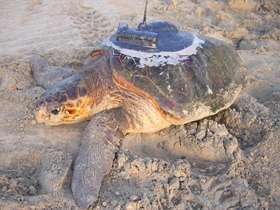
Scientists leading an international effort to safeguard the future of endangered loggerhead turtles have this week watched the capture and demise of one of their turtles being tracked by satellite. This week "Sodade", a loggerhead sea turtle from the republic of Cabo Verde, an island archipelago off the coast of Western Africa, appears to have been captured by fishermen.
She is one of 9 turtles being tracked by satellite from the recently discovered loggerhead nesting population in Cape Verde, which is 2nd only to Florida in the Atlantic and is the most important site in West Africa.
Each time the tracked turtles surface to breathe, their transmitting units connect with orbiting satellites and send radio transmissions that allow their position to be calculated. As discovered this week, this can also allow us to monitor their capture from space.
"We started to receive an unusually large number of very high quality locations from ´Sodade´- the 3rd turtle to be tracked in this study" said Dr. Brendan Godley, NERC Research Fellow with the Marine Turtle Research Group of the University of Exeter in Cornwall, UK.
"Such signals are received when a turtle spends large amounts of time at the surface suggesting she was likely on the deck of a boat and we became suspicious. Two days ago, transmissions ceased, suggesting that her transmitter has been removed and dumped. Given the large number of turtles captured for food in Cape Verde and the presence of fishing boats in the area at the time, we think we know her fate."
Funded by several funding bodies in the United Kingdom and the USA1, the project is a collaboration between the Marine Turtle Research Group2, Project Cabo Verde Natura 20003, the Instituto Nacional Desenvolvimento das Pescas4 and the Canarian Institute of Marine Science5 and will collect some of the most important data for this species to date. The project is being backed by US based NGO SEATURTLE.ORG6 and recognising its importance, WWF West Africa Programme are supporting the project with dissemination of results as part of their capacity building initiatives in the region.
SEATURTLE.ORG is providing real-time public access to this project with live maps of the turtles' tracks provided online. Members of the public are invited to follow the movements of these turtles on a daily basis:
"We have over 100,000 visits to our satellite tracking pages at www.seaturtle.org/tracking each month with the public marvelling at the migratory endeavours of these amazing creatures." Dr. Michael Coyne, Director of SEATURTLE.ORG and research scientist at Duke University outlined. "It's a pity that we have tracked the demise of one of the turtles in this case."
Cape Verde hosts the most important nesting population of loggerhead sea turtles in Africa. "This unfortunate incident highlights the need for greater enforcement of existing protective legislation for loggerhead turtles in Cape Verde but the perennial problem as in many developing nations is the lack of resources available to biodiversity protection agencies." Said Luis-Felipe Lopez-Jurado, Cape Verde Project Director for the Canarian Institute of Marine Science and Professor at the Universidad Las Palmas, Gran Canaria. "Such measures will be vital to ensure Cape Verdeans are able to enjoy loggerhead turtles long into the future".


