There's More to the North Star Than Meets the Eye
January 9th, 2006 There's More to the North Star Than Meets the Eye

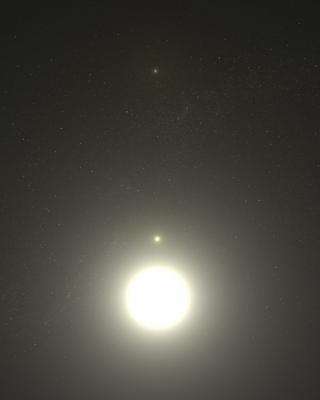
Image: There is more to Polaris than meets the eye - two faint stellar companions. The North Star is actually a triple star system. And while one companion (at top in this artist's concept) can be seen easily through small telescopes, the other hugs Polaris so tightly that it has never been seen directly - until now. By stretching the capabilities of NASA's Hubble Space Telescope to the limit, Smithsonian astronomer Nancy Evans and her colleagues have photographed the close companion of Polaris (seen here just above bright Polaris itself) for the first time. (Image not to scale.) Credit: Greg Bacon (STScI)

We tend to think of the North Star, Polaris, as a steady, solitary point of light that guided sailors in ages past. But there is more to the North Star than meets the eye - two faint stellar companions. The North Star is actually a triple star system. And while one companion can be seen easily through small telescopes, the other hugs Polaris so tightly that it has never been seen directly - until now.

By stretching the capabilities of NASA's Hubble Space Telescope to the limit, astronomers have photographed the close companion of Polaris for the first time. They presented their findings today in a press conference at the 207th meeting of the American Astronomical Society in Washington, DC.

"The star we observed is so close to Polaris that we needed every available bit of Hubble's resolution to see it," said Smithsonian astronomer Nancy Evans (Harvard-Smithsonian Center for Astrophysics).

The companion proved to be less than two-tenths of an arcsecond from Polaris - an incredibly tiny angle equivalent to the apparent diameter of a quarter located 19 miles away. At the system's distance of 430 light-years, that translates into a physical separation of about 2 billion miles.

"The brightness difference between the two stars made it even more difficult to resolve them," stated Howard Bond of the Space Telescope Science Institute (STScI). Polaris is a supergiant more than two thousand times brighter than the Sun, while its companion is a main-sequence star. "With Hubble, we've pulled the North Star's companion out of the shadows and into the spotlight."

By watching the motion of the companion star, Evans and her colleagues expect to learn not only the stars' orbits but also their masses. Measuring the mass of a star is one of the most difficult tasks facing stellar astronomers.

Astronomers want to determine the mass of Polaris accurately because it is the nearest Cepheid variable star. Cepheids are used to measure the distance to galaxies and the expansion rate of the universe, so it is essential to understand their physics and evolution. Knowing their mass is the most important ingredient in this understanding.

"Studying binary stars is the best available way to measure the masses of stars," said science team member Gail Schaefer of STScI.

"We only have the binary stars that nature provided us," added Bond. "With the best instruments like Hubble, we can push farther into space and study more of them up close."

The researchers plan to continue observing the Polaris system for several years. In that time, the movement of the small companion in its 30-year orbit around the primary should be detectable.

"Our ultimate goal is the get an accurate mass for Polaris," said Evans. "To do that, the next milestone is to measure the motion of the companion in its orbit."

Source: Harvard-Smithsonian Center for Astrophysics


print this article email this article download pdf blog this article bookmark this article     Digg this Stumble it share on Facebook share on Reddit add to delicious save to Yahoo! bookmarks
4.6/5 after 9 votes


January 9th, 2006 all stories
Space & Earth /

Comments: 0
Rank: 4.6/5 after 9 votes

  • Stumble this up

  • Digg this

  • Share it:
  • share on Facebook
  • share on MySpace
  • share on Slashdot
  • rss-newsfeed
  • share on Google
  • share on Reddit
  • add to delicious
  • save to Yahoo! bookmarks
  • share on Windows Live
  • Add to Mixx!
Rating: 4.6/5 after 9 votes


Tags


  • Physicists Demonstrate Quantum Memory with Matter Qubits
    Physicists Demonstrate Quantum Memory with Matter Qubits
    Physics / General Physics
    created Jul 03, 2009 | popularity 4.4 / 5 (17) | comments 1
  • 'Holey' Nanosheets for Wastewater Dye Removal
    Nanotechnology / Nanomaterials
    created Jul 01, 2009 | popularity 5 / 5 (5) | comments 1
  • Jellyfish Robot Swims Like its Biological Counterpart
    Jellyfish Robot Swims Like its Biological Counterpart
    Electronics / Robotics
    created Jun 26, 2009 | popularity 4.4 / 5 (8) | comments 1
  • Could Maxwell's Demon Exist in Nanoscale Systems?
    Could Maxwell's Demon Exist in Nanoscale Systems?
    Physics / General Physics
    created Jun 24, 2009 | popularity 4.4 / 5 (18) | comments 29
  • Living Safely with Robots, Beyond Asimov's Laws
    Living Safely with Robots, Beyond Asimov's Laws
    Electronics / Robotics
    created Jun 22, 2009 | popularity 4.6 / 5 (54) | comments 40
  • Other News

    Space Station Marathon

    Space Station Marathon

    Space & Earth / Space Exploration

    created 43 minutes ago | popularity not rated yet | comments 0

    The International Space Station (ISS) is about to make a remarkable series of flybys over the United States. Beginning this 4th of July weekend, the station will appear once, twice, and sometimes three times ...


    Proba-2's journey to Russia marks its first step towards space

    Proba-2's journey to Russia marks its first step towards space

    Space & Earth / Space Exploration

    created 53 minutes ago | popularity not rated yet | comments 0

    (PhysOrg.com) -- Proba-2, one of the smallest satellites ESA has ever built for space, is about to leave its Belgian homeland. Its development and testing complete, the satellite is being packed up for the ...


    Researchers test new 'space Internet' system on International Space Station

    Researchers test new 'space Internet' system on International Space Station

    Space & Earth / Space Exploration

    created 1hour ago | popularity not rated yet | comments 0

    The University of Colorado at Boulder is working with NASA to develop a new communications technology now being tested on the International Space Station, which will extend Earth's Internet into outer space ...


    China environmental phenomena monitored from space

    Space & Earth / Earth Sciences

    created 4 hours ago | popularity not rated yet | comments 0

    China is in a very seismically active area and has had many catastrophic earthquakes during its history. A joint European-Chinese team is using satellite radar data to monitor ground deformation across major continental faults ...


    California to require sun-blocking car windows

    Space & Earth / Environment

    created 6 hours ago | popularity 2 / 5 (4) | comments 9

    New cars sold in California must include windshields that block or absorb the sun's rays beginning in 2012, the state's Air Resources Board recently ruled.