Scientists probe black hole's inner sanctum
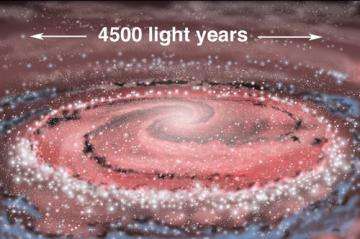
How does matter spiral its way to the center of a galaxy and into the mouth of a supermassive black hole? A new study provides the best glimpse yet at the death spiral of material as it descends into the core of a galaxy hosting a large black hole. The study predicts that, barring obstructions, the galactic debris will take about 200,000 years to make a one-way trip through the inner regions of the galaxy and into oblivion.
An international team of scientists led by Kambiz Fathi at Rochester Institute of Technology, together with astronomers in Brazil, Italy, and Chile, measured the internal motions of gas surrounding the nucleus of the active galaxy NGC1097. Using sophisticated spectroscopic techniques with the Gemini South Telescope in Chile, the team measured the spiral motions of gas streaming inside the nuclear ring. The observations zoomed in 10 times closer to the supermassive black hole than ever before, to see clouds of material within 10 light-years of the galactic core. Previous observations of this type of environment have detected gas clouds located between 100 and 1,000 light-years from the galaxy's nucleus.
Fathi presented the team's results at the 207th meeting of the American Astronomical Society Jan. 9 in Washington, D.C.
"It is the first time anyone has been able to follow gas this close to the supermassive black hole in the center of another galaxy," says Fathi, a postdoctoral scholar at RIT. "The work of our team confirms the main theories that have never been observationally confirmed at this level. We have been able to show that it is possible to measure these velocities down to these scales."
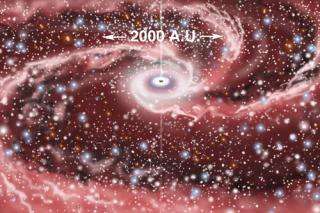
Modeling the galaxy's spectra revealed the dynamic shifts in the gas and showed the spiral arms pulling gas from about a thousand light-years out from the center to the nucleus at 52 kilometers (31 miles) per second. Previous imaging by the Hubble Space Telescope and the European Southern Observatory Very Large Telescope has shown structure inside the central ring of NGC1097. The Gemini data complement this with a velocity map of the gas inside the ring.
"When we extrapolate our last data points, about 30 light-years from the black hole, this is where we find that it would take about 200,000 years for the gas to travel the last leg of its one-way journey to the supermassive black hole," says Fathi.
The team measured the streaming motions toward the black hole by using two-dimensional spectroscopy to capture spectral data at several thousand points surrounding the nucleus of the galaxy.
"The resolution of this data is unprecedented when you look at how we were able to isolate so many different points around the nucleus of this galaxy and acquire a spectrum for each point at once," says team member Thaisa Storchi Bergmann of Instituto de Fisica in Brazil. "This paints an incredibly detailed picture of the region around the black hole and gives us a new glimpse at something we could only imagine before."
The technology that allows these types of observations is called integral field spectroscopy. It takes light from many different parts of the telescope's field simultaneously and splits the light from each region into a rainbow or spectrum of light. "This allows astronomers to do in 30 minutes what would have taken four nights a decade ago," says Fathi.
NGC1097 is located about 47 million light-years away in the southern constellation Fornax.
This work used data from the Gemini Observatory's Multi-Object Spectrograph integral field unit and the Hubble Space Telescope's high resolution Advanced Camera for Surveys.
Project collaborators include Thaisa Storchi-Bergmann, UFRGS, Brazil; David Axon and Andrew Robinson, RIT, USA; Alessandro Capetti, INAF-Turin, Italy, Alessandro Marconi, INAF-Florence, Italy; Rogemar Riffel, UFRGS, Brazil, and Claudia Winge, Gemini Observatory, Chile.
The results of this study will appear in an upcoming issue of The Astrophysical Journal Letters.
Source: Rochester Institute of Technology


