'Supermap' of avian flu yields new info on source, spread
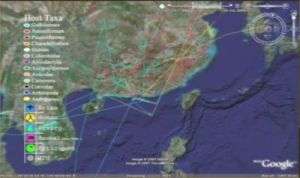
Scientists here have designed a new, interactive map of the spread of the avian flu virus (H5N1) that for the first time incorporates genetic, geographic and evolutionary information that may help predict where the next outbreak of the virus is likely to occur.
In the process, they also tested hypotheses about the nature of specific strains of the virus that appear to be heading westward and have the ability to infect humans.
A team of biomedical experts, led by Daniel Janies, an assistant professor in the department of biomedical informatics, used special software to create an evolutionary tree of the virus's mutations. They used Keyhole Markup Language in Google Earth to project the tree onto the globe and then chose colors and symbols to indicate different hosts that carry the virus and where they live. TimeSpan, another function in Google Earth, allowed them to animate the spread of the virus over the past decade.
The map is chock-full of additional information. Clicking on a specific viral subtype generates a popup window revealing diagnostic mutations that distinguish one strain of the virus from another, and all of the data is linked to the National Institute of Health's GenBank.
"The map gives us a whole new way of seeing the virus in action and understanding what it is – and isn't – doing," says Janies. "It's enabled us to compare findings about viruses in the real world against pre-existing hypotheses about the spread of H5N1 that come from laboratory studies."
The study appears online this week in the April issue of Systematic Biology.
The avian flu virus was first recognized in wild aquatic birds in Guangdong, China in 1996. It then spread to chickens and humans in Hong Kong the following year. From 1997 until 2005, it emerged in several Southeast Asian countries and spread via multiple hosts throughout central and southern China, Russia, the Middle East and India. To date, additional outbreaks have been reported as far west as Europe and Africa and as far east as Japan, Korea and Indonesia.
In creating the supermap, researchers studied genetic data from 351 isolates of the virus. They were especially interested in discovering if certain hosts were carrying specific forms of the virus and which viruses carried specific mutations enabling transmission to humans.
"We found the visualization of multiple layers of information very helpful in generating hypotheses we could test through statistical analysis of the mutation data we organized in the evolutionary tree," says Janies. "The findings helped us understand whether mutations that appear to be associated with certain hosts or geographic regions appeared by chance, or whether they were true adaptations of the virus as it spread."
Flu viruses are classified according to several criteria: whether they come from animals or humans, and the activity of two key proteins that sit on the surface of the virus, hemaglutinin (HA), and neuraminidase (NA). HA helps the virus "stick" to a host cell and infect it; NA helps the virus escape from the cell and spread to other cells and hosts. In the past, scientists hypothesized that if a strain of the virus emerged that enabled human-to-human transmission, it would probably involve mutations in these two proteins.
Janies and his colleagues did not find any genotypes associated with mutations in these two surface proteins that were significantly associated with any specific type of host. They did, however, find a strong association between a specific genotype (Lysine-627 in the polymerase basic protein of the virus) and mammalian hosts in the field.
"While this genotype is not exclusive to mammals, we think it is important to track how this particular mutation is spreading because it appears to be so infective and deadly in mice," says Janies.
For now, it appears that the H5N1 virus is not highly communicable to humans or between humans. But that could change quickly. Scientists say emerging, unpredictable mutations could equip the virus with just what it needs to jump more nimbly between species, and experts say a pandemic would be disastrous. The Centers for Disease Control and Prevention estimates that 15 to 35 percent of the human population in the United States could become infected at a cost ranging from $71 billion to $166 billion.
According to the World Health Organization, which is charged with tracing H5N1 data, there have been 291 cases of the disease in humans since the initial outbreak, and 172 deaths.
Janies says the supermap is universally applicable in tracking the spread of infectious agents, adding that his group is already working on mapping other diseases, such as SARS. He notes that despite recent efforts to stimulate collaboration and publication of all data regarding the H5N1 virus, a significant amount of genomic information remains in private hands. That, alone, means the current map is incomplete, at best. He also notes that while there is good data in a number of public databases, those genetic sequences are not well-annotated with information about host species – whether they are wild or domestic, for example.
Still, the supermap may offer investigators a novel way to share information about new outbreaks and predict where public health officials need to act quickly to begin countermeasures. "There was an interesting case in 2004, where some infected eagles were illegally smuggled from Thailand to Belgium," says Janies. "While the birds were quickly confined and the virus didn't spread at that point, those cases did show up as a clear anomaly in our map, reflecting an instance where illegal trade allowed the virus to make a huge geographic leap."
Source: Ohio State University


