MIT team takes high-res, 3-D images of eye
April 30, 2007 MIT team takes high-res, 3-D images of eye

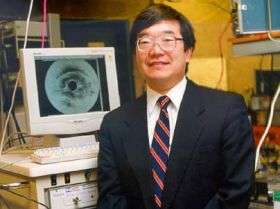
Professor James Fujimoto with a high-resolution, 3-D image generated using a new type of laser in combination with the Optical Coherence Tomography (OCT) system he developed in the early 1990s with Eric Swanson of MIT Lincoln Laboratory. Credit: John Cook, RLE

In work that could improve diagnoses of many eye diseases, MIT researchers have developed a new type of laser for taking high-resolution, 3-D images of the retina, the part of the eye that converts light to electrical signals that travel to the brain.

The research will be presented at the Conference on Lasers and Electro-Optics and the Quantum Electronics and Laser Science Conference in Baltimore on May 10.

The new imaging system is based on Optical Coherence Tomography (OCT), which uses light to obtain high-resolution, cross-sectional images of the eye to visualize subtle changes that occur in retinal disease. OCT was developed in the early 1990s by MIT Professor James Fujimoto, Eric Swanson at MIT Lincoln Laboratory and collaborators; Fujimoto is an author of the report to be presented in May.

"Within the last few years optical coherence tomography has become a standard diagnostic for ophthalmology. New techniques are now enabling dramatic increases in image acquisition speeds. These advances promise to enable new and powerful three-dimensional visualization methods which could improve early diagnosis of disease and treatment monitoring," said Fujimoto, who holds appointments in MIT's Department of Electrical Engineering and Computer Science and the Research Laboratory of Electronics.

Conventional OCT imaging typically yields a series of two-dimensional cross-sectional images of the retina, which can be combined to form a 3-D image of its volume. The system works by scanning light back and forth across the eye, measuring the echo time delay of reflected light along micrometer-scale lines that, row by row, build up high-resolution images.

Commercial OCT systems scan the eye at rates ranging from several hundred to several thousand lines per second. But a typical patient can only keep the eye still for about one second, limiting the amount of three-dimensional data that can be acquired.

Now, using the new laser, researchers in Fujimoto's group report retinal scans at record speeds of up to 236,000 lines per second, a factor of 10 improvement over current OCT technology.

Future clinical studies, as well as further development, may someday enable ophthalmologists to routinely obtain three-dimensional "OCT snapshots" of the eye, containing comprehensive volumetric information about the microstructure of the retina. Such snapshots could potentially improve diagnoses of retinal diseases such as diabetic retinopathy, glaucoma and age-related macular degeneration.

Fujimoto's colleagues on the work are Robert Huber, a visiting scientist at MIT now at the Ludwig-Maximilians University in Germany, Desmond C. Adler and Vivek Srinivasan. Adler and Srinivasan are both graduate students in EECS.

Source: MIT


print this article email this article download pdf blog this article bookmark this article     Stumble it Digg this share on Facebook retweet share on Reddit add to delicious
Rate this story - 5 /5 (2 votes)


April 30, 2007 all stories

Comments: 0

5 /5 (2 votes)
  • Stumble this up

  • Digg this

  • share this

  • hide
  • Related Stories

  • Neuroscientists find neural stopwatch in the brain
    created Oct 19, 2009 | popularity not rated yet | comments 0
  • 3-D snapshots of eyes reveal details of age-related blindness
    created Mar 19, 2009 | popularity not rated yet | comments 0
  • Worm study sheds light on human aging, inherited diseases
    created Oct 01, 2007 | popularity not rated yet | comments 0
  • Rapid, high-resolution 3-D images of the retina
    created May 02, 2007 | popularity not rated yet | comments 0
  • ET: Check your voicemail
    created Nov 24, 2009 | popularity not rated yet | comments 0


  • hide
  • Relevant PhysicsForums posts

  • Chest x-ray???
    created 4 hours ago
  • Multiple Sclerosis & CCSVI
    created Nov 26, 2009
  • 23 Years in a Vegetative State....or not?
    created Nov 25, 2009
  • Has the H1N1 vaccine been scientifically proven to work?
    created Nov 24, 2009
  • More from Physics Forums - Medical Sciences

Other News

eye

Over-the-counter eye drops raise concern over antibiotic resistance

Medicine & Health / Medications

created 16 hours ago | popularity 3.5 / 5 (2) | comments 1

(PhysOrg.com) -- The use of antibiotic eye drops for conjunctivitis has increased by almost half since they became available over the counter at chemists in 2005, data obtained by Oxford University researchers ...


Overeating can set stage for obesity, researchers say

Medicine & Health / Health

created 9 hours ago | popularity not rated yet | comments 1

It doesn't seem like a fair fight. In one corner loomed the Thanksgiving table, groaning with poultry, pie and mashed potatoes.


New tools for prediction of disease progression in acute childhood leukemia

Medicine & Health / Cancer

created 10 hours ago | popularity not rated yet | comments 0

(PhysOrg.com) -- Researchers at Uppsala University and University Children’s Hospital in Uppsala have devised powerful new tools for typing cells from children with acute lymphatic leukemia and for prediction of how children ...


Nuclear science to fight sleeping sickness

Medicine & Health / Diseases

created 13 hours ago | popularity not rated yet | comments 0

The International Atomic Energy Agency on Friday announced an agreement to help African nations battle the tsetse fly, the main carrier of parasites that causes sleeping sickness with its bites.


A costly diagnosis: Alzheimer's disease takes toll on memories, and money too

Medicine & Health / Health

created 14 hours ago | popularity not rated yet | comments 0

Alzheimer's disease takes a devastating emotional toll on families but it also is one of the most expensive conditions to treat because of its progressive nature, requiring increasing assistance with eating, bathing and other ...