Noxious Lightning
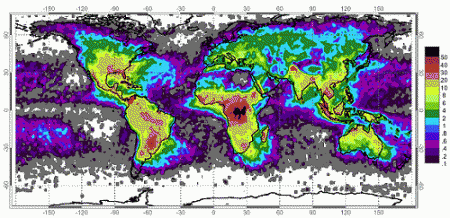
Lightning is more than light and noise: It's an intense chemical factory that affects both local air quality and global climate. But how big is the effect? Researchers aren't sure. To answer the question they're developing a new technique to estimate the factory's output.
Lightning is more than light and noise: It's an intense chemical factory that affects both local air quality and global climate. But how big is the effect? Researchers aren't sure. To answer the question they're developing a new technique to estimate the factory's output.
"Atmospheric chemists are very interested in trace gases produced by lightning, particularly nitrogen oxides ('NOx' for short)," explains William Koshak, a lightning researcher at NASA's Marshall Space Flight Center. NOx includes nitric oxide (NO), a toxic air pollutant produced by automobile engines and power plants, and nitrogen dioxide (NO2), a poisonous reddish-brown gas with a sharp odor.
"We know that lightning is the most important source of NOx in the upper troposphere, where our weather takes place," Koshak continues. "NOx indirectly influences our climate because it partly controls the concentration of ozone (O3) and hydroxyl radicals (OH) in the atmosphere. Ozone is an important greenhouse gas, and OH is a highly reactive molecule that controls the oxidation of several greenhouse gases."
While the output from cars and industry can be measured, lightning is a wildcard in models of regional air quality and global climate because it is difficult to realistically model several important lightning characteristics--e.g., lightning energy and the thermochemical yield of NOx produced by a lightning stroke. As such, the global production rate of lightning NOx is still uncertain, and ranges anywhere from 2 to 20 teragrams per year (1 teragram = 1 trillion grams).
"Fortunately, space-based atmospheric chemistry measurements made by NASA's Aura satellite provide a 'top-down' constraint on global chemistry and climate models," Koshak says. "With these new constraints, the best estimate to date is closer to 6 teragrams per year. However, more work must be done to better model lightning and other chemical processes before full confidence in this estimate is achieved."
To better understand lightning flash energy -- a critical parameter in lightning NOx production -- Koshak and his colleagues are using data from the Lightning Imaging Sensor (LIS) aboard the Tropical Rainfall Measuring Mission (TRMM) satellite and two arrays of ground instruments at NASA's Kennedy Space Center in Florida. LIS is a special camera that uses a very narrow spectral filter and other techniques to detect the lightning optical emissions during both day and night. The filter is centered near 777.4 nm, which is just below the deep red limit of human vision.
Their results will be reported in Lightning charge retrieval: dimensional reduction, LDAR constraints, and a first comparison with LIS satellite data, a paper recently accepted for publication in the Journal of Atmospheric & Oceanic Technology of the American Meteorological Society. His co-authors are E. Philip Krider, Natalie Murray, and Dennis Boccippio.
"The idea is to investigate what correlation may exist between the optical characteristics of flashes seen by LIS vs. ground-based lightning measurements at Kennedy. The ground-based sensors allow us to probe deep within the thundercloud to determine the geometry of the lightning channel, the charges deposited by the flash, and the energy of the flash. The key is to see if the space-based optical measurements can be related to the ground-based flash energy estimates. If this can be done, it would be possible to use sensors in space to remotely retrieve flash energetics over a much larger region of the globe," says Koshak.
"It's a formidable task, and this is just a preliminary look," he says of the forthcoming paper. The cloud medium is variable and therefore scatters the light emitted from lightning in complex ways. Energetic flashes embedded deep within an "optically thick" thundercloud could appear relatively dim to a space sensor, while weak-energy flashes occurring near cloud-top could appear relatively bright. All these complexities must be unraveled, and it is "tricky business."
Ultimately Koshak hopes to provide a technique that will use GLM data to estimate lightning flash energy. "In practice we'll do it in a statistical fashion. We would like to give the atmospheric chemistry modelers a realistic probability distribution function for lightning flash energies that they can use in their models to better simulate lightning (be it ground or cloud flashes)."
From that, scientists will start to better understand the global production of one of the key pollutants in the atmosphere pertinent to global climate and air quality.
Source: by Dave Dooling, Science@NASA


